The 2019 Toyota Highlander is a three-row mid-size crossover that offered three distinct powertrains: a four-cylinder, a V6, and a V6-based hybrid. This article explains how each engine and transmission worked, which trims offered them, and what fuel economy and towing figures buyers could expect.

Engine Options at a Glance
Toyota offered the 2019 Highlander with a choice of three powertrains, all of them shared with the wider Highlander range rather than being unique to any single trim:
- 2.7-liter four-cylinder (1AR-FE): 185 hp and 184 lb-ft of torque, matched to a six-speed automatic and front-wheel drive only.
- 3.5-liter V6 (2GR-FKS): 295 hp at 6,600 rpm and 263 lb-ft at 4,700 rpm, matched to an eight-speed automatic and available with front- or all-wheel drive.
- 3.5-liter V6 hybrid (2GR-FXS): a V6 plus electric motors with 306 hp of total system output, matched to a continuously variable automatic and standard all-wheel drive.
The V6 used Toyota’s D-4S direct- and port-injection system, which helped it deliver both power and competitive highway fuel economy for a three-row vehicle.
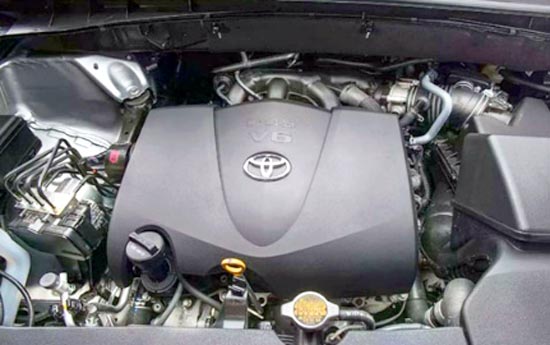
The engines carried Toyota’s internal codes: the four-cylinder was the 1AR-FE, the V6 was the 2GR-FKS, and the V6 hybrid was the 2GR-FXS. The V6 used dual variable valve timing (VVT-iW on the intake side and VVT-i on the exhaust), an Atkinson-cycle-capable design, and D-4S direct and port fuel injection. Toyota rated it at 295 hp at 6,600 rpm and 263 lb-ft of torque at 4,700 rpm.
Transmissions and Drivetrains
Each engine used a different transmission. The four-cylinder came with a six-speed automatic. The V6 used an eight-speed automatic that Toyota called Direct Shift, and it was the transmission that brought the V6 its better highway economy versus the four-cylinder. The hybrid used an electronically controlled continuously variable transmission, listed in EPA data as AV-S6.
Front-wheel drive was standard on gas models, with all-wheel drive optional. The hybrid, by contrast, came only with all-wheel drive. That system used a rear electric motor to drive the back axle on demand, so it did not need a mechanical driveshaft to the rear wheels. On gas V6 models, Toyota fitted Dynamic Torque Control all-wheel drive, which could vary front-to-rear torque using inputs from vehicle speed, steering angle, throttle angle, and yaw rate.
An automatic stop-start system was standard on V6 models except the base LE. It shut the engine off at a full stop and restarted it when the driver lifted off the brake.
Hybrid Hardware and Drivetrain
In the Hybrid, the 3.5-liter V6 worked with two permanent-magnet synchronous electric motors under Toyota’s Hybrid Synergy Drive system. Combined system output was 306 horsepower (228 kW), and a sealed nickel metal hydride (Ni-MH) battery sat under the second row. The rear motor drove the back axle on demand to give the Highlander its standard Electronic On-Demand All-Wheel Drive with intelligence (AWD-i); there was no mechanical driveshaft to the rear.
Gas models used front-wheel drive as standard, with Dynamic Torque-Control all-wheel drive available. Toyota certified the gas engines to the Ultra Low Emission Vehicle II (ULEV II) standard and the Hybrid to the stricter Super Ultra Low Emission Vehicle (SULEV) standard.

Fuel Economy
EPA estimates for the 2019 Highlander varied by engine and drivetrain:
- 2.7-liter four-cylinder: 20 city / 24 highway mpg
- 3.5-liter V6, front-wheel drive with stop-start: about 21 city / 27 highway mpg
- 3.5-liter V6, all-wheel drive: about 20 city / 26 highway mpg
- 3.5-liter V6 hybrid, all-wheel drive: 29 to 30 city / 27 to 28 highway mpg
The hybrid’s advantage was concentrated in city driving. In period highway testing, the hybrid’s real-world result was close to the gas V6, so buyers who mostly drive on the highway saw less benefit from the electric assist.
EPA combined ratings were 22 mpg for the four-cylinder, 23 mpg for the front-drive V6, 22 mpg for the all-wheel-drive V6, and 28 to 29 mpg for the hybrid. The U.S. Department of Energy estimated annual fuel costs of about $2,650 for the V6 gas models and $2,100 to $2,200 for the hybrid.
Towing
When properly equipped, Highlanders with the 2.7-liter four-cylinder could tow 1,500 pounds, while V6-powered models could tow up to 5,000 pounds. The hybrid’s towing figure was lower than the gas V6 because of its powertrain design.
Toyota rated the V6 Hybrid at 3,500 pounds. Maximum payload across the range was about 1,409 to 1,636 pounds depending on grade and drivetrain, and every 2019 Highlander used a 19-gallon fuel tank. The model measured 192.5 inches long, 75.8 inches wide, and 68.1 inches tall on a 109.8-inch wheelbase, with 8.0 inches of ground clearance.

Which Trims Offered Which Engine
The 2.7-liter four-cylinder was limited to the front-wheel-drive LE. The 3.5-liter V6 was optional on the LE and standard on the LE Plus and every grade above it. The hybrid was sold in three grades: LE, XLE, and Limited. The gas range ran from LE through Limited Platinum, while the hybrid stopped at Limited.
For a look at the pickup side of Toyota’s 2019 lineup, see the 2019 Toyota Tundra Crewmax Exterior Specs and Release Date. The Highlander’s top trim is covered in the 2019 Toyota Highlander Limited Platinum Review, and more brand coverage appears under Toyota Review.
Safety and Ratings
Toyota Safety Sense-P was standard on every 2019 Highlander and bundled a pre-collision system with pedestrian detection, lane departure alert with steering assist, dynamic radar cruise control, and automatic high beams. The National Highway Traffic Safety Administration gave the 2019 Highlander a five-star overall rating, and the Insurance Institute for Highway Safety named it a 2019 Top Safety Pick.
Model-Year Context
The 2019 Highlander was the last model year of the third generation, which ran from 2014 through 2019. Toyota kept the engines and transmissions unchanged for 2019 and saved the next round of mechanical updates for the redesigned 2020 Highlander, which moved to the TNGA-K platform and introduced a 2.5-liter four-cylinder hybrid system.

Sources
- https://en.wikipedia.org/wiki/Toyota_Highlander
- https://www.motortrend.com/cars/toyota/highlander/2019
- https://pressroom.toyota.com/exterior-upgrades-aplenty-for-2019-toyota-highlander/
- https://fueleconomy.gov/FEG/bymodel/2019_Toyota_Highlander.shtml
- https://s3.amazonaws.com/cdn.autoipacket.com/brochures/toyota/2019/toyota_2019_highlander.pdf