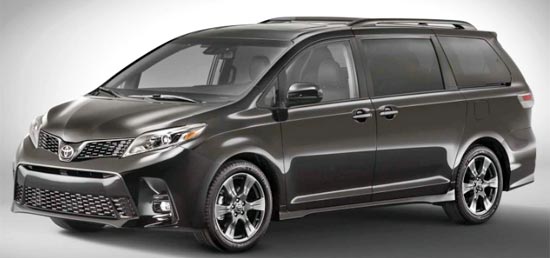
The 2020 Toyota Sienna was the final model year of the minivan’s third generation, model code XL30, which had been on sale since the 2011 model year. Production ran from January 2010 to August 2020 at Toyota’s plant in Princeton, Indiana. For buyers who needed all-wheel drive, the 2020 Sienna was significant because it was, at the time, the only minivan sold in the United States with a mechanical all-wheel-drive system. This article covers the AWD model’s engine, fuel economy, dimensions and pricing.
The Last Year of the Third Generation
The third-generation Sienna was introduced for 2011 and received a major update for 2017, when a new V6 engine and an eight-speed automatic transmission replaced the earlier units. The 2020 model carried those changes forward largely unchanged; it was a carryover year ahead of a full redesign. Toyota positioned the Sienna below only its largest SUVs in seating capacity, with room for seven or eight depending on the trim and layout.

Engine and Powertrain
Every 2020 Sienna used the same 3.5-liter V6, engine code 2GR-FKS. It produced 296 hp (221 kW) and 263 lb-ft of torque. Power reached the wheels through an eight-speed automatic transmission, coded UA80E for front-wheel-drive versions and UA80F for the all-wheel-drive model. The V6 and the eight-speed gave the van brisk acceleration for its size, and the EPA rated front-drive models at 19 mpg city, 27 highway and 22 combined, with the AWD version at 18 mpg city, 24 highway and 20 combined.

All-Wheel Drive
Toyota offered all-wheel drive on the LE, XLE, SE and Limited trims, but not on the entry-level L. The system was a mechanical, on-demand setup that could send torque to the rear wheels when the front wheels lost traction, which made the Sienna more sure-footed in rain or snow than front-drive rivals. The trade-off was a small fuel-economy penalty and slightly higher weight. No all-wheel drive was available on the entry L model, so AWD shoppers had to start at the LE.

Dimensions and Practicality
The third-generation Sienna rode on a 119.3-inch wheelbase and measured about 200.2 inches long and 78.2 inches wide. Curb weight was roughly 4,310 pounds, and AWD versions added a little more. It carried a 20-gallon fuel tank. Cargo space ranged from about 39.1 cubic feet behind the third row to as much as 150 cubic feet with the second and third rows folded, and the van was rated to tow up to 3,500 pounds. The turning diameter was 37.4 feet.

Trims and Pricing
The 2020 Sienna lineup spanned a wide price range. The base L started at $31,640, the LE with all-wheel drive listed at $37,000, and the top-of-the-line Limited Premium AWD reached $49,415. These figures are manufacturer’s suggested retail prices and exclude a delivery fee of about $1,175. Notable trim features included dual power sliding doors on the LE, leather upholstery and a moonroof on the XLE, and a power-folding third-row seat with a driver’s-voice amplification system on the Limited.
What Replaced the 2020 Sienna
Toyota replaced the third-generation Sienna with an all-new fourth-generation model for 2021, model code XL40. That van moved to the TNGA-K platform and dropped the V6 in favor of a 2.5-liter four-cylinder hybrid system rated at 243 hp combined, with an available electronic all-wheel-drive setup. Because the 2021 model was hybrid-only, the 2020 Sienna was the last V6 Sienna and the last with a conventional mechanical AWD system. Buyers weighing other Toyota models of the same period can also look at the 2020 Toyota Auris and the 2020 Toyota Alphard Hybrid.
The Sienna was introduced for the 1998 model year to replace the mid-engined Previa and the Camry wagon, and it has always been Toyota’s North American minivan. A second generation arrived for 2004, and the third generation for 2011. The name comes from the Italian city of Siena.
Interior and Equipment
The Sienna could seat seven or eight passengers depending on the layout. Toyota fitted dual power sliding doors from the LE upward, stain-resistant cloth upholstery and a power driver’s seat on that trim; the XLE added a power passenger’s seat, leather upholstery and a moonroof; and the Limited came with a power-folding third-row bench. Toyota also offered a driver’s-voice amplification system on the Limited to help front-seat occupants speak to passengers in the back rows.
Safety and Towing
The third-generation Sienna was engineered as a tow vehicle as well as a family hauler, with a rating of up to 3,500 pounds. A rear-view camera was standard, and higher trims added blind-spot monitoring with rear cross-traffic alert; the van won a Top Safety Pick award from the Insurance Institute for Highway Safety during this generation. All-wheel-drive versions were the ones most often chosen in cold-weather states, where traction rather than towing drove the decision.
Toyota’s approach was a mechanical system with a transfer case and driveshaft rather than the electric rear motor that many newer all-wheel-drive hybrids use. That made the 2020 Sienna the last traditional all-wheel-drive minivan in its segment at the time, and it gave the van a real advantage in markets with heavy snow.
Sales and Competition
The Sienna was one of the most popular minivans in the United States, competing against the Honda Odyssey, the Chrysler Pacifica and the Kia Sedona. Toyota sold about 137,500 Siennas in the United States in 2015 and 124,500 in 2014; sales stood at 73,585 in 2019 before falling to 42,885 in 2020 as buyers waited for the redesigned model and factory output wound down.