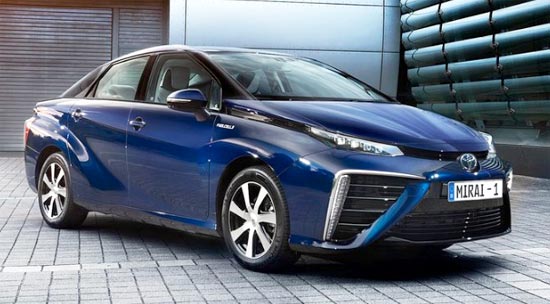
The 2019 Mirai was the last full year of the first-generation Toyota hydrogen fuel cell sedan, a four-seat car sold in California. Its cabin was a central part of the pitch: Toyota equipped the Mirai as a premium mid-size sedan rather than a stripped-down technology demonstrator. This article looks at what the 2019 interior actually offered, alongside the specifications that defined the car.
Cabin Layout and Seating
Unlike the second-generation Mirai, which seats five, the first-generation car was a strict four-seater with two rows of bucket seats. Front occupants got heated, SofTex-trimmed seats, an eight-way power driver’s seat and a multifunction, telescoping steering wheel. The rear bench was shaped for two passengers, with the battery and hydrogen tanks packaged beneath and behind the cabin so that the floor stayed flat.

Materials and Comfort Features
The Mirai used acoustic glass for the windshield to reduce noise, and Toyota advertised the cabin as unusually quiet because the fuel cell drivetrain has no reciprocating engine. Carbon-fiber-style trim pieces echoed the hydrogen tanks’ construction. Dual-zone automatic climate control, push-button start, heated leather-trimmed seats and a full-color driver display rounded out the standard equipment. Because the tanks sit under the rear seat and floor, cargo volume is modest for the car’s exterior footprint.
Technology and Safety
Technology included a premium JBL audio system tuned specifically for the Mirai, a touchscreen infotainment system, a rearview camera with a projected-path feature, and multiple charging points — a 12-volt rear auxiliary outlet, two rear USB ports and a USB media port. Toyota Safety Sense came standard and bundled pre-collision warning, lane departure alert with steering assist, automatic high beams and dynamic radar cruise control. Toyota also fitted the car with a Vehicle Proximity Notification System, a speaker that alerts pedestrians at low speed when the car is running in near silence.
Dimensions
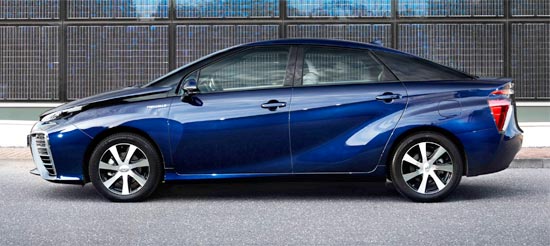
For a mid-size car the Mirai was relatively heavy because of its fuel cell system and tanks. The first-generation model measured 2,780 mm (109.4 in) in wheelbase, 4,890 mm (192.5 in) long, 1,815 mm (71.5 in) wide and 1,535 mm (60.4 in) tall, and weighed 1,850 kg (4,078 lb). That footprint is close to a mid-size gasoline sedan, but the curb weight is roughly 400 lb higher because of the fuel cell stack and the high-pressure hydrogen tanks.
The H2O Button and How the Fuel Cell Works
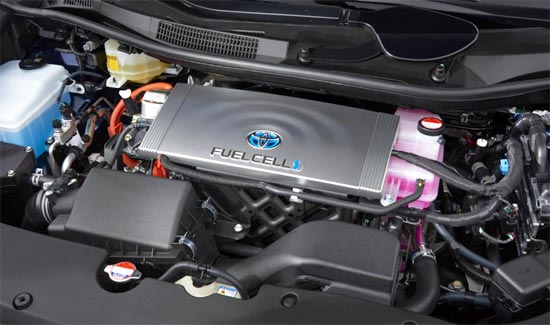
A fuel cell generates electricity by combining hydrogen with oxygen from the air, emitting only water. In the Mirai a boost converter raises the stack voltage to drive the motor, while a 1.6 kWh nickel-metal hydride battery captures regenerative energy and supplements power under acceleration. A button labeled H2O opens a gate at the rear to release accumulated water, and the car produces roughly 240 milliliters of water for every four kilometers driven. Toyota declared consumption of about 0.8 kilograms of hydrogen per 100 kilometers.
Powertrain Recap
The single 4JM fuel-cell-powered electric motor produced 113 kW (152 hp) and 335 N·m (247 lb-ft), driving the front wheels through a one-speed transmission. Two carbon-fiber hydrogen tanks held 122 liters at 70 MPa (about 10,000 psi), and the EPA rated the car at 502 km (312 miles) of range with a combined 66 mpg-equivalent. The 0 to 60 mph sprint took 9.0 seconds, and refueling took roughly three to five minutes.
Living With a First-Generation Mirai
The interior appeal of the Mirai came with the same constraint as the rest of the car: hydrogen refueling. In the United States, retail sales were limited to California, where the fueling network is concentrated. The 2019 car’s US price was $58,500, and Toyota recalled roughly 2,800 early Mirai examples in 2017 to recalibrate fuel cell software. For buyers today, the second-generation Mirai, introduced for 2021, offers a five-seat cabin, rear-wheel drive and up to 402 miles of EPA range.

Second-Generation Interior (2021)
The 2021 Mirai moved to a five-seat layout and a rear-wheel-drive platform, which changed the cabin significantly. Because the fuel cell stack and tanks were repositioned, the newer car has a lower floor and more usable rear-seat space, and it added a fully digital instrument cluster on higher trims. Toyota also lowered the starting price to $49,500 while raising the EPA range to 402 miles in the XLE grade, so the second generation offers both more space and more range than the four-seat 2019 car.
Entertainment, Storage and Comfort
Cabin storage in the first-generation Mirai is limited compared with a conventional sedan because the hydrogen tanks occupy space beneath the rear seat and cargo floor. The car nonetheless included a full infotainment suite with Bluetooth and USB media playback, smart-key entry, a rear 12-volt outlet and two rear USB charging ports, so rear passengers can keep devices topped up on longer trips.
The seats were trimmed in Toyota’s synthetic SofTex material rather than leather, which is lighter and more durable, and the front seats were heated. A power tilt-and-telescoping steering wheel with audio and phone controls, an auto-dimming rearview mirror and dual-zone climate control rounded out the comfort package.
Because the fuel cell runs without a conventional engine, Toyota was able to tune the cabin for low noise, and the acoustic windshield glass reduces wind and road noise further. The trade-off is weight: at 4,078 lb, the first-generation Mirai is heavier than a comparable gasoline sedan, which is why its 152 hp delivers a nine-second 0-to-60 time.
For more on the Mirai nameplate, see the 2019 Toyota Mirai Rumors and Engine Specs, which covers the powertrain in more depth.