The Toyota Mirai is a hydrogen fuel cell electric sedan and the first fuel cell vehicle to be mass-produced and sold commercially. The 2019 Mirai belonged to the first generation, model code JPD10, which Toyota built from December 2014 through 2020. A redesigned second-generation car, switching to rear-wheel drive, arrived for the 2021 model year. A 2019 Mirai is therefore a real vehicle, but it was the closing stretch of the original design rather than a fresh model.
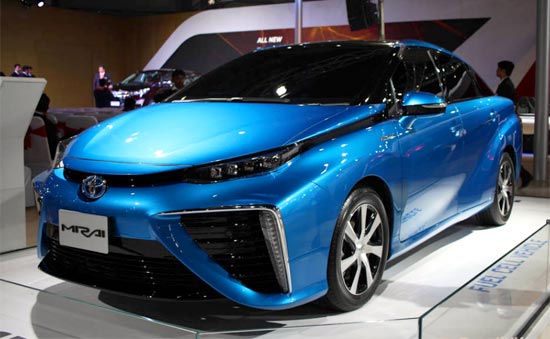
Where the 2019 Mirai Fits
The Mirai was unveiled at the November 2014 Los Angeles Auto Show; its name is the Japanese word for “future.” Sales began in Japan on December 15, 2014, and in the United States in August 2015, with retail deliveries starting in California that October. The first generation stayed on sale through the 2020 model year. For 2019, the US manufacturer’s suggested retail price was $58,500, and the 2020 car listed at $58,550.
The bigger news model was the second generation, not the 2019 car. Buyers who see a 2019 or 2020 Mirai are looking at the four-door, front-wheel-drive sedan that launched the nameplate. It is a mid-size car built on Toyota’s premium running gear, with the fuel cell stack and tanks packaged beneath and behind the cabin.
Fuel Cell Powertrain
The first-generation Mirai used the Toyota Fuel Cell System, which combines a fuel cell stack with hybrid components: the electric motor, power control unit and other parts are drawn from Toyota’s Hybrid Synergy Drive. Toyota quoted the following figures for the car:

- Electric motor: 4JM fuel-cell-powered unit rated at 113 kW (152 hp) and 335 N·m (247 lb-ft)
- Layout: front-motor, front-wheel drive, with a single-speed transmission
- Battery: 1.6 kWh nickel-metal hydride pack
- Hydrogen storage: two carbon-fiber tanks at 70 MPa (about 10,000 psi), 122 liters total
- Acceleration: 0 to 60 mph in 9.0 seconds
- Curb weight: 1,850 kg (4,078 lb)
How the Fuel Cell Works
A fuel cell produces electricity by combining hydrogen from the tanks with oxygen from the air, and the only by-product is water. In the Mirai, a boost converter raises the stack’s voltage to drive the electric motor, while a small battery buffers power during acceleration and stores energy recovered under braking. Toyota declared hydrogen consumption of about 0.8 kilograms per 100 kilometers on the combined cycle. A button labeled H2O opens a gate at the rear to release the accumulated water; the car produces roughly 240 milliliters of water for every four kilometers driven.
Range and Emissions
On the US Environmental Protection Agency cycle, the first-generation Mirai was rated at 502 km (312 miles) of range on a full tank, with a combined city/highway rating of 66 miles per gallon equivalent. Refueling takes roughly three to five minutes, comparable to a gasoline stop, rather than the hours required by many battery-electric cars of the same era.

Dimensions
The first-generation Mirai measured 2,780 mm (109.4 in) in wheelbase, 4,890 mm (192.5 in) long, 1,815 mm (71.5 in) wide and 1,535 mm (60.4 in) tall, making it a mid-size sedan close in footprint to a Camry.
Development and Testing
Toyota began fuel cell development in the early 1990s and showed progressively more advanced concepts, including the FCV-R at the 2011 Tokyo Motor Show and the FCV sedan at the 2013 show. Before launch, test vehicles logged more than 1,600,000 km of road testing, including hot-weather running in Death Valley and cold-weather testing in Yellowknife, Canada. The production car earned the 2016 World Green Car of the Year award, and in April 2018 a Mirai became the first hydrogen fuel cell car to drive the length of Great Britain, from John O’Groats to Land’s End, covering about 1,785 km.

The 2021 Second Generation
Toyota announced the second-generation Mirai in October 2019 and put it on sale in December 2020 as a 2021 model. The car moved to the rear-wheel-drive TNGA GA-N platform shared with the Toyota Crown. Power rose to 182 hp (136 kW) with 300 N·m (221 lb-ft) of torque, the battery became a 1.24 kWh lithium-ion unit, and hydrogen storage grew to three tanks totaling 141 liters. EPA range rose to 402 miles in the XLE grade and 357 miles in the heavier Limited, and the starting price dropped to $49,500, which Toyota noted was $9,050 less than the outgoing car. In August 2021, a second-generation Mirai set a Guinness World Record by traveling 1,360 km (845 miles) on a single 5.65 kg fill of hydrogen.

Sales and What to Buy Today
As of November 2022, global Mirai sales totaled 21,475 units, led by the United States with 11,368 and Japan with 7,435. Because the 2019 and 2020 cars share the original design, a used first-generation Mirai offers the same 312-mile range and 152 hp as earlier examples, usually at a steep discount to its original price. Buyers who want the longer range, more power and rear-wheel-drive layout should look at a 2021 or newer car instead. Either way, hydrogen infrastructure remains the deciding factor; in the US, retail sales were confined to California.
Where the Mirai Was Sold
The Mirai was not a US-only experiment. After Japan and the United States, Toyota made the car available for retail sale in the United Kingdom, Denmark, Germany, Belgium and Norway, with German pricing starting at about €60,000 before VAT. Japanese buyers paid about ¥6.7 million, partly offset by a government fuel cell subsidy of roughly ¥2 million. Sales stayed modest in every market because hydrogen refueling stations remained scarce, and the car was never offered for general sale outside the regions that had infrastructure.
For more on the hydrogen sedan’s powertrain, see the 2019 Toyota Mirai Interior and Review, which looks at the cabin in detail.