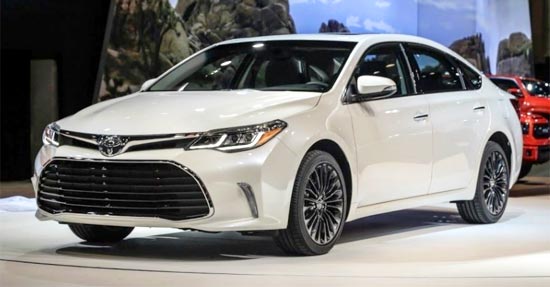
The 2020 Toyota Avalon is the fifth generation of Toyota’s full-size front-wheel-drive sedan, sold in the United States, Canada, China, South Korea, and the Middle East. It rides on the GA-K version of Toyota’s TNGA architecture, which it shares with the Camry and Lexus ES, and it went on sale for the 2019 model year after a launch at the 2018 North American International Auto Show. The 2020 Avalon is a carryover of that car, with the addition of a new TRD grade. This review covers the range as it was sold for the 2020 model year, including trims, powertrains, fuel economy, and equipment.
Trims and Prices
The 2020 Avalon came in five grades. Pricing before Toyota’s destination and handling fee was $35,875 for the XLE, $38,375 for the XSE, $42,175 for the Limited, $42,375 for the TRD, and $42,575 for the Touring. Three of those grades — the XLE, XSE, and Limited — were also offered as the Avalon Hybrid.
| Grade | Starting MSRP | Engine | EPA combined |
|---|---|---|---|
| XLE | $35,875 | 3.5L V6 | 26 mpg |
| XSE | $38,375 | 3.5L V6 | 25 mpg |
| Limited | $42,175 | 3.5L V6 | 25 mpg |
| TRD | $42,375 | 3.5L V6 | 25 mpg |
| Touring | $42,575 | 3.5L V6 | 25 mpg |
| XLE / XSE / Limited Hybrid | $37,000 and up | 2.5L I4 hybrid | 43 mpg |

Powertrains
Two powertrains were offered. The standard engine is a 3.5-liter 2GR-FKS V6 producing 301 horsepower at 6,600 rpm and 267 lb-ft of torque at 4,700 rpm, matched to an eight-speed Direct Shift automatic. The Avalon Hybrid pairs a 2.5-liter four-cylinder making 176 horsepower and 163 lb-ft with two electric motors and an eCVT, for a net system output of 215 horsepower. Both drive the front wheels only for 2020. The hybrid is mechanically related to the Lexus ES Hybrid and the 2019 Toyota Camry Hybrid Review, sharing Toyota’s fourth-generation hybrid system.
Fuel Economy
The V6 Avalon is EPA-rated at 22 mpg city and 31 mpg highway, for 25 mpg combined, except the slightly lighter XLE, which is rated 22/32/26. The Avalon Hybrid is rated 43/44/44 for the XLE and 43/43/43 for the XSE and Limited. Those hybrid figures are among the best in the full-size sedan class and close the gap to smaller, cheaper cars. For buyers who prioritize fuel cost, the hybrid is the clear efficiency choice; for those who want the smoother, more powerful V6, the trade-off is roughly 18 mpg of combined economy.
Interior and Equipment
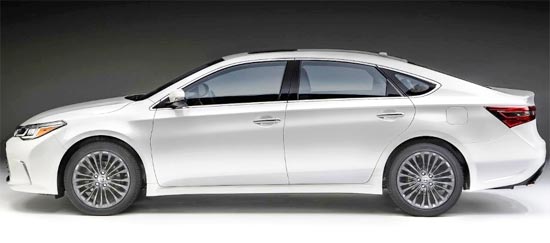
The Avalon’s cabin is its strongest argument. The wheelbase stretches 113.0 inches and total length is 195.9 inches, which gives generous rear legroom for a front-drive sedan. All grades use a 9-inch center touchscreen with Apple CarPlay, a feature Toyota introduced on this generation, plus Amazon Alexa and Wi-Fi connectivity options. SofTex-trimmed seats are standard on the XLE, with leather and real wood appearing on the Limited; the Touring and XSE use a SofTex and Ultrasuede mix. Rear passengers get air vents, USB charging ports, and available seat warmers.

Safety
Toyota made its Safety Sense P suite standard on every 2020 Avalon. It includes a pre-collision system with pedestrian detection, full-speed range adaptive cruise control, lane departure alert with steering assist, and automatic high beams. Ten airbags and the Star Safety System are also standard. The IIHS awarded the Avalon a Top Safety Pick+ rating. The National Highway Traffic Safety Administration rated the car five stars overall. These results place the Avalon among the better-protected large sedans of its year.

What Was New for 2020
The 2020 changes were modest. Toyota added the Avalon TRD, the first TRD-badged Avalon, which joined the Camry TRD as Toyota’s first TRD sedans. The TRD takes the XSE as its base, adds a lower sport-tuned suspension, larger front brakes, extra body bracing, a louder dual exhaust, and an aerodynamic body kit, while keeping the standard 301-hp V6. Otherwise the range carried over from 2019, and the four-cylinder all-wheel-drive Avalon that Toyota later offered did not arrive until the 2021 model year.
How It Compares
The Avalon competes with large front-drive sedans such as the Nissan Maxima and the now-discontinued Chevrolet Impala, as well as with its own platform-mate, the Lexus ES. Its advantage is interior space and a standard V6 at a price below the Lexus. Its disadvantage is that the segment itself has shrunk as buyers move to crossovers. Toyota ended North American Avalon production after 2022 and replaced the nameplate with the Crown, so the 2020 model is one of the last of a long-running line. Related reading includes the 2019 Toyota Corolla S Price And Review.
Hybrid or V6, and Ownership
Choosing between the Avalon’s two powertrains comes down to priorities. The 3.5-liter V6 delivers 301 horsepower and a smooth, linear character, at the cost of 25 mpg combined. The hybrid makes 215 horsepower but returns 43 to 44 mpg combined, a gap of roughly 18 mpg that translates into a substantial fuel-cost saving over a year of driving. The V6 is the better choice for towing or frequent highway passing, while the hybrid suits high-mileage commuters. Both use regular gasoline, and both were available in the XLE, XSE, and Limited grades.
The fifth-generation Avalon shares its engine and platform with the Camry and Lexus ES, so parts and service knowledge are widely available. The 2GR-FKS V6 is a proven, long-running design, and Toyota’s hybrid system has a long track record for durability. Buyers shopping used should check for open recalls and, on early fifth-generation cars, confirm that the passenger-side small-overlap structural update was applied. The Avalon also tends to hold value reasonably well for a full-size sedan, though the shrinking segment limits overall demand.
Verdict
The 2020 Avalon is a spacious, quiet, and well-equipped large sedan with two sensible powertrain choices: a strong V6 and a very efficient hybrid. It is not a sport sedan, and buyers who want sharp handling were directed to the TRD or Touring grades and their firmer suspension tuning. For buyers who value room, comfort, and standard safety equipment over agility, the 2020 Avalon makes a defensible case, and the hybrid in particular stands out for combining size with high fuel economy.