The Toyota Vios is a subcompact sedan that Toyota has produced since 2002, primarily for markets in Asia-Pacific and the Middle East. It is one of Toyota’s most important models in Southeast Asia, where it serves as an affordable family sedan and a common fleet and taxi vehicle. The Vios was never sold in the United States or Europe, so its specifications and trim structure differ from cars more familiar to American and European buyers.
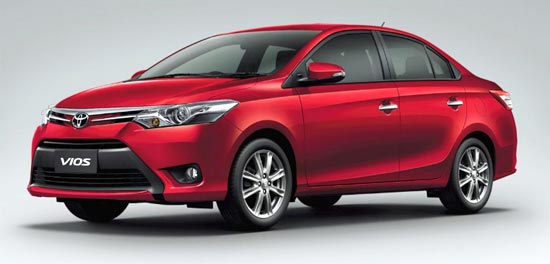
What the Vios Is
The Vios is a four-door sedan in the subcompact class, sized below the Corolla. It is closely related to the Yaris family: the second-generation Vios was sold as the Yaris sedan in several markets, and the third-generation car shares its platform with the XP150 Yaris. In different countries the Vios has also carried the names Yaris ATIV, Yaris sedan and, in Indonesia, a taxi-specific version called the Limo.
The Three Generations
The Vios has passed through three generations, each aimed at value-conscious buyers.
- First generation (XP40), 2002–2007: launched in Thailand as the Soluna Vios and sold in several Asian markets.
- Second generation (XP90), 2007–2013: essentially a rebadged Toyota Belta, also marketed as the Yaris sedan in North America and Australia.
- Third generation (XP150), 2013–present: the model sold in 2020, facelifted in 2016 and again later in its life.
The Third-Generation Vios
Toyota unveiled the third-generation Vios in March 2013 at the Bangkok International Motor Show. It was designed as a global model for markets outside Europe and North America and was assembled in several countries, including Thailand, the Philippines, Malaysia and China. Toyota updated it in 2016 with revised styling and new engine choices, and the car remained in production well beyond 2020.

Engine Options for 2020
In 2020 the Vios was offered with two four-cylinder gasoline engines, depending on the market and trim. The smaller unit is a 1.3-liter Dual VVT-i engine producing about 98 horsepower and 123 Nm of torque. The larger is a 1.5-liter Dual VVT-i engine producing around 106 horsepower and 140 Nm. Both are naturally aspirated and designed for durability and low running costs rather than performance.
Transmission and Economy
Buyers could choose between a five-speed manual transmission and a continuously variable transmission (CVT), with the CVT becoming the mainstream choice in most markets. Because the Vios is light and its engines are modest, real-world fuel consumption is low, which matters in the markets where it is sold. Emission standards varied by country, with Thai and Philippine versions typically meeting Euro 4 standards during this period.

Dimensions and Practicality
The third-generation Vios measures roughly 4,425 mm long, 1,730 mm wide and 1,475 mm tall, with a 2,550 mm wheelbase and seating for five. Ground clearance is about 133 mm in standard form. The trunk offers around 326 liters on the 1.3-liter variants, with the 1.5-liter models rated higher. These dimensions make the Vios a compact but usable family sedan for dense cities.
Interior and Equipment
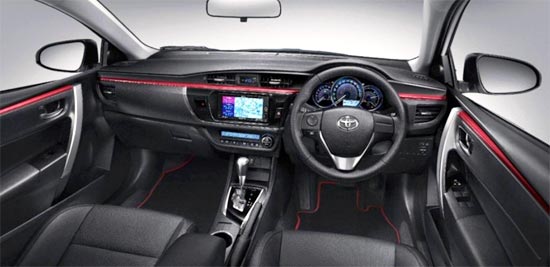
Equipment varied widely by market and trim. Higher grades offered a touchscreen infotainment system with Apple CarPlay and Android Auto, automatic climate control, push-button start, leather upholstery, cruise control and a multi-function steering wheel. Safety equipment on top versions included multiple airbags, anti-lock brakes with electronic brake-force distribution and brake assist, stability control, hill-start assist and ISOFIX child-seat anchors.
The Vios as a Taxi and Fleet Car
One reason the Vios has been so visible in Southeast Asia is its popularity with taxi and ride-hailing fleets. Toyota even produced a dedicated taxi variant, the Limo, for the Indonesian market, and the Vios became a familiar sight on the streets of Bangkok, Manila and Jakarta. That fleet role reflects the car’s reputation for reliability and inexpensive maintenance.
Where the Vios Was Sold
The Vios was marketed across the Asia-Pacific region and in parts of the Middle East. It was not offered in North America, where Toyota’s small-car lineup instead relied on the Yaris and, later, on crossover models. This regional focus explains why the Vios is well known in some countries and almost unknown in others.

Buying a 2020 Vios
For buyers in the markets where it was sold, the 2020 Vios represents a sensible used-car choice: the mechanical package is simple and well proven, parts are inexpensive and widely available, and the car holds its value reasonably well. The main checks on a used example are the service history and the condition of the CVT, which requires correct maintenance to last.
How the Vios Fits Toyota’s Lineup
Within Toyota’s Asian range, the Vios sits below the Corolla and above the very smallest city cars. It is positioned as the entry point to Toyota’s sedan range for families moving up from a hatchback or a motorcycle, which is why Toyota emphasized durability, low maintenance costs and generous standard safety features in its marketing.
What the Vios Cost
Pricing varied by market and by whether the car was a 1.3-liter or 1.5-liter variant. In the Philippines, for example, 2020-era 1.3-liter models started at a level well below the equivalent Corolla, with the 1.5-liter top grades costing more for their extra equipment and larger engine. This spread let Toyota sell the Vios to a wide range of budgets.
The Vios in Context
The Vios shows how Toyota adapts its model strategy to different regions. Where American and European buyers moved toward crossovers and hatchbacks, Southeast Asian buyers continued to favor compact sedans, and the Vios was tuned for that demand. Its long production life, spanning three generations and nearly two decades by 2020, reflects how well that approach worked.