The 2019 Toyota Vios was a subcompact four-door sedan built mainly for Southeast Asia and other emerging markets. Despite what its model year suggests, the 2019 car was not a new generation: it was a facelifted version of the third-generation Vios, internally coded XP150, which had been in production since 2013. This article sets out the verified engine specifications, dimensions, safety equipment and market details for the 2019 Vios, and corrects the common misreporting that surrounded it.

What the 2019 Vios Actually Was
Toyota introduced the Vios nameplate in 2002 as a subcompact sedan for Southeast Asia, China and Taiwan, replacing the Tercel and Soluna in several markets. The third generation, coded XP150, was world-premiered at the 2013 Bangkok Motor Show and went on sale across the region that year. The 2019 model was the facelifted XP150: Thailand had received an update in 2017, the Philippines in July 2018 and Malaysia in January 2019. Toyota continued to build the third-generation Vios until around 2022, when the fourth generation replaced it.
Because the Vios was engineered for price-sensitive markets, it had to balance cost with durability, and it became one of the best-selling sedans in the region over its run. Claims that the 2019 car was an all-new generation with an all-new 1.6-liter gasoline or diesel engine for India are incorrect; the Vios has always used small displacement gasoline engines. In several markets the same car was sold under other names, including the Toyota Yaris sedan, Yaris Ativ (Thailand) and Yaris L sedan (China), per Wikipedia’s Vios entry.
Interior and Features
The 2019 Vios seated five and paired dark and light interior finishes depending on trim. Higher grades added leather-trimmed seats, a touchscreen infotainment system with Apple CarPlay, a 4.2-inch multi-information display in an Optitron instrument cluster, keyless entry, automatic climate control and a 60/40 split-folding rear seat. Malaysian 1.5 G cars tested by Automacha used a 6.8-inch touchscreen and a reversing camera.

Exterior Design
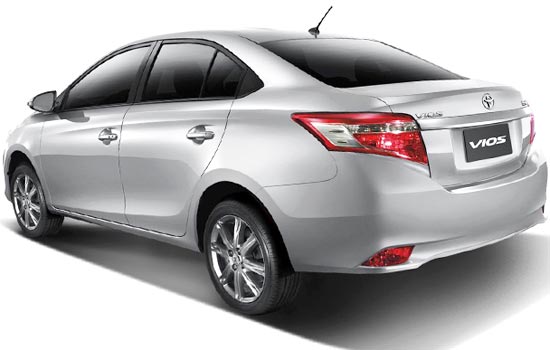
The facelift that created the 2019 model brought a wider, T-shaped grille, projector headlamps with LED light guides, vertical LED daytime running lights in the lower bumper and LED tail lamps joined by a thin chrome bar. The update added roughly 10 mm of length and 30 mm of width over the pre-facelift XP150, and higher trims rode on 16-inch alloy wheels with 195/60 tires. A body-color “Aerokit” with lower spoilers and a trunk-lid spoiler was offered as an accessory in some markets.
Engines and Specifications
Toyota offered the 2019 Vios with two Dual VVT-i four-cylinder gasoline engines, both driving the front wheels:
- 1.3-liter 1NR-FE inline-four — 99 PS (98 hp) at 6,000 rpm and 123 Nm of torque at 4,200 rpm
- 1.5-liter 2NR-FE inline-four — 107 PS (106 hp) at 6,000 rpm and 140 Nm of torque at 4,200 rpm
- A smaller 1.2-liter 3NR-FE engine (87 hp and 104 Nm) was also offered in Thailand
Both main engines are 16-valve DOHC units with Dual VVT-i. The 1.5-liter figures are the ones quoted by Automacha’s 2019 Vios review, while the 1.3-liter and 1.2-liter outputs are described in Autodeal’s Vios engine guide.

Transmission
From 2016 Toyota replaced the older four-speed automatic with a seven-speed continuously variable transmission (Super CVT-i), and the five-speed manual remained on lower trims. The Malaysian 2019 facelift dropped the manual option entirely, leaving J, E and G trims with the CVT. The 1.5 G model in some markets also gained paddle shifters and ECO and POWER drive modes.
Driving Character
The 1.5-liter CVT was tuned for economy rather than pace. Reviewers found the engine droned under hard acceleration but that the transmission settled into low revs quickly at cruising speed — Automacha recorded the engine turning at roughly 1,600 rpm at 110 km/h in ECO mode, while noting that the suspension favoured ride comfort. Noise, vibration and harshness were considered good for the car’s size and price.
Dimensions and Practicality
The facelifted 2019 Vios measured 4,420 mm long, 1,730 mm wide and 1,475 mm tall, on a 2,550 mm wheelbase, according to Wikipedia. Curb weight ranged from about 1,075 kg to 1,145 kg, and boot capacity was approximately 470 liter. The rear bench used a 60/40 split-fold, and the sedan’s flat rear floor helped passenger space.
Safety
For its class the 2019 Vios was well equipped: seven SRS airbags, anti-lock brakes with electronic brakeforce distribution, Vehicle Stability Control and traction control were available or standard across most trims. Toyota added Vehicle Stability Control to the Vios as part of the facelift, and the model earned a five-star ASEAN NCAP rating for adult occupant protection in regional testing.
Markets, Price and Release Date
The 2019 Vios was built and sold primarily in Thailand, Indonesia, Malaysia, the Philippines, Vietnam and Singapore, as well as China and Taiwan, with assembly carried out by Toyota affiliates in each region. It was also offered in India between 2018 and 2021. In the Philippines, where the facelifted car had arrived in July 2018, the 2019 Vios 1.3 XLE CVT was priced from PHP 908,000, according to Toyota Motor Philippines. The car competed in the B-segment against the Honda City and the Nissan Almera.
Summary
In short, the 2019 Toyota Vios was a proven, regionally focused subcompact sedan rather than a new generation. Buyers got a choice of 1.3-liter and 1.5-liter Dual VVT-i gasoline engines, a seven-speed CVT, dimensions of 4,420 x 1,730 x 1,475 mm and a seven-airbag safety package. The car was replaced by an all-new fourth-generation Vios around 2022, so anyone researching a 2019 example is looking at the mature end of the XP150 line. For readers comparing Toyota models, the related subcompact is covered in the 2019 Toyota Yaris Review, while the small urban model is discussed in the 2019 Toyota Rukus Review. More Toyota coverage is collected on the site’s Car Review index.