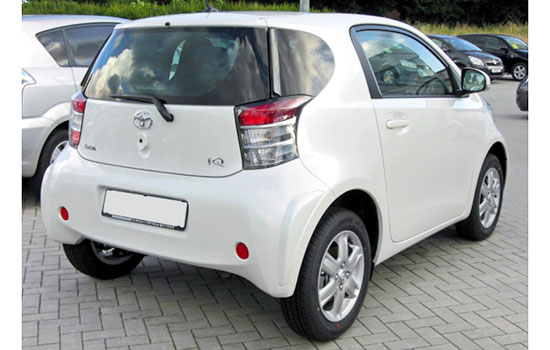
The Toyota iQ is a four-seat city car that Toyota sold in a single generation. It went on sale in Japan and Europe in 2008 and reached North America in 2012 under the Scion badge. The last iQ was built in December 2015, and Japanese sales ended on April 4, 2016. That means a 2019 Toyota iQ was never produced or sold.

There Is No 2019 Toyota iQ
Toyota never announced a 2019 model year for the iQ. Its real production span was Japan 2008–2016, Europe 2008–2015 and North America 2012–2015, where it was marketed as the Scion iQ. By the time the 2019 model year arrived the car had already been out of production for three years, so any listing or article describing a new “2019 Toyota iQ” refers to a vehicle that was discontinued. The final cars rolled off the line in 2015.
The name itself is simple: “iQ” was chosen to suggest intelligence and intelligence quotient, and Toyota used it consistently on the single generation it built between 2008 and 2016.
What the Toyota iQ Was
The iQ was a premium small car designed to seat up to four occupants in a very short body. It was front-wheel drive and used a transverse engine, a layout chosen to keep the cabin as large as possible within tight exterior dimensions. Toyota positioned the iQ above conventional city cars, and in Europe the same body was even lent to Aston Martin, which sold a rebadged version as the Cygnet from 2011 to 2013.
Unlike many small cars of its era, the iQ was engineered around passenger space rather than outright economy. Its short, tall proportions and wide track were unusual for the segment, and much of the interior room came from placing the wheels at the extreme corners of the body.
Market Availability and Production
Toyota introduced the iQ in Japan and Europe during 2008. European sales continued through 2015, and North American sales ran from 2012 to 2015 under the Scion brand. Production ended in December 2015, and Toyota withdrew the car from the Japanese market on April 4, 2016. The overlapping dates matter when buying used: a European and a Japanese iQ built in the same year are mechanically almost identical, while North American Scion iQ models used the same engines and transmissions.

Toyota iQ Engines and Specifications
The iQ was offered with small gasoline engines and, in some European markets, a diesel. Power outputs were modest and matched to low running costs rather than acceleration. The table below lists the engines Toyota fitted during the model’s production run.
| Engine | Code | Type | Displacement | Power | Torque | Transmission |
|---|---|---|---|---|---|---|
| 1.0 | 1KR-FE | Inline-3, gasoline | 998 cc | 68 PS (50 kW / 67 hp) at 6,000 rpm | 98 N·m (72 lb-ft) at 4,800 rpm | 5- or 6-speed manual, CVT |
| 1.33 | 1NR-FE | Inline-4, gasoline | 1,329 cc | 98 PS (72 kW / 97 hp) at 6,000 rpm | 123 N·m (91 lb-ft) at 4,400 rpm | 6-speed manual, CVT |
| 1.4 D-4D | 1ND-TV | Inline-4, diesel | 1,364 cc | 90 PS (66 kW / 89 hp) at 3,400 rpm | 190 N·m (140 lb-ft) at 1,800–3,200 rpm | 6-speed manual |
Exterior, Interior and Packaging
The iQ’s styling is defined by its short overhangs and upright stance. The design is a pure function of its packaging: a wide track and a nearly vertical tail were used to free up interior space, and the headlights and grille were kept compact to shorten the nose. Because the model was sold for eight years with only minor updates, later cars look almost identical to early ones. Buyers should expect the same silhouette on a 2009 car and a 2015 car.

The cabin makes the most of the iQ’s footprint. Toyota’s design allows three adults to sit across the front of the car, with the driver’s position offset, and one more seat behind on the passenger side. The dashboard and instruments are simple and neatly laid out, and although the car is short it feels wider inside than its exterior suggests. That three-plus-one arrangement is the iQ’s most distinctive feature and is why it was marketed as a four-seater rather than a strict two-plus-two.

The iQ EV: Toyota’s Electric Version
Toyota also built an all-electric iQ. Marketed as the iQ EV in some markets and the Scion iQ EV in the United States, it used a 47 kW (63 hp) AC permanent-magnet motor with 120 lb-ft (163 N·m) of torque sent to the front wheels through a single-speed reduction gearbox. A 12.0 kWh, 277.5-volt lithium-ion battery gave an estimated range of up to 50 miles (80 km) in ideal stop-and-go driving. Top speed was 78 mph, the 0–60 mph sprint took 13.4 seconds, and a full charge took roughly three hours on a 240-volt supply.
The iQ EV was never a mainstream retail product. Toyota built only a small number — around 90 units in the United States — and placed them with campus and urban car-sharing programs rather than selling them through dealers. That makes the electric iQ far rarer than the gasoline car and one of the least common Toyota EVs ever produced.
Why the iQ Was Discontinued
The iQ was a low-volume, relatively expensive small car. Buyers in most markets chose larger models such as the Yaris, which offered more space for similar money, and demand never justified continuing it. Production ended in December 2015 and the model was withdrawn from the Japanese market in April 2016. Toyota later applied the same “small but premium” idea to different models, including the compact cars covered in our 2019 Toyota Wigo Review.
Buying an iQ or iQ EV Today
Because production ended in 2015, every iQ is now a used car. European, Japanese and North American examples all share the same basic mechanical package, so condition and service history matter more than the market of origin. The 1.0-liter cars are the cheapest to run, while the 1.33-liter model is better suited to highway driving. The iQ EV is far rarer still: fewer than a few hundred were built, most were leased into fleets, and they are essentially collector or enthusiast vehicles today. This overview is part of our broader Car Review coverage of Toyota’s line-up.