2027 Honda HR-V: Refresh Interior Screens, Hybrid Powertrain Expectations, and MSRP
The Honda HR-V succeeds by making everyday driving uncomplicated: its cabin is practical, its controls are approachable, and its compact footprint suits crowded parking lots without making the back seat an afterthought. For 2027, the important questions concern how Honda might improve that formula. Will the interior receive more sophisticated screens? Could a hybrid finally reach American buyers? And how much room remains for price increases before shoppers start considering a larger SUV?
This guide to the 2027 Honda HR-V: refresh interior screens, hybrid powertrain expectations, and MSRP separates established U.S.-market specifications from forward-looking analysis. Without a verified final 2027 specification sheet and price announcement, screen configurations, hybrid availability, and pricing projections should be treated as expectations—not confirmed equipment or manufacturer commitments.
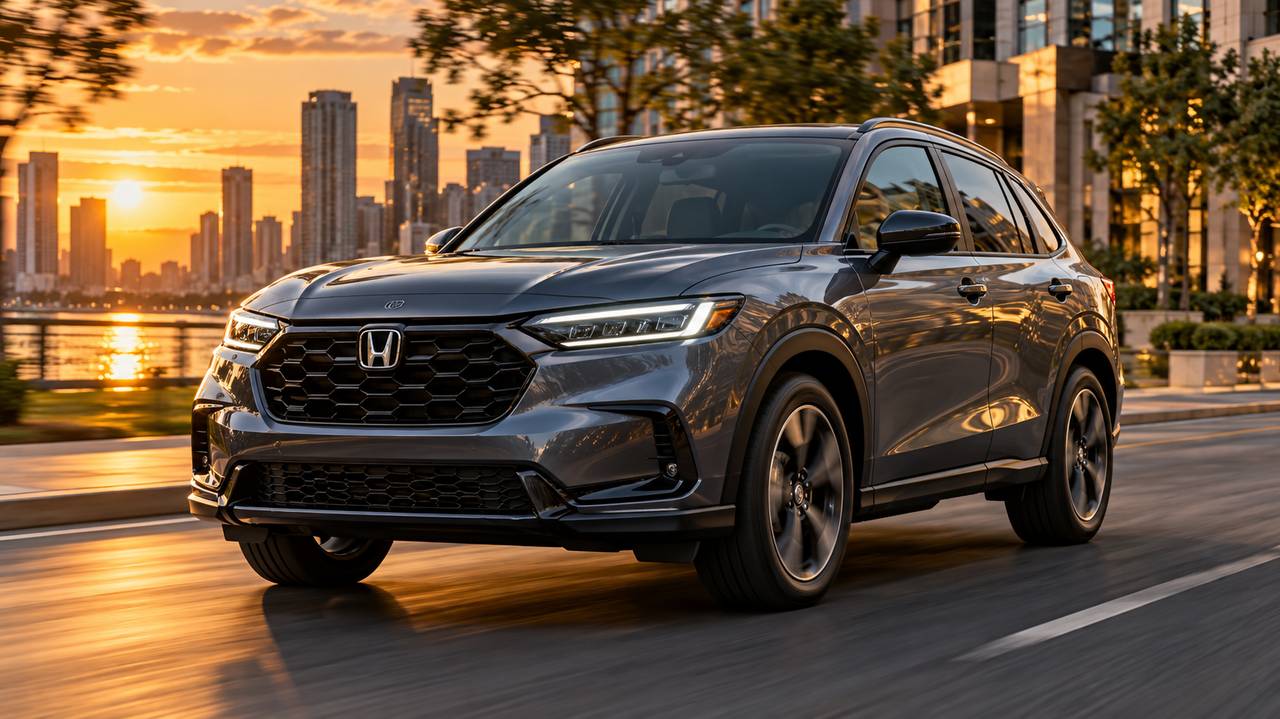
Background: Which Honda HR-V Are We Discussing?
The HR-V name does not describe an identical vehicle worldwide. The current American HR-V is a larger, Civic-related crossover, introduced for the 2023 model year. In other markets, Honda sells a different HR-V, closely associated with the Vezel, with hybrid power available in various regions. The North American vehicle is sold under the ZR-V name in some overseas markets, where electrified configurations also exist.
That distinction matters whenever an overseas hybrid review or dashboard photograph appears alongside a prediction about the U.S. model. Shared branding does not establish American availability, and related architecture does not guarantee identical engines, emissions certification, packaging, or infotainment software.
The established U.S. formula combines a naturally aspirated 2.0-liter four-cylinder engine, a continuously variable transmission, and either front-wheel drive or available all-wheel drive. Its strengths are usable space, predictable handling, and straightforward operation rather than vigorous acceleration. A successful 2027 update would improve convenience and efficiency without undermining affordability.
2027 Honda HR-V Reference: Baseline Versus Expectations
The following comparison uses the established current-generation U.S. HR-V as context. Forecast entries are analytical estimates, not an official 2027 order guide.
| Category | Established U.S. Baseline | 2027 Outlook |
|---|---|---|
| Gasoline engine | 2.0-liter four-cylinder; 158 horsepower and 138 lb-ft | Carryover is plausible; final specifications require confirmation |
| Transmission and drive | CVT; front-wheel drive or available AWD | Similar gasoline configuration is a reasonable expectation |
| Infotainment | 2026 update brought a standard 9-inch touchscreen and wireless smartphone integration | Further software or display changes remain unverified |
| Hybrid availability | No hybrid in the established U.S. lineup | Technically plausible, but not established here as a confirmed offering |
| Cargo capacity | Approximately 24.4 cubic feet behind the rear seat; 55.1 with it folded | Similar space is likely without substantial structural changes |
| Gasoline-model MSRP | Positioned below the larger CR-V | Planning estimate: roughly $27,000–$32,000 before destination, options, and taxes |
Interior Refresh: Better Screens, Not Just Bigger Screens
The Recent Upgrade Changes the Conversation
Predictions that the 2027 HR-V will finally receive a standard 9-inch touchscreen overlook an important development: that improvement arrived for the U.S. 2026 model, alongside standard wireless Apple CarPlay and Android Auto. Consequently, the meaningful 2027 question is whether Honda refines this setup or introduces additional changes—not whether it simply replaces the earlier base screen.
A useful refresh would prioritize quicker startup, reliable phone reconnection, legible navigation, and straightforward menu structures. Screen size alone says little about usability. A responsive 9-inch display with accessible volume adjustment can be easier to live with than a larger panel that buries essential functions.
Instrumentation and Physical Controls
A more configurable instrument display would be welcome, particularly if it presents driver-assistance status and navigation prompts clearly. However, claims of a specific larger digital cluster, Google built-in, or an entirely redesigned dashboard need model-specific confirmation. Features offered in a Civic, Accord, or overseas ZR-V should not automatically be assigned to an American HR-V.
Honda should also preserve convenient climate controls and sensible storage. The HR-V’s appeal depends on low-effort daily use: adjusting temperature with gloves, securing a phone, or finding a charging connection without searching through menus. Premium technology discussed in the 2027 Acura MDX Type S: Turbo V6 Super Handling All-Wheel Drive Refresh and Luxury Tech illustrates a different market position; the HR-V needs clarity and value more than luxury-grade complexity.
Hybrid Powertrain Expectations: Credible Possibility, Unconfirmed Product
Why a Hybrid Makes Sense
A hybrid would address two weaknesses in the gasoline HR-V: modest acceleration and unexceptional urban fuel economy. Honda’s two-motor hybrid approach, used elsewhere in its range, can deliver immediate electric-motor response while allowing the gasoline engine to operate efficiently. Such characteristics suit stop-start commuting particularly well.
The existing gasoline model’s familiar EPA benchmarks are approximately 26 mpg city, 32 highway, and 28 combined with front-wheel drive, versus 25 city, 30 highway, and 27 combined with AWD. These provide context, not certified 2027 ratings. A hybrid could improve city efficiency substantially, but publishing a specific U.S. horsepower figure or EPA estimate before certification would create false precision.
Why Overseas Availability Is Not Enough
Honda already has relevant hybrid technology and related overseas applications. Nevertheless, a U.S. launch involves manufacturing allocation, component sourcing, emissions approval, pricing, and decisions about how closely the HR-V should compete with the CR-V Hybrid. Battery placement can also affect cargo packaging, weight, and servicing considerations.
Buyers should therefore avoid assuming that a hypothetical hybrid would offer AWD, match another Honda’s output, or retain identical cargo volume. Likewise, an e-CVT designation in a Honda hybrid does not describe the same belt-and-pulley mechanism as the gasoline HR-V’s conventional CVT.
A conventional hybrid also differs fundamentally from the battery-electric ownership proposition explored in the 2027 Acura ZDX EV: Performance Electric SUV Changes, Air Suspension, and Real-World Range. An HR-V hybrid would ordinarily refuel with gasoline rather than require external charging; EV range and charging speed would not be relevant purchasing metrics.
Real-World Driving, Comfort, and Practicality
With 158 horsepower in its established configuration, the HR-V favors measured progress. Highway merging with passengers and luggage demands more planning than in a turbocharged crossover. Hard acceleration can also produce sustained engine noise as the CVT holds higher revs. A test drive should include an uphill on-ramp, not merely neighborhood streets.
The chassis is more convincing than the acceleration figures suggest. Independent rear suspension helps deliver composed responses, while the approximately 104.5-inch wheelbase supports useful passenger accommodation. Rear legroom measures about 37.7 inches in the established model, making the second row viable for adults, although taller occupants should assess headroom personally.
Available AWD primarily improves traction; it does not make the HR-V a dedicated off-roader or shorten braking distances on ice. Suitable tires remain crucial. Buyers whose needs include rougher trails or pickup utility should recognize the different priorities described in the 2027 Honda Ridgeline TrailSport: Unibody Truck Upgrades, High-Strength Skid Plates, and Price.
Expected MSRP and the Value Equation
A sensible preliminary budget for a gasoline 2027 HR-V is approximately $27,000–$32,000 in base MSRP across the likely trim ladder, excluding destination and other charges. This is a planning range, not Honda-announced pricing. AWD, accessories, registration, taxes, and dealer adjustments can move the transaction total meaningfully higher.
If a hybrid arrives, a premium of several thousand dollars would be plausible, but its actual value would depend on equipment and annual mileage. For illustration, driving 12,000 miles at 28 mpg consumes about 429 gallons; achieving 40 mpg would reduce that to 300 gallons. At $3.50 per gallon, the difference is approximately $450 annually. The 40-mpg figure is hypothetical, not an HR-V forecast.
Compare final out-the-door quotes with the CR-V and competing compact crossovers. Also resist paying for a performance identity the HR-V does not promise: the priorities in the 2027 Acura Integra Type S: Track Focused Performance Tweaks, Brembo Brakes, and Exhaust Note belong to a very different buying brief.
Verdict: Watch the Details, Not the Rumors
The strongest potential 2027 HR-V would combine its established practicality with polished connectivity and, ideally, better efficiency. Yet the standard-screen improvement already introduced for 2026 should not be repackaged as future news, and a U.S. hybrid should remain an expectation until Honda confirms it. Before ordering, verify the model-year equipment sheet, certified fuel economy, destination charge, and actual dealer price. Those details—not speculative screen dimensions or borrowed overseas specifications—will determine whether waiting pays off.