2027 Acura Integra Type S: Track Focused Performance Tweaks, Brembo Brakes, and Exhaust Note
The Acura Integra Type S occupies an increasingly rare corner of the performance market: a powerful, manual-only, front-wheel-drive liftback engineered to entertain without abandoning everyday usefulness. Its appeal comes from the relationship between its turbocharged engine, limited-slip differential, adaptive dampers, substantial brakes, and expressive exhaust—not simply an impressive horsepower figure.
For readers researching 2027 Acura Integra Type S: track focused performance tweaks, Brembo brakes, and exhaust note, the essential distinction is between established hardware and verified model-year changes. This guide uses the existing production Type S as its technical reference. It does not treat additional power, revised brakes, a new exhaust calibration, pricing, or a release date as confirmed 2027 specifications.
Background: A More Sophisticated Kind of Integra
The modern Integra Type S arrived for the 2024 model year, reviving the performance credibility associated with the Integra name while taking a different approach from the lightweight, high-revving Type R of earlier decades. Instead of chasing minimal mass above everything else, the contemporary car combines considerable turbocharged torque with a usable rear seat, generous liftback access, and more road-focused refinement.
Its closest mechanical relative is the Honda Civic Type R. Both use a turbocharged 2.0-liter four-cylinder engine, a six-speed manual transmission, and specialized front suspension geometry intended to make substantial front-wheel-drive power manageable. However, their personalities differ. The Acura emphasizes muscular styling, a richer cabin experience, and suspension tuning suited to mixed road conditions rather than presenting itself primarily as a circuit tool.
That distinction matters when discussing a potential 2027 update. Sharper responses would be welcome, but excessive spring stiffness, louder cruising noise, or less compliant damping could undermine the qualities that make the Type S unusually easy to live with.
Specifications: The Established Type S Baseline
The following figures describe the established U.S.-market production specification, not an independently verified 2027 announcement. Any eventual model-year changes should be checked against Acura’s official specifications and the equipment fitted to the particular vehicle.
| Area | Established Type S Specification | Performance Significance |
|---|---|---|
| Engine | 2.0-liter turbocharged four-cylinder; 320 hp and 310 lb-ft | Broad torque supports strong corner-exit acceleration. |
| Transmission and drive | Six-speed manual; front-wheel drive; helical limited-slip differential | Driver involvement with improved power delivery through corners. |
| Suspension | Dual-axis front struts; multilink rear; adaptive dampers | Balances steering control, body discipline, and road compliance. |
| Front brakes | Brembo four-piston fixed calipers; 13.8-inch ventilated, two-piece rotors | Substantial braking hardware for repeated high-load use. |
| Wheels and tires | 19-inch wheels; 265/30ZR19 Michelin Pilot Sport 4S summer tires | High dry-road grip, with cold-weather limitations. |
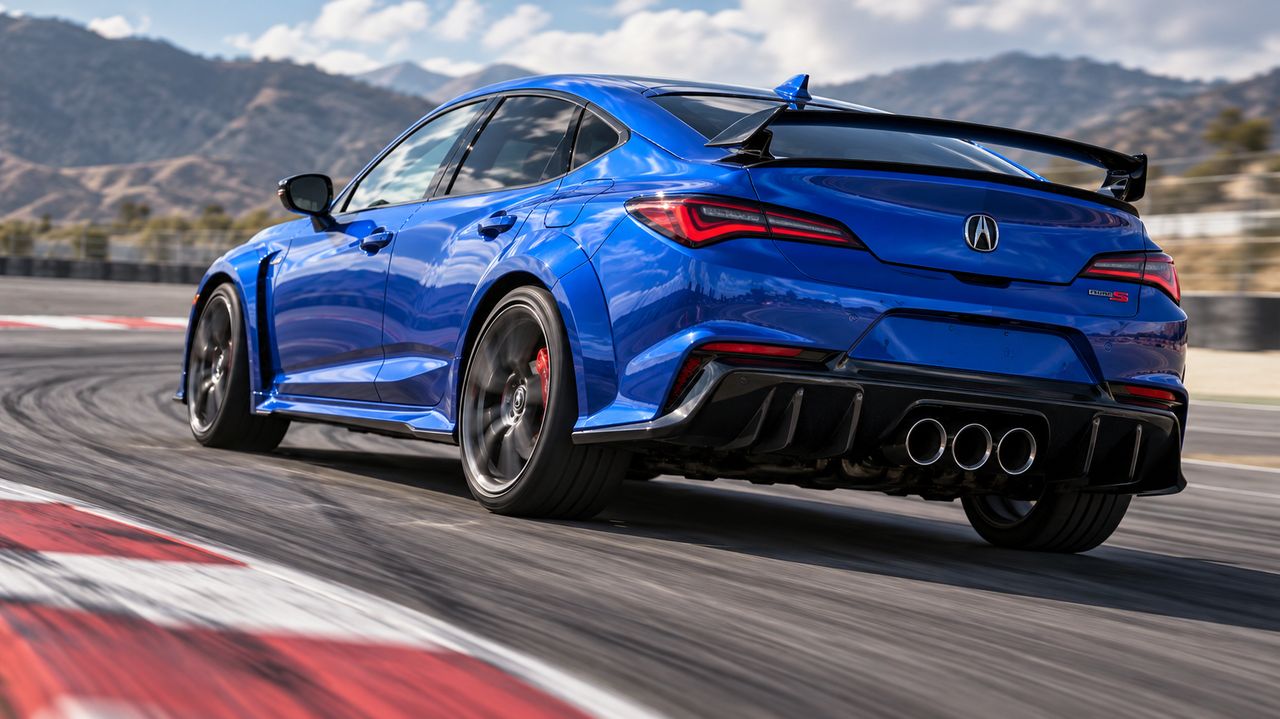
| Exhaust | High-flow system with an active valve and three center outlets | Variable sound character according to operating conditions and mode. |
Track-Focused Performance Tweaks: What Would Actually Help?
Prioritize Consistency Over Peak Output
A meaningful track-oriented revision does not necessarily require more horsepower. During repeated laps, the more important questions concern intake temperatures, coolant and oil temperatures, brake endurance, and whether the tires retain their grip. A car that delivers predictable responses throughout a session can be more rewarding than one that produces a spectacular first lap before performance deteriorates.
Potential improvements worth examining in any future announcement include cooling airflow, damper calibration, brake-pad specification, and alignment settings. These are evaluation priorities, not confirmed 2027 upgrades. Likewise, a larger intercooler or additional aerodynamic hardware should not be assumed merely because a model is marketed as more track focused.
Understand the Front Axle’s Workload
The front tires must steer, transmit engine torque, and perform most of the braking. The helical limited-slip differential helps distribute drive torque when corner-exit grip differs between the front wheels, but it cannot create traction beyond the tires’ available grip. Unwinding the steering progressively before applying full throttle remains fundamental.
The dual-axis front suspension reduces the steering-axis offset associated with torque steer. It does not eliminate every tug through the wheel, especially over uneven pavement. On a circuit, smooth inputs and thoughtful tire-pressure management are generally more useful starting points than immediately installing stiffer components.
Do Not Confuse Stiffness With Speed
Adaptive damping lets the Type S adjust its character without requiring a single uncompromising setup. A firmer setting can improve transient control on smooth asphalt, while a more compliant setting may preserve tire contact over bumps and curbing. The best choice depends on the surface, not simply the name of the drive mode.
That mission-specific approach also applies beyond performance cars. Our discussion of the 2027 Honda Ridgeline TrailSport: Unibody Truck Upgrades, High-Strength Skid Plates, and Price explores a different vehicle brief; its future-model claims, like those surrounding the Integra, require confirmation from the manufacturer.
Brembo Brakes: Hardware, Heat, and Real-World Expectations
The Type S’s four-piston Brembo front calipers and large ventilated rotors are central to its performance credentials. Fixed calipers provide a rigid platform for applying pad pressure, while the rotors absorb and shed the heat generated as the car slows. Their two-piece construction also allows the friction ring and central mounting section to serve different thermal and structural requirements.
However, a Brembo badge does not establish unlimited fade resistance. Repeated stops convert considerable kinetic energy into heat. Pad compound, fluid condition, airflow, vehicle speed, and driver technique all influence how long the system remains consistent.
- Before a track day: Inspect pad thickness, rotor condition, tire health, and brake-fluid service history.
- Follow event requirements: Use fluid and consumables appropriate to the manufacturer’s guidance and the organizer’s inspection standards.
- Watch pedal behavior: A longer or softer pedal warrants backing off and checking the system rather than continuing at full pace.
- Plan cooldowns: Allow the brakes and powertrain to shed heat before parking after a hard session.
Single-stop braking distance also depends heavily on tires, pavement, temperature, and ABS operation. Larger brakes often provide their greatest advantage through thermal capacity and repeatability, rather than automatically producing a shorter emergency stop.
Exhaust Note: Character Without Constant Intrusion
The established Type S uses a high-flow exhaust with an active valve and a distinctive three-outlet center arrangement. Its sound changes with drive mode and engine load, with Sport+ providing the most assertive character, including overrun pops and crackles under suitable conditions.
Those sounds should not be mistaken for evidence of additional power. Exhaust character depends on valve operation, gas flow, combustion strategy, and silencing. The existing Type S’s 320-horsepower rating belongs to its complete factory powertrain calibration; changing the noise alone does not reproduce that engineering.
There is also an important distinction between exterior exhaust sound and what occupants hear inside. Cabin sound enhancement can influence the perceived experience. A useful road test therefore includes steady-speed cruising, moderate acceleration, and low-speed operation—not just full-throttle recordings made beside the tailpipes.
For track use, sound limits deserve attention. Some circuits enforce both static and drive-by limits, and an aftermarket system may create problems even if it feels tolerable on the road. Any claimed 2027 exhaust revision should be assessed for resonance, highway comfort, and venue compatibility, not loudness alone.
Everyday Ownership and the Wider Honda Context
The liftback body gives the Integra genuine practical appeal, but its wide summer tires and low-profile sidewalls introduce compromises. Cold-weather traction, pothole exposure, replacement costs, and wheel alignment deserve consideration. Drivers in freezing or snowy conditions should plan suitable seasonal tires rather than treating the original summer rubber as an all-year solution.
Honda’s broader product range also illustrates how different buyers define progress. The 2027 Honda Prologue EV: Upgraded Ultium Battery Platform, Faster DC Fast Charging, and Trims addresses electric-SUV priorities, although its headline should not itself be treated as confirmation of future specifications.
Similarly, the 2027 Honda Accord Hybrid: Mid-Cycle Refresh, Google Built-In Cockpit, and MPG Ratings provides a contrasting efficiency-and-technology topic. Neither alternative replaces the particular involvement of selecting gears and managing traction in the Type S.
Verdict: Judge the Engineering, Not the Model-Year Hype
The strongest case for the Integra Type S remains its integrated package: substantial turbocharged performance, a rewarding manual transmission, capable Brembo front brakes, adjustable damping, and an exhaust with genuine personality. Its appeal does not depend on turning every commute into a qualifying lap.
For a 2027 purchase, verify the actual specification, equipment, price, warranty terms, and any announced revisions. Until those details are established, track-focused improvements remain possibilities rather than facts. The right development direction is clear: preserve everyday usability while improving thermal consistency, braking confidence, and driver feedback—the qualities that remain valuable long after the headline horsepower number loses its novelty.