2027 Honda Prologue EV: Upgraded Ultium Battery Platform, Faster DC Fast Charging, and Trims
The Honda Prologue gives buyers a familiar badge on an electric SUV with a distinctly different engineering foundation. Developed through Honda’s partnership with General Motors, it combines Honda-specific styling and cabin decisions with GM’s Ultium battery and propulsion architecture. That arrangement makes the Prologue an important bridge between Honda’s combustion-powered SUV lineup and its broader electric-vehicle ambitions.
For shoppers researching the 2027 Honda Prologue EV: upgraded Ultium battery platform, faster DC fast charging, and trims, however, one distinction matters immediately: those headline upgrades should not be treated as confirmed specifications without model-year-specific Honda documentation. This guide separates the established Prologue baseline from the changes buyers should look for in a verified 2027 announcement.
Background: Where the Prologue Fits
Introduced for the 2024 model year, the Prologue entered the competitive two-row electric SUV market. Its approximately 192-inch length and 121.8-inch wheelbase give it a substantial footprint, with generous passenger space and a relatively low, wide stance. It competes for buyers considering vehicles such as the Chevrolet Blazer EV, Hyundai Ioniq 5, Nissan Ariya, and Tesla Model Y.
The Prologue is not simply a gasoline Honda converted to electric power. Its dedicated EV underpinnings position the battery beneath the passenger compartment, supporting a flat cabin layout and a low center of gravity. Honda’s contribution includes exterior design, interior execution, chassis tuning, and the ownership experience surrounding the vehicle.
For households comparing different routes to electrification, the distinction between a battery EV and a hybrid remains essential. Our 2027 Honda Accord Hybrid: Mid-Cycle Refresh, Google Built-In Cockpit, and MPG Ratings preview explores a different category: electrification that retains gasoline refueling rather than depending on charging access.
Established Specifications Versus 2027 Expectations
The clearest way to evaluate a future Prologue is to start with published specifications from an established model year. The following figures describe the 2025 U.S.-market Prologue baseline; they are not confirmed 2027 specifications. Equipment, range, charging capability, and trim availability require fresh verification for any subsequent model year.
| Specification | Established 2025 Baseline | What to Verify for 2027 |
|---|---|---|
| Battery architecture | GM Ultium; 85-kWh battery specification | Capacity, chemistry, and thermal-management changes |
| Single-motor output | Front-wheel drive; 220 hp | Availability, power, and efficiency |
| Dual-motor output | All-wheel drive; 300 hp | Output and drivetrain revisions |
| EPA-estimated range | 308 miles FWD; 294 miles EX/Touring AWD; 283 miles Elite AWD | Final EPA ratings for each configuration |
| DC fast charging | Up to 150 kW | Peak power, charging curve, and connector |
| Trim structure | EX, Touring, and Elite | Names, standard equipment, and pricing |
What an Upgraded Ultium Battery Platform Would Mean
Capacity Is Only Part of the Story
Ultium describes a flexible EV architecture, not one identical battery fitted to every vehicle. Pack configuration, propulsion hardware, cooling systems, and software vary by application. Improvements announced for another GM-based EV therefore do not automatically apply to the Prologue.
A meaningful Prologue battery upgrade could involve revised cells, improved pack cooling, lower electrical losses, or software that allows more consistent performance. A larger battery might increase range, but it could also add weight, cost, and charging demand. Better efficiency can be more valuable than additional capacity because it reduces energy consumption on every journey.
Usable Energy and Battery Longevity
Published battery capacities also need careful interpretation. Gross capacity includes energy that battery-management software may reserve, while usable capacity describes what the driver can access. Comparisons become misleading when one vehicle’s gross figure is measured against another’s usable figure.
For ownership, warranty coverage and charging guidance matter more than platform branding. Buyers should review the actual battery warranty, any stated capacity-retention provisions, and Honda’s recommended daily charging limit for the specific vehicle. An upgraded pack does not eliminate normal degradation or the effects of temperature and repeated high-power charging.
Faster DC Fast Charging: Look Beyond Peak Kilowatts
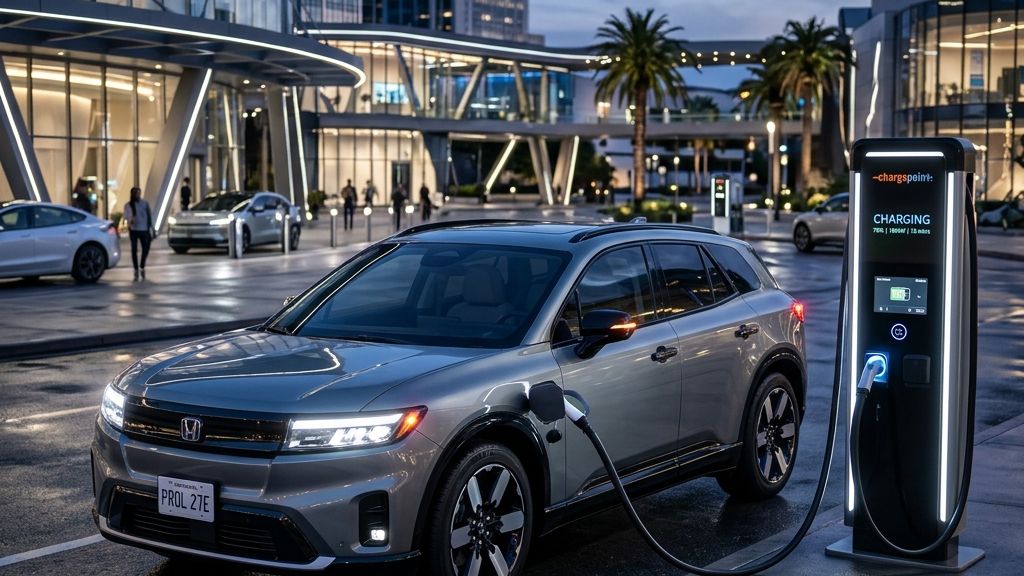
The established Prologue’s maximum DC charging rate of 150 kW is a ceiling, not a continuous charging speed. The vehicle requests power according to battery temperature, state of charge, charger capability, and protective limits. A station labeled 350 kW cannot make a 150-kW-limited vehicle accept 350 kW.
For a prospective 2027 update, the most useful improvement would be a stronger charging curve: maintaining higher power through a larger portion of the session. A higher peak that lasts briefly may save less time than a modest peak supported consistently. Buyers should prioritize comparable 10–80 percent charging results over isolated maximum-power claims.
Temperature, Preconditioning, and Connector Compatibility
Cold batteries can charge slowly even at powerful stations. Battery preconditioning, where supported and correctly activated, helps bring the pack toward an appropriate temperature before arrival. Any 2027 claim should specify whether charging-route navigation automatically triggers that preparation and under what conditions.
Connector details deserve equal attention. The established Prologue launched with a CCS1 DC charging inlet. For a 2027 vehicle, verify whether it retains CCS1 or adopts native NACS, which adapters Honda approves, and which networks support the exact vehicle. Access through an adapter is not the same as having a native connector, and neither guarantees access to every charging location.
Trims: Understanding EX, Touring, and Elite
The existing EX, Touring, and Elite hierarchy provides a useful shopping framework, but it should not be presented as a finalized 2027 lineup. Historically, EX and Touring have offered front- or all-wheel drive, while Elite has paired its premium equipment with all-wheel drive.
- EX: The value-oriented starting point, especially for buyers prioritizing practical equipment and lower acquisition cost.
- Touring: A comfort-focused step upward, historically adding features such as leather-trimmed seating, upgraded audio, and convenience equipment.
- Elite: The premium configuration, historically including larger wheels, ventilated front seats, and a head-up display.
Wheel size illustrates the trade-off between appearance and efficiency. Larger wheels and their associated tires can reduce range and increase replacement costs. The established Elite’s lower EPA range shows why the most expensive trim is not necessarily the best long-distance choice.
Cabin Technology and Everyday Practicality
The established Prologue combines an 11-inch digital instrument display with an 11.3-inch central touchscreen. Google built-in and wireless Apple CarPlay and Android Auto give it a useful mix of integrated navigation and smartphone connectivity. Buyers should check connected-service subscription terms rather than assuming every feature remains complimentary indefinitely.
Its spacious second row suits family use, although cargo shape, child-seat installation, and loading height deserve an in-person test. Families needing sliding doors or three-row flexibility are considering a different vehicle class; the 2027 Honda Odyssey Hybrid: Long-Awaited Electrified Minivan Redesign, Cabin Magic, and Release preview discusses that alternative, with prospective specifications requiring separate confirmation.
Range, Home Charging, and Ownership Costs
EPA range is a comparison tool, not a guaranteed trip distance. Sustained highway speeds, cold weather, cabin heating, elevation changes, and headwinds can reduce usable travel distance. Road-trip planning should allow a reserve rather than treating the displayed range as a promise.
Home charging often matters more than a modest fast-charging improvement. A correctly installed Level 2 circuit can replenish substantial daily mileage overnight, reducing dependence on public stations. Installation costs depend on electrical-panel capacity, cable routing, permits, and local labor rates; obtain an electrician’s assessment before purchase.
Drivers without dependable charging should compare alternatives honestly. The 2027 Honda Passport TrailSport: Rugged Midsize SUV Redesign, V6 Powertrain, and Off-Road Tech preview addresses a different set of priorities, particularly for shoppers weighing gasoline convenience and rough-road capability against electric efficiency.
Verdict: Verify the Upgrade, Not Just the Headline
The Prologue’s appeal rests on comfortable packaging, familiar Honda design, and an established electric architecture. A genuinely upgraded battery system and faster sustained charging could strengthen that proposition, but neither should be assumed from a future-model headline.
Before ordering a 2027 Prologue, obtain its official specification sheet, trim-specific EPA rating, charging information, warranty, and written transaction price. The best version will be the one that matches your charging access and driving routine—not necessarily the one with the biggest wheels or highest advertised peak charging rate.