2027 Honda Accord Hybrid: Mid-Cycle Refresh, Google Built-In Cockpit, and MPG Ratings
The Honda Accord Hybrid occupies a useful sweet spot: spacious enough for family duty, efficient enough for a demanding commute, and more satisfying to drive than its fuel-economy mission might suggest. A potential 2027 update raises three important questions: How extensively will Honda refresh the design, will Google built-in reach more trims, and can efficiency improve without sacrificing comfort or performance?
This guide to the 2027 Honda Accord Hybrid: mid-cycle refresh, Google built-in cockpit, and MPG ratings separates established engineering from expectations. Final 2027 specifications, equipment, pricing, and EPA ratings are not verified here. Where figures appear below, they describe the established U.S.-market Accord Hybrid, using the 2025 model as a clearly identified reference—not confirmed 2027 specifications.
Background: Why a 2027 Refresh Matters
The eleventh-generation Accord arrived for the 2023 model year, retaining the nameplate’s traditional strengths while making hybrid power central to its upper trim levels. Its restrained styling, roomy cabin, and straightforward controls offer an alternative to the increasingly elaborate interiors found elsewhere in the midsize segment.
By 2027, an update would fit a plausible product-cycle window. However, timing alone does not establish that Honda will introduce a particular grille, dashboard, battery, or drivetrain revision. A mid-cycle refresh typically changes selected components rather than replacing the vehicle’s underlying architecture.
For buyers, the distinction matters. Revised software, improved sound insulation, or broader availability of desirable equipment can deliver more everyday value than dramatic styling. Conversely, a cosmetic update alone would not justify assuming better mileage, stronger acceleration, or a substantially different ownership experience.
Mid-Cycle Refresh: What Could Realistically Change?
Exterior Design and Practical Packaging
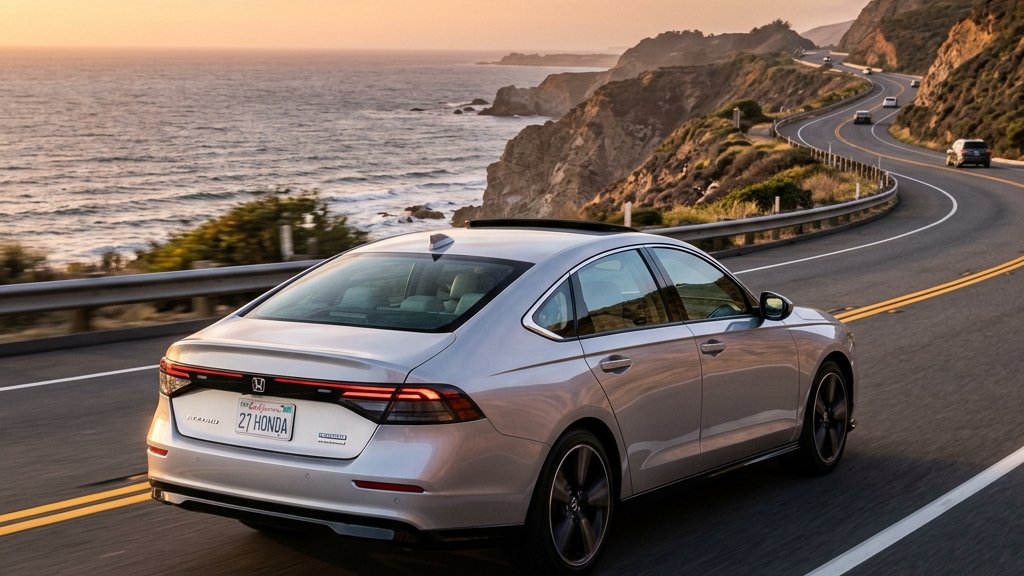
A refreshed Accord could receive revised bumper treatments, lighting details, wheel designs, and paint choices. These are conventional opportunities to modernize an established body without changing its major structural components. Until Honda publishes model-specific information, renderings and speculative photographs should not be treated as production confirmation.
The existing sedan already offers roughly 16.7 cubic feet of trunk capacity and generous rear-seat accommodation. Preserving those advantages would be important: buyers choose an Accord partly because it handles adult passengers, luggage, and child-seat duties without requiring a crossover’s taller body.
Wheel selection deserves particular attention. Larger wheels can sharpen appearance, but their tire specifications and additional mass can affect ride quality, replacement costs, and efficiency. A refresh that prioritizes visual impact over sensible wheel-and-tire combinations could make some versions less appealing for long-distance commuting.
Cabin Refinement Over Reinvention
The strongest opportunities inside are incremental: quieter highway cruising, better seat materials, improved connectivity reliability, and clearer equipment packaging. Physical climate controls remain valuable because drivers can operate them without navigating touchscreen menus. Retaining that usability would be more meaningful than simply increasing screen dimensions.
Shoppers who genuinely need higher ground clearance or more rugged capability should evaluate a different vehicle category rather than expect an Accord refresh to provide it. Our coverage of the 2027 Honda Passport TrailSport: Rugged Midsize SUV Redesign, V6 Powertrain, and Off-Road Tech explores that separate utility-focused brief; any forward-looking specifications still require model-specific verification.
Hybrid Powertrain: Understanding the Existing Foundation
The established Accord Hybrid combines a 2.0-liter Atkinson-cycle four-cylinder engine with Honda’s two-motor hybrid system. In the 2025 U.S. specification, total system output is 204 horsepower, while the traction motor produces 247 lb-ft of torque. Those figures are useful benchmarks, not evidence of unchanged or increased 2027 output.
The system behaves differently from a conventional engine connected to a belt-type continuously variable transmission. Although Honda uses the e-CVT designation, propulsion frequently comes from the electric drive motor, with the gasoline engine generating electricity. Under suitable cruising conditions, a clutch allows the engine to drive the wheels mechanically.
This arrangement explains the Accord’s responsive low-speed character. Electric torque makes pulling away and merging feel straightforward, while the control system selects an efficient operating mode. Strong acceleration can still bring noticeable engine sound; electrification does not make sustained high-load driving silent.
The existing Accord Hybrid is not a plug-in hybrid. It recovers energy during deceleration and manages battery charge through the powertrain, so owners do not connect it to a charger. Its battery supports efficient operation rather than providing a substantial, separately rated electric-only commuting range.
Possible performance-oriented electrification elsewhere should not be confused with the Accord’s economy-focused mission. The 2027 Honda Civic Type R Hybrid: Electrified Track Monster Rumors, Downforce Aero, and MSRP discusses a different, explicitly speculative direction—not confirmation of shared future hardware.
Specifications and MPG: Reference Figures Versus 2027 Unknowns
The table below establishes a practical comparison baseline. Its economy figures are 2025 EPA ratings for U.S.-market vehicles, and they must not be presented as certified 2027 results.
| Category | 2025 U.S. Accord Hybrid Reference | 2027 Status |
|---|---|---|
| Powertrain | 2.0-liter four-cylinder, two-motor hybrid; front-wheel drive | Final specification not verified |
| Output | 204 hp combined; 247 lb-ft traction-motor torque | No verified change |
| EX-L Hybrid economy | 51 city / 44 highway / 48 combined mpg | EPA ratings not verified |
| Sport, Sport-L, Touring Hybrid economy | 46 city / 41 highway / 44 combined mpg | Trim-specific ratings not verified |
| Infotainment | 12.3-inch touchscreen on hybrids; Google built-in on Touring | Availability and services require confirmation |
What Those MPG Differences Mean Financially
At 12,000 miles annually, a vehicle averaging 48 mpg uses approximately 250 gallons, versus about 273 gallons at 44 mpg. With gasoline at $3.50 per gallon, the difference is roughly $80 annually. Efficiency matters, but modest fuel savings may not outweigh purchase price, seat comfort, or tire-replacement expenses.
Actual consumption depends on conditions. Short winter trips, cabin heating, high freeway speeds, elevation changes, and aggressive acceleration can reduce mileage. The existing EPA figures also show why a hybrid’s city advantage does not automatically translate into equally impressive high-speed highway economy.
Google Built-In Cockpit: Useful Integration, Important Caveats
Google built-in means compatible Google services run through the vehicle’s infotainment system rather than relying entirely on smartphone projection. In the established Accord Touring implementation, that includes Google Maps, Google Assistant, and access to compatible applications through Google Play. Availability can depend on market, connectivity, accounts, and service terms.
This is distinct from Android Auto, which projects a compatible phone interface. Apple CarPlay serves a similar phone-integration role for iPhone users. Existing Accord Hybrid models offer wireless smartphone integration, so Google built-in should be evaluated as an additional convenience rather than a prerequisite for usable navigation.
For 2027, the key issue is distribution: will integrated Google services remain restricted to a flagship trim, or become available more broadly? Neither outcome should be assumed. Buyers should also check included data periods, ongoing connectivity costs, update support, and which functions remain available without a paid service.
Ownership, Alternatives, and the Buying Decision
Test-drive priorities should include brake-pedal consistency, seat comfort, tire noise, and the behavior of driver-assistance systems. Regenerative braking blends with friction braking, and buyers should experience that transition in stop-and-go traffic. Confirm the exact Honda Sensing equipment and limitations rather than interpreting assistance features as autonomous driving.
Honda’s other electrification pathways also illustrate why terminology matters. The 2027 Honda CR-V FCEV: Hydrogen Fuel-Cell Electric Crossover Range, Plug-In Specs, and Price concerns a hydrogen-and-charging proposition with very different infrastructure requirements. Similarly, the 2027 Honda S2000 EV: Electric Roadster Revival, RWD Architecture, and Target Release explores a potential sports-car revival, not a confirmed substitute for a family hybrid sedan.
Verdict: Wait for the Specifications, Not the Hype
The Accord Hybrid’s established appeal is substantive: efficient urban operation, useful passenger space, and responsive everyday performance without charging obligations. A thoughtful 2027 refresh could strengthen that formula through quieter cruising, improved equipment value, and broader access to integrated navigation.
However, a refresh, expanded Google availability, and improved MPG remain separate claims requiring separate confirmation. Before ordering, compare Honda’s final U.S. specification sheet, the exact vehicle’s EPA label, connectivity terms, and the out-the-door price. Those details—not speculative styling or recycled mileage figures—will determine whether the 2027 Accord Hybrid deserves a place on your shortlist.