2027 Honda S2000 EV: Electric Roadster Revival, RWD Architecture, and Target Release
The prospect of a battery-powered Honda S2000 has become one of the most compelling stories surrounding Japan’s next generation of performance cars. A compact electric roadster could give Honda a distinctive halo model while reviving a name associated with high-revving engines, rear-wheel drive, precise controls, and unusually disciplined engineering. Yet the most important fact is also the easiest to overlook: Honda has not officially confirmed a production vehicle called the 2027 Honda S2000 EV.
Reports, executive comments about future electric sports cars, Honda’s evolving EV strategy, and the company’s striking electric concepts have encouraged speculation about an S2000 successor. A 2027 debut is plausible as a target rather than a guaranteed launch date. If the car reaches production, its challenge will not simply be acceleration. It must translate the original S2000’s light, mechanical character into an electric format without becoming a heavy grand tourer wearing a nostalgic badge.
Why an Electric S2000 Revival Makes Sense
Honda sold the original S2000 from 1999 through 2009. The AP1 and later AP2 models combined a front-mid-mounted four-cylinder engine with a six-speed manual transmission, rear-wheel drive, near-ideal weight distribution, and an open two-seat body. Early versions became famous for an engine that revved to approximately 9,000 rpm, while later specifications delivered broader torque and more forgiving road manners.
That formula gave the S2000 a clear identity. It was not built around maximum cylinder count or straight-line dominance. Its appeal came from response: a crisp throttle, short gear changes, accurate steering, a rigid structure, and a chassis that rewarded deliberate inputs. Those qualities make electrification both logical and difficult. Electric motors provide immediate response and precise torque control, but batteries add mass and remove the escalating engine note and manual gearbox that shaped the original experience.
Honda nevertheless needs emotionally engaging vehicles as it expands its electric portfolio. Practical crossovers will generate volume, but a roadster can establish technological credibility and create enthusiasm for an entire platform. Other Japanese manufacturers are similarly using distinctive products to explain their electrification strategies, from the long-range battery ambitions discussed in the 2027 Toyota Solid-State Battery EV: Groundbreaking 700-Mile Range Technology Preview to the lifestyle-focused 2027 Toyota Compact Cruiser EV: Retro Off-Roader Styling, Battery Architecture, and Expected MSRP.
Expected RWD Architecture
A credible S2000 successor should use a rear-mounted electric drive unit powering the rear wheels. That arrangement would preserve the behavior expected from the badge: clean steering without front-axle propulsion duties, adjustable cornering balance, and the ability to rotate the car progressively under power. A compact rear motor could also concentrate drivetrain mass close to the driven axle while freeing space ahead of the cabin for crash structures, cooling hardware, storage, and suspension components.
The battery layout is more complicated. A conventional flat skateboard pack is efficient for manufacturing and cabin packaging, but it raises the seating position and can make a small roadster feel thick-bodied. Honda may instead use a sculpted pack with modules distributed through the floor, center tunnel, and area behind the seats. Such an arrangement could create a lower hip point while preserving structural side sills and useful ground clearance.
Battery mass would ideally sit low and within the wheelbase. Engineers would then tune the suspension, steering ratio, regenerative braking, and electronic differential controls around predictable weight transfer rather than disguising bulk with excessive tire width. Aluminum body panels, hollow suspension components, compact motors, and selective use of composite materials could help, although cost will determine how aggressively Honda pursues weight reduction.
Single Motor or Dual Motor?
A single-motor layout is the purist’s choice. It should weigh less, produce more natural steering feedback, and maintain the traditional rear-drive relationship between throttle position and chassis attitude. Output in the region of 300 to 400 horsepower would already make a compact EV roadster extremely rapid.
A dual-motor variant could provide all-wheel-drive traction and sophisticated torque distribution, but it risks diluting the S2000 formula. Honda could reserve that configuration for a higher-performance Type R or Type S derivative, provided the front motor can disconnect during normal driving. The standard car would be more convincing as a lightweight rear-wheel-drive model than as a specification-driven super-EV.
Projected Specifications and Competitive Context
The figures below are informed estimates rather than confirmed Honda specifications. They illustrate the engineering window in which an electric S2000 could remain usable, competitive, and faithful to its predecessor.
| Category | Original Honda S2000 | Potential 2027 S2000 EV | Engineering Priority |
|---|---|---|---|
| Powertrain | 2.0- or 2.2-liter gasoline four-cylinder | Single rear motor; dual-motor performance model possible | Immediate but progressive response |
| Drive layout | Rear-wheel drive | Rear-wheel drive expected | Preserve steering purity and balance |
| Estimated output | Approximately 237-247 hp, market dependent | Approximately 300-400 hp | Performance without excessive tire demand |
| Battery capacity | Not applicable | Approximately 60-75 kWh usable | Balance range against curb weight |
| Estimated range | Gasoline touring range | Approximately 250-300 miles | Useful road-trip range with a compact pack |
| 0-60 mph estimate | Roughly 5.4-6.0 seconds | Approximately 3.5-4.5 seconds | Repeatability rather than launch theatrics |
| Target price | Originally positioned as an attainable sports car | Approximately $55,000-$75,000 | Premium engineering at sub-exotic pricing |
Battery, Charging, and Thermal Performance
A roadster does not need an enormous battery if efficiency is treated as a performance metric. A usable capacity of roughly 60 to 75 kWh could support an estimated 250 to 300 miles of range, depending on aerodynamics, wheels, climate, and testing methodology. Keeping the pack moderate in size would reduce weight, shorten charging sessions, and improve braking and direction changes.
Fast charging will matter because sports-car owners frequently travel to scenic roads and circuits beyond their daily commute. An 800-volt-class electrical system could enable high charging power while reducing current and cable mass, although Honda has not confirmed such hardware for an S2000. A competitive goal would be a 10-to-80-percent charge in approximately 20 minutes under favorable conditions.
Thermal management is equally important. Repeated acceleration, regenerative braking, and track use create sustained heat loads that reveal the difference between a genuinely engineered sports EV and a quick commuter car. Dedicated cooling circuits for the battery, inverter, and motor would help preserve power consistency. Preconditioning tied to navigation could prepare the pack for rapid charging, while a circuit mode might prioritize cooling before a track session.
Driving Character: More Than Instant Torque
The S2000 name demands finesse. Honda should map the accelerator for fine control rather than delivering maximum torque in the first few millimeters of pedal travel. Several regenerative-braking settings would allow drivers to choose between conventional coasting, road-friendly one-pedal operation, and stronger regeneration for descents.
Brake-pedal consistency will be crucial. Blended braking must transition smoothly between motor regeneration and hydraulic friction brakes, especially near the limit. A limited-slip effect generated through motor control could improve traction, but transparent programming is preferable to aggressive interventions that make the chassis feel synthetic.
Steering should remain light, fast, and communicative. Narrower front tires, restrained curb weight, and rigid suspension mounting points may contribute more to engagement than headline horsepower. Honda could add simulated gear steps or synthesized sound, but these features should be optional. An electric S2000 should develop an authentic vocabulary of inverter tone, motor speed, wind, tire load, and chassis feedback instead of imitating an internal-combustion engine by default.
Design, Cabin, and Everyday Usability
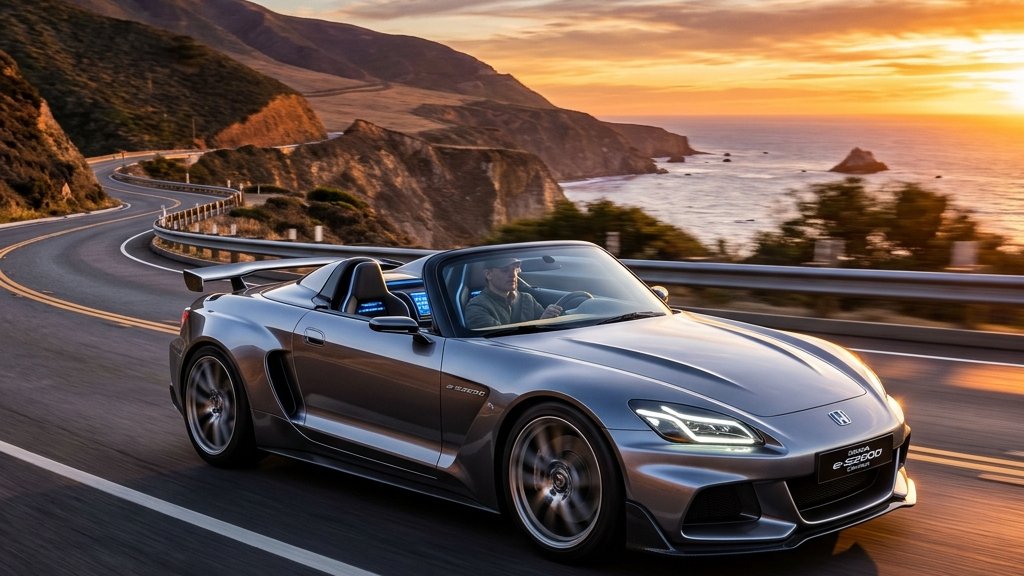
A production model would likely adopt a long visual hood, short rear deck, low cowl, and compact two-seat cabin without literally reproducing the original. Honda’s modern EV concepts suggest clean surfacing, slim lighting, and careful aerodynamic management. Functional air curtains, a smooth underbody, and an active rear spoiler could generate stability without oversized wings.
Inside, the priorities should be a low seating position, excellent pedal alignment, physical controls for frequently used functions, and a compact driver-focused display. A powered fabric roof would minimize mass and preserve trunk space more effectively than a folding metal hardtop. Useful storage for charging cables and weekend luggage would broaden the car’s appeal beyond short recreational drives.
This focused approach would contrast with the scale and craftsmanship of the 2027 Toyota Century SUV: Ultra-Luxury Japanese Limousine Crossover Specs and Bespoke Price. It also shows how varied Japanese electrification and hybridization may become: a low sports EV can coexist with work-oriented products such as the 2027 Toyota Hilux GR Sport: Rugged Diesel Hybrid Specs, Wide Track Suspension, and Global Price.
Target Release Date and Expected Price
The 2027 model year remains speculative. If Honda approves the project, a concept or advanced prototype could appear before production, with sales potentially beginning in 2027 or slipping into 2028 as battery sourcing, platform timing, and factory capacity evolve. Regional availability is also uncertain; low-volume roadsters face different safety, homologation, and business requirements in North America, Europe, and Japan.
A starting price near $55,000 to $65,000 would place the car above mainstream roadsters but below many premium performance EVs. A highly equipped or dual-motor version could approach $75,000 or more. Honda must avoid pushing the model so far upscale that buyers expect supercar materials and power, yet pricing it too low could make its dedicated structure and lightweight components financially unrealistic.
Final Assessment
The 2027 Honda S2000 EV remains an informed possibility, not an announced production fact. Its strongest case rests on a compact rear-wheel-drive platform, a carefully sized battery, disciplined mass management, reliable thermal control, and controls tuned for precision rather than spectacle.
If Honda can preserve the original car’s intimacy while exploiting the responsiveness and packaging flexibility of electric propulsion, the result could be more than a revived badge. It could define what an attainable electric roadster should feel like: low, efficient, balanced, technically sophisticated, and rewarding long after the novelty of silent acceleration has faded.