2027 Toyota Hilux GR Sport: Rugged Diesel Hybrid Specs, Wide Track Suspension, and Global Price
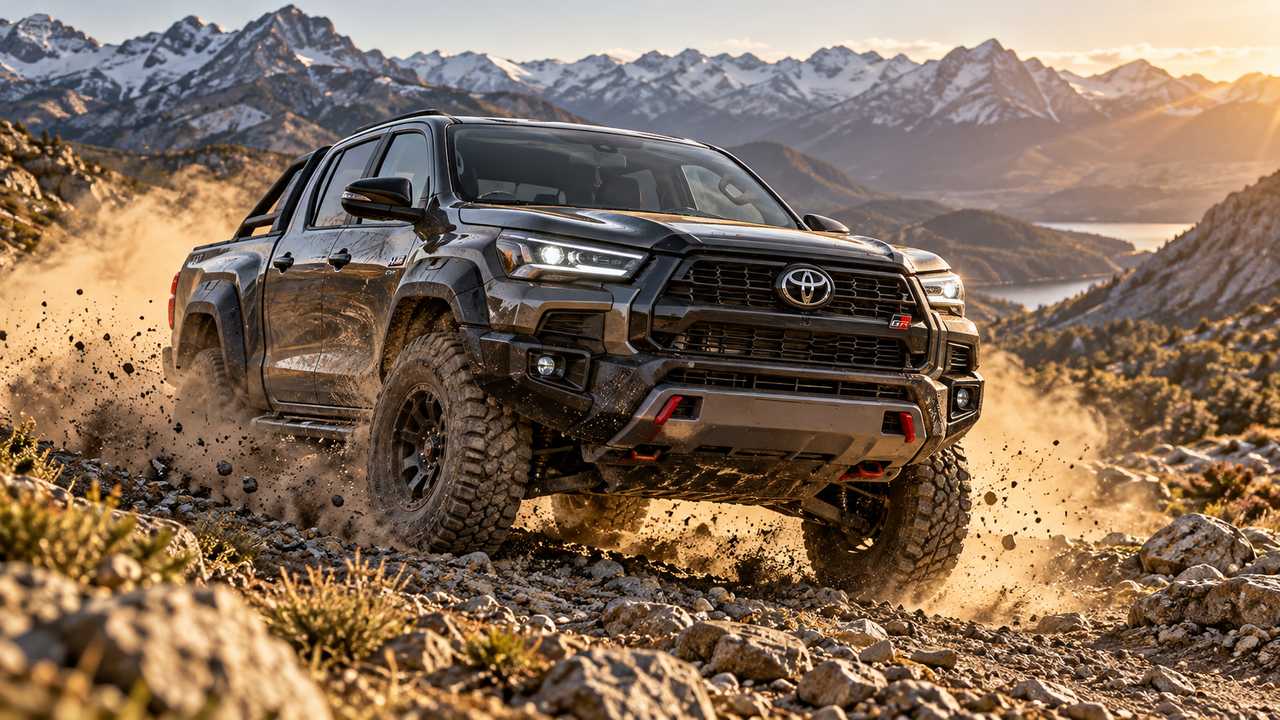
The 2027 Toyota Hilux GR Sport is expected to sit at the adventurous end of Toyota’s next-generation pickup range, combining the durability for which the Hilux is famous with Gazoo Racing-inspired chassis tuning, a wider stance, and an increasingly likely electrified diesel powertrain. Rather than becoming a high-output desert racer, the GR Sport should remain a practical double-cab truck engineered for towing, difficult trails, agricultural work, and long-distance travel.
Important details remain provisional. Toyota has not published complete global specifications or pricing for a 2027 Hilux GR Sport, and equipment will differ among Australia, Europe, Asia, Africa, the Middle East, and Latin America. The specifications discussed here combine Toyota’s current Hilux technology, the brand’s announced electrification direction, and realistic expectations for the next model cycle.
Why the 2027 Hilux GR Sport Matters
The Hilux has spent decades building its reputation in environments where mechanical resilience matters more than showroom novelty. It works on mine sites, farms, construction projects, arid outback tracks, humid tropical roads, and high-altitude routes. The GR Sport treatment adds visual aggression and greater chassis sophistication without abandoning that utility-led identity.
This positioning separates the Hilux GR Sport from Toyota’s road-focused performance cars. The engineering philosophy associated with the 2027 Toyota GR Yaris Evolution: Lightweight Aero Tweaks, 300 HP Output, and Availability emphasizes low mass, aerodynamic response, and rapid cornering. In the Hilux, the GR badge instead translates into stronger underbody protection, revised dampers, wider tracks, all-terrain capability, and improved control on broken surfaces.
Its likely rivals include the Ford Ranger Wildtrak and Tremor, Volkswagen Amarok PanAmericana, Isuzu D-Max X-Rider or Arctic Trucks derivatives, Mitsubishi Triton Athlete, and region-specific Nissan Navara models. The more extreme Ford Ranger Raptor occupies a different niche because of its high-performance suspension and, in some markets, petrol V6 engine. Toyota is likely to preserve the Hilux GR Sport as the rationaler choice: muscular, capable, and usable with a meaningful payload.
Expected Diesel Hybrid Powertrain
2.8-Liter Turbo-Diesel with 48-Volt Assistance
The most credible powertrain is an updated version of Toyota’s 2.8-liter four-cylinder 1GD-FTV turbo-diesel, supported by a 48-volt mild-hybrid system. In its current application, this arrangement uses a belt-driven motor-generator and a compact lithium-ion battery. It can recover energy while decelerating, assist the engine during initial acceleration, and power electrical accessories more efficiently than a conventional 12-volt system.
This is not a full hybrid in the passenger-car sense. The truck is unlikely to travel meaningful distances using electricity alone, and the motor will not transform it into a silent urban EV. Its advantages should be smoother stop-start operation, stronger low-speed response, reduced engine load, and a modest fuel-consumption improvement in traffic and mixed driving.
Expected output is approximately 150 to 165 kW, equivalent to 201 to 221 hp, with torque in the 500 to 550 Nm range. Final figures will depend on emissions regulations and transmission calibration. A six-speed automatic remains plausible, although Toyota could adopt a newer transmission if the next Hilux shares more hardware with the latest Tacoma and Land Cruiser family.
| Category | Expected 2027 Hilux GR Sport Specification | Practical Significance |
|---|---|---|
| Engine | 2.8-liter four-cylinder turbo-diesel | Strong low-speed pulling power and established serviceability |
| Hybrid system | 48-volt motor-generator with compact battery | Smoother launch, energy recovery, and lower accessory load |
| Estimated output | 150-165 kW; 500-550 Nm | Suitable for towing and controlled off-road progress |
| Drivetrain | Selectable or full-time 4WD, market dependent | Low-range traction with improved sealed-road flexibility |
| Towing target | Up to 3,500 kg braked | Competitive capacity for trailers, boats, and equipment |
| Suspension | GR-tuned dampers, wide track, rear leaf springs | Better stability while retaining load-carrying strength |
| Wheels and tires | Approximately 17-inch wheels with all-terrain tires | Useful sidewall depth and improved loose-surface grip |
Wide Track Suspension and Off-Road Hardware
A wider track is one of the GR Sport’s most meaningful upgrades. Moving the wheels farther apart increases lateral stability, reduces the top-heavy sensation common to tall pickups, and allows more assertive tuning without making the truck nervous on corrugated roads. Current regional GR Sport models already demonstrate this approach, so an evolved version is highly probable for 2027.
Expect independent double-wishbone front suspension and a durable leaf-sprung live rear axle. GR-specific monotube dampers, revised springs, altered steering calibration, and reinforced components could provide sharper body control while preserving articulation. The key engineering challenge is balance: excessively firm tuning might feel impressive on smooth asphalt but become tiring over washboard tracks and less composed when the cargo bed is empty.
Useful off-road equipment should include low-range gearing, hill-descent control, an electronically locking rear differential, selectable terrain modes, and improved underbody protection. Higher trim levels may add a multi-camera terrain monitor that displays obstacles hidden beneath the hood line. Ground clearance will probably remain around the upper-200-mm region, although tire size, local homologation, and side-step design can alter the published figure.
All-terrain tires should deliver more real-world value than oversized road-biased wheels. Their taller sidewalls can deform around rocks, absorb sharp edges, and provide a broader pressure-adjustment range on sand. Responsible drivers should nevertheless remain on established trails: even an advanced four-wheel-drive system cannot prevent tire damage to fragile alpine plants, desert biological soil crusts, wetland margins, or shallow-rooted forest vegetation.
Exterior Design and Cabin Technology
The GR Sport should be immediately distinguishable through widened fenders, a dark mesh grille, TOYOTA lettering, red GR accents, protective skid plates, and model-specific bumpers. Wider bodywork must be functional rather than decorative, covering the increased wheel track and managing mud spray. Recovery points may appear prominently, but owners should verify whether they are load-rated before conducting a vehicle recovery.
Inside, Toyota is expected to mix hard-wearing materials with more supportive front seats, red contrast stitching, aluminum-look pedals, and GR graphics. A larger central touchscreen, digital instrument display, wireless smartphone connectivity, multiple USB-C outlets, and a surround-view camera are reasonable expectations. The cabin should remain glove-friendly and retain physical controls for climate settings, four-wheel drive, and frequently used off-road functions.
The Hilux’s electrification strategy is notably different from the urban emphasis of the 2027 Toyota bZ3C: Sleek Electric Crossover Coupe Range, Cockpit Screens, and Global Plans. It also prioritizes sustained load carrying over the family comfort offered by the 2027 Toyota Sienna Hybrid: Refresh Changes, Luxury Captain Chairs, and All-Weather AWD. Toyota is effectively tailoring electrification to each vehicle’s duty cycle rather than applying one system universally.
Towing, Payload, and Everyday Performance
A 3,500-kg braked towing rating is the likely target in major right-hand-drive markets, but buyers must examine gross combination mass, tow-ball load, and payload simultaneously. A pickup can reach its legal mass limit before reaching the advertised trailer maximum once passengers, accessories, recovery equipment, and cargo are added.
The GR Sport’s payload may also be lower than that of a basic work-focused Hilux because larger wheels, underbody armor, powered seats, and additional technology increase curb weight. Toyota should still aim for competitive capacity, but shoppers carrying heavy tools or slide-on equipment should compare certification plates rather than assuming every Hilux has identical ratings.
On the road, the mild-hybrid diesel should feel strongest in the middle of its rev range, where abundant torque supports overtaking and climbing without frequent downshifts. Fuel economy could improve by roughly five to ten percent under favorable conditions, but tire choice, roof racks, towing, speed, temperature, and terrain will have a greater effect than laboratory figures suggest.
Safety and Driver Assistance
Toyota Safety Sense is expected to bring autonomous emergency braking, pedestrian and cyclist detection, adaptive cruise control, lane-departure alert, road-sign assistance, blind-spot monitoring, and rear cross-traffic alert. Trailer-aware stability programming and a 360-degree camera would be especially valuable.
Calibration matters as much as the feature list. Lane assistance designed for passenger cars can become intrusive on narrow rural roads, while adaptive cruise control must manage the diesel’s torque smoothly when towing. Toyota will need to tune these systems for the Hilux’s broad global operating conditions rather than simply transferring software from a crossover such as the 2027 Toyota Grand Highlander Nightshade: Blacked-Out Styling, Hybrid Max Specs, and Price.
Estimated Global Price and Release Timing
No official 2027 global price has been announced. Based on current premium Hilux derivatives, inflation, added hybrid hardware, and expected technology, indicative pricing could fall between AU$78,000 and AU$88,000 before on-road costs in Australia. European pricing could approach €55,000 to €65,000 excluding or including local taxes depending on the market’s commercial-vehicle rules. In South Africa, a broad estimate of R1.05 million to R1.25 million is plausible, while selected Asian and Middle Eastern markets may price the truck between approximately US$45,000 and US$65,000 equivalent.
These are planning estimates, not dealer quotations. Taxes, import duties, exchange rates, body configuration, emissions rules, and local equipment packages can produce substantial differences. The United States is unlikely to receive the Hilux because Toyota positions the Tacoma there, while launch timing elsewhere may range from late 2026 to sometime in 2027.
Final Assessment
The 2027 Toyota Hilux GR Sport has the potential to become a particularly well-rounded version of Toyota’s enduring pickup. Its expected 48-volt diesel system should improve refinement and efficiency without sacrificing long-distance range, while the wide track and GR-tuned suspension promise greater control on both highways and rough terrain.
Its success will depend less on headline horsepower than on payload, thermal durability, suspension compliance, emissions-system reliability, and sensible pricing. If Toyota protects those fundamentals while modernizing the cabin and safety technology, the new GR Sport should remain an appealing global alternative to lifestyle pickups that look adventurous but compromise the working qualities serious Hilux buyers still require.