2027 Toyota Solid-State Battery EV: Groundbreaking 700-Mile Range Technology Preview
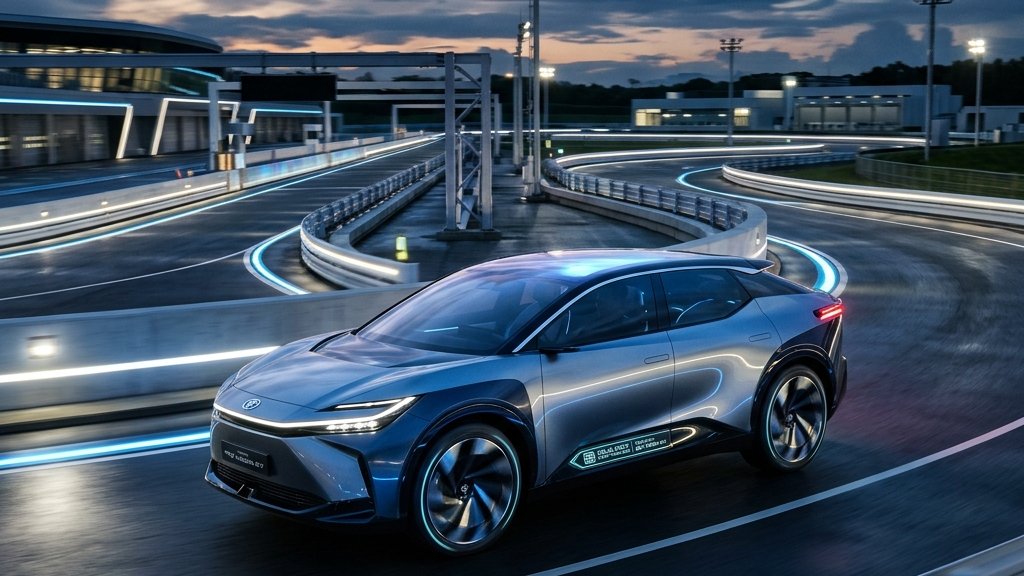
The 2027 Toyota solid-state battery EV: groundbreaking 700-mile range technology preview represents one of the automotive industry’s most ambitious attempts to move electric vehicles beyond today’s compromises. Toyota has publicly outlined plans to commercialize all-solid-state batteries in the 2027–2028 period, targeting approximately 1,000 kilometers—about 621 miles—of driving range in an initial application. When combined with improved aerodynamics and vehicle efficiency, the company has discussed a higher-order potential of roughly 1,200 kilometers, or approximately 745 miles.
Those numbers explain the widely reported “700-mile Toyota EV” description, but they require context. Toyota has not yet revealed a production model with a certified 700-mile EPA range, nor has it announced final pricing, battery capacity, charging curves, or launch markets. The technology is better understood as a development target for a forthcoming generation of battery-electric vehicles rather than a confirmed specification for one named 2027 model.
Why Toyota’s Solid-State Battery Program Matters
Toyota helped popularize electrification with the Prius, yet it adopted battery-electric vehicles more cautiously than several competitors. Its strategy has continued to support hybrids, plug-in hybrids, hydrogen fuel-cell vehicles, and conventional EVs according to regional energy conditions and customer needs. Solid-state batteries could strengthen the battery-electric part of that portfolio by addressing the concerns that discourage many drivers from switching: range, charging time, battery weight, durability, and cold-weather performance.
A conventional lithium-ion battery normally uses a liquid or gel electrolyte to transport lithium ions between the anode and cathode. An all-solid-state battery replaces that flammable liquid with a solid electrolyte. In theory, this construction enables greater energy density, improved thermal stability, more compact packaging, and faster charging. It may also support lithium-metal anodes, which can store more energy than the graphite-dominant anodes commonly used today.
The principle is straightforward; mass production is not. Solid materials must maintain excellent physical contact across countless charge cycles, while manufacturers must suppress dendrite growth, prevent cracks, manage pressure, and produce cells consistently at automotive scale. Toyota’s importance to the story comes from its extensive patent activity, long development history, and partnership with energy company Idemitsu Kosan to establish supply and production technology for solid electrolytes.
Projected Specifications and Technology Targets
| Category | Toyota Solid-State Target | Real-World Interpretation |
|---|---|---|
| Expected introduction | Around 2027–2028 | Likely limited-volume deployment before broader availability |
| Initial driving range | Approximately 1,000 km (621 miles) | Test cycle and vehicle configuration remain unconfirmed |
| Higher-efficiency potential | Approximately 1,200 km (745 miles) | Depends on aerodynamics, mass, tires, and powertrain efficiency |
| Rapid charging goal | About 10 minutes from 10% to 80% | Requires a suitably powerful charger and effective thermal management |
| Battery chemistry | All-solid-state lithium-based cells | Final cathode, anode, and electrolyte specifications are undisclosed |
| Likely launch positioning | Premium or performance-focused EV | Early production cost may limit mainstream availability |
The table separates Toyota’s development objectives from specifications that regulators or independent testers have verified. Range figures may be measured under Japanese, European, Chinese, or internal testing procedures, all of which can differ from the U.S. EPA methodology. A nominal 745-mile laboratory result therefore would not automatically translate into a 745-mile EPA label.
How a 700-Mile Toyota EV Could Work
Higher Energy Density Without an Oversized Pack
One route to extreme range is simply installing a much larger battery. That approach adds cost and mass, increases material consumption, and can reduce handling efficiency. Solid-state technology instead aims to store more energy in a similar or smaller physical volume. A lighter pack could improve acceleration, braking, cornering, tire wear, and consumption while giving designers greater freedom over cabin and cargo space.
Toyota has not disclosed the capacity of its intended production pack. Depending on vehicle efficiency, a genuine 700-mile EV could still require substantial usable energy. A sleek sedan consuming 20 kWh per 100 miles would need around 140 kWh for 700 miles, whereas a large SUV consuming 30 kWh per 100 miles would require approximately 210 kWh. That difference demonstrates why body shape is as important as cell chemistry.
Aerodynamics, Electronics, and Thermal Control
Toyota’s next-generation EV plans extend beyond batteries. The manufacturer is developing more aerodynamic bodies, compact electric axles, updated power electronics, and manufacturing methods intended to reduce component count and vehicle mass. Silicon-carbide semiconductors can also reduce electrical losses, especially under high loads. Heat pumps and intelligent battery conditioning would help preserve efficiency in winter and prepare the cells for rapid charging.
A low-roof grand tourer or performance sedan is therefore a more plausible first showcase than a bluff, heavy off-roader. Customers interested in a more adventurous Toyota EV should also examine the 2027 Toyota Compact Cruiser EV: Retro Off-Roader Styling, Battery Architecture, and Expected MSRP, although its rugged proportions would naturally impose a greater aerodynamic penalty.
Charging in 10 Minutes: The Transformative Claim
Range attracts headlines, but charging speed could be the more meaningful breakthrough. Toyota has targeted a roughly 10-minute charge from 10% to 80% for its solid-state technology. If achieved repeatedly without excessive degradation, that performance would make long-distance EV travel far more comparable to refueling a combustion vehicle.
The infrastructure challenge is considerable. Adding hundreds of miles in 10 minutes may demand charging power well beyond the output of many current public stations. The exact requirement depends on pack capacity and charging efficiency, but a large battery accepting 100 kWh in one-sixth of an hour would average approximately 600 kW. Peak power could be higher. Such performance requires high-voltage architecture, liquid-cooled cables, robust grid connections, accurate cell monitoring, and a charger capable of sustaining the requested output.
Drivers should also distinguish ideal laboratory charging from everyday use. Battery temperature, state of charge, charger sharing, ambient weather, and software limits all affect speed. The final 20% typically charges more slowly to protect the cells, which is why automakers advertise 10-to-80% times rather than a complete recharge.
What the First Solid-State Toyota Might Look Like
Toyota has not confirmed the body style or production name of its first solid-state EV. A low-volume Lexus or premium Toyota would make strategic sense because higher pricing could absorb the initial cost of new cells, specialized production equipment, and intensive quality control. A fast grand tourer could also demonstrate the battery’s claimed advantages in range, output, compact packaging, and repeated high-power operation.
A flagship luxury crossover is another possibility, particularly as wealthy customers value quietness, effortless performance, and long-distance comfort. For perspective on Toyota’s approach to high-end Japanese craftsmanship, the 2027 Toyota Century SUV: Ultra-Luxury Japanese Limousine Crossover Specs and Bespoke Price illustrates how exclusivity and chauffeur-oriented refinement can shape a halo product.
Mainstream deployment would likely follow only after manufacturing volume rises and costs fall. Toyota could then adapt solid-state packs to crossovers, sedans, and selected commercial vehicles. Nevertheless, demanding work vehicles may retain mixed powertrain strategies for years. The 2027 Toyota Hilux GR Sport: Rugged Diesel Hybrid Specs, Wide Track Suspension, and Global Price reflects why diesel-hybrid solutions can remain relevant where towing range, remote-area refueling, and payload are critical.
Real-World Range Will Depend on Use
Even an exceptionally efficient solid-state EV cannot escape physics. Highway speed, freezing temperatures, steep terrain, headwinds, roof racks, towing, and aggressive acceleration can materially reduce range. Conversely, moderate speeds and mild weather can allow an EV to exceed its official figure. Buyers should treat a headline 700-mile estimate as a standardized benchmark, not a guarantee for every journey.
- Cold weather: Cabin heating and reduced electrochemical activity increase energy consumption.
- High-speed travel: Aerodynamic drag rises rapidly as speed increases.
- Towing: Trailer mass and frontal area can cut range dramatically.
- Wheel selection: Large wheels and performance tires usually reduce efficiency.
- Battery reserve: The usable capacity may be smaller than gross capacity to support longevity.
For drivers who cannot yet rely on dependable public charging, a plug-in hybrid may remain the practical bridge. The 2027 Toyota Venza Revival: Rumored Premium Crossover Return, PHEV Powertrain, and Trims offers relevant context for how Toyota could combine useful electric commuting with gasoline-backed long-distance flexibility.
Manufacturing, Longevity, and Cost Questions
The greatest uncertainty is not whether a laboratory cell can deliver impressive performance, but whether millions of cells can be produced affordably and consistently. Solid electrolytes may be sensitive to moisture, interfaces must remain stable, and cell stacks can require carefully controlled pressure. Tiny manufacturing defects become major financial and safety risks when multiplied across a full-size automotive pack.
Toyota and Idemitsu’s work on sulfide solid electrolytes is intended to establish reliable material supply and scalable processes. Initial production, however, is expected to be limited. That points toward a measured rollout rather than an immediate replacement for conventional lithium-ion batteries. Toyota is simultaneously developing lower-cost and higher-performance liquid-electrolyte batteries, allowing it to assign different chemistries to different price points.
Longevity will be equally important. A battery that charges in 10 minutes but loses capacity rapidly would not satisfy private owners or fleet operators. Production validation must demonstrate cycle life, crashworthiness, puncture resistance, thermal behavior, recyclability, and consistent performance across climates. Warranty terms will ultimately reveal how confident Toyota is in the technology.
Outlook: Revolution, but Not Yet a Production Guarantee
The 2027 Toyota solid-state battery EV could reset expectations for electric transportation if it combines 600-plus-mile usable range, near-refueling-speed charging, lower weight, and durable performance. A credible path toward approximately 700 miles would reduce range anxiety and allow smaller, lighter packs in vehicles that do not need maximum distance.
Still, the responsible conclusion is cautiously optimistic. Toyota has announced technology targets and a commercialization window, not a finalized 700-mile production vehicle with certified specifications. The decisive milestones will be pilot-scale yields, supplier readiness, independent range testing, charging consistency, warranty coverage, and retail pricing. If those pieces align, Toyota’s solid-state program may prove more significant than any single EV model: it could redefine how far an electric car travels, how quickly it recharges, and how naturally it fits into long-distance life.