2027 Toyota Century SUV: Ultra-Luxury Japanese Limousine Crossover Specs and Bespoke Price
The 2027 Toyota Century SUV occupies an unusually rarefied corner of the luxury market. It is not simply a more expensive Lexus, nor is it intended to chase the performance-focused character of a Bentley Bentayga, Lamborghini Urus, or high-output Range Rover. Instead, Toyota has translated the discreet, chauffeur-oriented philosophy of the Century sedan into a tall, four-seat crossover built around privacy, ceremonial comfort, and Japanese craftsmanship.
Toyota introduced the Century SUV in Japan in 2023, but it has not confirmed complete specifications, pricing, or international availability for a 2027 model-year version. Consequently, the most credible 2027 outlook is based on the current Japanese-market vehicle, Toyota’s expanding customization program, and the possibility of limited technical and equipment updates. Prospective buyers should treat unannounced 2027 details as informed projections rather than finalized factory data.
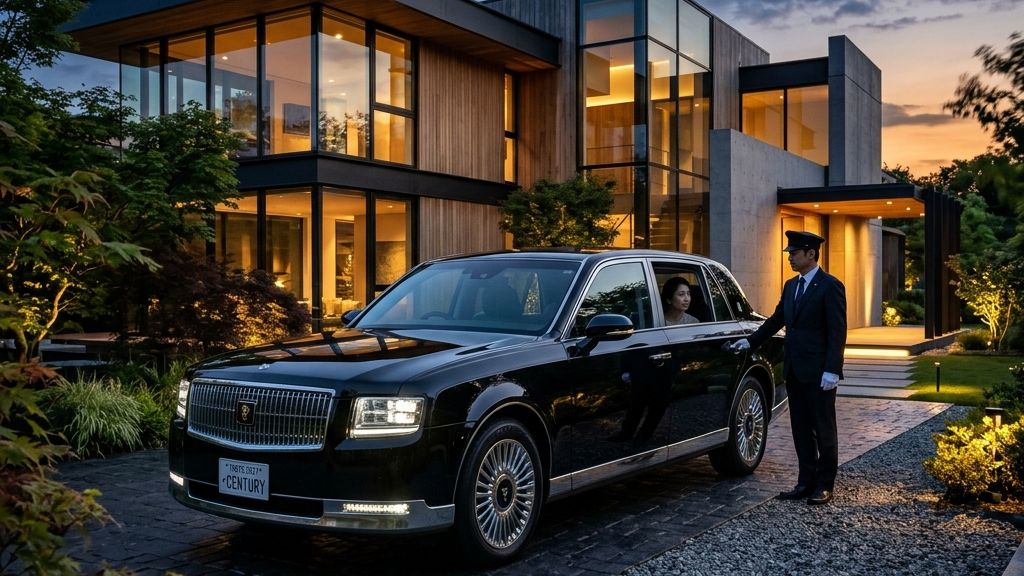
A Century Designed Around Its Rear Passengers
The Century name dates to 1967 and has long represented Toyota’s highest expression of formal transportation. Traditional Century sedans are associated with senior executives, public officials, and passengers who prefer restrained status over conspicuous branding. That philosophy remains central to the SUV, despite its larger body, elevated seating position, and plug-in hybrid drivetrain.
Its proportions communicate presence without resorting to excessive decoration. The upright grille, squared shoulders, carefully surfaced doors, and phoenix emblems separate it from ordinary Toyota products. Even the four-lamp headlight graphics are arranged to look architectural rather than aggressive. Paint application and panel finishing receive greater attention than on volume-production models, while selected vehicles can be tailored through Toyota’s bespoke program.
This makes the Century fundamentally different from family-oriented premium crossovers. A vehicle such as the 2027 Toyota Grand Highlander Nightshade: Blacked-Out Styling, Hybrid Max Specs, and Family Price emphasizes three-row practicality, cargo flexibility, and accessible hybrid performance. The Century uses its considerable footprint primarily to create a private first-class compartment for two rear occupants.
Expected 2027 Toyota Century SUV Specifications
Unless Toyota announces a major mechanical revision, the 2027 Century SUV should retain the established plug-in hybrid architecture. The existing model combines a 3.5-liter naturally aspirated V6 gasoline engine with front and rear electric motors, an electronically controlled continuously variable transmission, and electric all-wheel drive. Toyota identifies the system as a performance-oriented plug-in hybrid rather than a fuel-saving powertrain alone.
Current Japanese specifications quote a maximum system output of approximately 303 kW, equivalent to 412 metric horsepower. Toyota does not promote a dramatic acceleration figure because outright speed is secondary to progressive power delivery. Electric assistance provides immediate response while helping the V6 operate with less noise and vibration. The ability to complete shorter urban journeys using electricity is particularly appropriate for a chauffeur-driven vehicle that may spend considerable time in city traffic.
| Specification | Current Century SUV Reference | 2027 Outlook |
|---|---|---|
| Powertrain | 3.5-liter V6 plug-in hybrid | Likely retained with calibration updates |
| System output | 303 kW, approximately 412 PS | Expected to remain near 400 horsepower |
| Drivetrain | E-Four electric all-wheel drive | Likely standard |
| Electric range | Up to 69 km WLTC in Japan | Similar or modestly improved |
| Length | 5,205 mm | No major change expected |
| Width and height | 1,990 mm and 1,805 mm | Likely unchanged |
| Wheelbase | 2,950 mm | Likely unchanged |
| Seating | Four individual seats | Four-seat layout expected |
| Reference price | From ¥25,000,000 in Japan | Potentially ¥25 million to ¥30 million before bespoke work |
The battery is positioned beneath the floor to preserve cabin space and lower the center of gravity. Japanese WLTC testing gives the current model an electric driving range of up to 69 kilometers, although temperature, traffic, climate-control use, and driving style affect real-world results. A 2027 update could introduce revised battery management or slightly greater usable capacity, but there is no confirmed evidence of a wholesale battery replacement.
Ride, Steering, and Chauffeur-Friendly Engineering
At roughly 5.2 meters long and nearly two meters wide, the Century is substantial even by full-size SUV standards. Rear-wheel steering helps reduce its turning circle and improves low-speed maneuverability in hotel entrances, office garages, and dense urban streets. At higher speeds, it contributes to stability by coordinating rear-wheel movement with the front steering.
Drive modes include settings intended to protect rear-seat comfort. Toyota’s Rear Comfort mode moderates acceleration and braking responses while adjusting suspension behavior to reduce body movement. Structural adhesives, reinforced body joints, noise insulation, and vibration-control measures also matter more here than headline cornering capability. The goal is to prevent the passenger from noticing the machinery working.
This engineering priority contrasts sharply with Toyota’s utility vehicles. The 2027 Toyota Hilux GR Sport: Rugged Diesel Hybrid Specs, Wide Track Suspension, and Global Price is designed around durability, wheel travel, payload, and rough-road control. The Century may have all-wheel drive, but it is configured for assured traction and dignified progress rather than remote-trail exploration.
Interior: A Mobile Private Suite
The defining feature is its rear cabin. Wide-opening rear doors and powered retractable steps make entry easier, while grab handles are positioned to support dignified ingress and egress. Depending on configuration, the doors can open to approximately 75 degrees. Toyota has also developed a sliding rear-door specification, demonstrating how extensively the body can be adapted for particular clients.
Two individual rear chairs provide extensive recline, heating, ventilation, massage functions, and deployable leg supports. The left rear seat can approach a near-flat relaxation position when the front passenger seat is moved forward. A rigid partition and luggage-area separation help isolate occupants from road noise and prevent cargo from intruding during sudden braking.
- Dedicated rear entertainment displays and passenger controls
- Premium audio engineered to create a concert-hall-like sound field
- Refrigerated storage for drinks and refreshments
- Power-operated sunshades for privacy and heat control
- High-grade leather, wood, metal, and textile trim selections
- Fold-out tables suitable for work or formal travel
The dashboard is deliberately restrained. Screens provide modern navigation, connectivity, and vehicle information, but the cabin does not rely on oversized displays as a visual gimmick. Physical controls remain important, especially where a chauffeur must operate functions without distraction. For 2027, software, infotainment processing, smartphone integration, and driver-assistance calibration are more likely to change than the fundamental interior architecture.
Bespoke Craftsmanship and Personalization
Toyota offers the Century through a tightly controlled sales process rather than treating it like a conventional showroom SUV. Selected buyers can commission individualized paint, upholstery, embroidery, trim, and functional modifications. The Century Meisters responsible for production and inspection work to unusually strict standards, and completed vehicles receive detailed quality checks.
Bespoke possibilities may include two-tone exterior treatments, custom interior color combinations, engraved or woven motifs, privacy-focused cabin fittings, and alternative rear-door arrangements. The phoenix badge itself reinforces the artisanal identity: it is more symbolic and exclusive than Toyota’s familiar three-oval emblem.
This customization strategy helps explain why a single universal transaction price is unrealistic. Paint complexity, hand-finished materials, structural changes, security equipment, and market-specific import requirements can add substantially to the base cost. Toyota has also displayed a performance-oriented GRMN interpretation with sportier bodywork and chassis treatment, but availability, final production specifications, and 2027 pricing remain uncertain.
2027 Toyota Century SUV Price and Availability
The current Century SUV launched in Japan at approximately ¥25 million before substantial customization. A lightly updated 2027 vehicle could plausibly begin between ¥25 million and ¥30 million, depending on inflation, equipment revisions, and Toyota’s production strategy. Heavily personalized commissions could exceed that range by a considerable margin.
Unofficial imports create a different cost structure. Shipping, taxes, registration, homologation, warranty limitations, and right-hand-drive configuration may make the delivered price dramatically higher. Buyers should not interpret currency conversion of the Japanese list price as a realistic on-road figure in North America, Europe, the Middle East, or other regions.
Nor should the Century be confused with a potential mainstream premium model. The 2027 Toyota Venza Revival: Rumored Premium Crossover Return, PHEV Powertrain, and Trims would target ordinary retail customers with broader production, conventional trim levels, and a far lower price. The Century’s scarcity, commissioning process, and chauffeur-first packaging place it closer to coachbuilt luxury transportation.
Safety and Ownership Considerations
The Century includes Toyota Safety Sense technologies such as pre-collision assistance, adaptive cruise control, lane-support functions, road-sign recognition, and parking aids, although exact features vary by production date and market. Blind-spot monitoring and camera coverage are particularly valuable given the vehicle’s dimensions. For 2027, enhanced sensor capability and smoother intervention would be sensible updates, but Toyota has not published a definitive model-year package.
Ownership also demands practical planning. Specialized plug-in hybrid components, unique body panels, custom cabin materials, and limited production may complicate servicing outside Japan. An independent importer should document parts support, diagnostic access, charging compatibility, insurance, and warranty terms before purchase.
Final Assessment
The 2027 Toyota Century SUV is best understood as a Japanese limousine with crossover proportions, not as an ordinary luxury SUV wearing a prestigious badge. Its expected 3.5-liter plug-in hybrid system, four-seat cabin, rear-wheel steering, and carefully managed ride serve one purpose: transporting important passengers with minimal disturbance.
Its appeal lies in restraint. Where rivals advertise power, technology, and visual drama, the Century emphasizes silence, privacy, precision, and cultural identity. If Toyota carries the existing formula into 2027, perhaps with software improvements and expanded bespoke choices, it will remain one of the world’s most distinctive ultra-luxury vehicles. The probable ¥25-million-plus starting point is only the beginning; for clients commissioning unique colors, materials, doors, or security features, the meaningful price is the one attached to the finished, individually specified automobile.