2027 Honda Passport TrailSport: Rugged Midsize SUV Redesign, V6 Powertrain, and Off-Road Tech
The Honda Passport TrailSport targets drivers who want genuine trail capability without sacrificing everyday comfort. Its appeal is straightforward: a naturally aspirated V6, torque-vectoring all-wheel drive, useful cargo space, and off-road hardware packaged in a manageable two-row SUV. For families whose weekends involve forest roads, mountain-bike trailheads, or remote campsites, that combination makes considerable sense.
This guide to the 2027 Honda Passport TrailSport: rugged midsize SUV redesign, V6 powertrain, and off-road tech separates established engineering from model-year expectations. The Passport’s major redesign arrived for 2026; it should not automatically be described as an all-new 2027 development. Until Honda confirms the complete 2027 specifications, pricing, and equipment, the redesigned 2026 model provides the most useful technical reference—not a guarantee of identical future specifications.
Background: A More Purposeful Passport
The modern Passport occupies an important space between Honda’s compact CR-V and three-row Pilot. It offers midsize-SUV passenger room without requiring buyers to carry an unused third row. Earlier versions already provided strong V6 performance and practical packaging, but the 2026 redesign gave the vehicle a more distinct identity and substantially more credible off-road equipment.
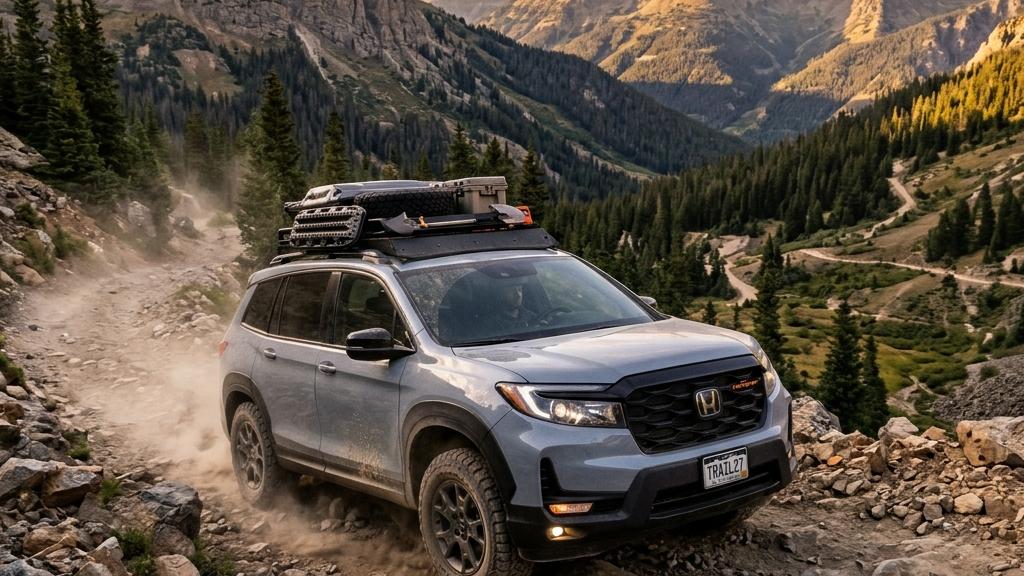
That change matters because “adventure” trims often amount to dark wheels and decorative cladding. The redesigned Passport TrailSport goes further, combining all-terrain tires, revised suspension tuning, underbody protection, and recovery provisions. The result remains a unibody crossover, but one engineered for more demanding use than a conventional family SUV wearing outdoorsy styling.
What Should Buyers Expect for 2027?
Following such a substantial redesign, a carryover model with equipment, color, or packaging adjustments would be a reasonable expectation. However, expectations are not announcements. Claims about a 2027 facelift, additional horsepower, hybrid propulsion, or dramatically increased towing capacity require confirmation from Honda.
Likewise, the TrailSport and more comprehensively equipped TrailSport Elite should not be treated as interchangeable. Camera systems and convenience features can vary by grade. Buyers researching a specific 2027 vehicle should check its official specification sheet and window sticker rather than relying on photographs of a differently equipped model.
Rugged Redesign: More Than Square-Shouldered Styling
The redesigned Passport adopts a boxier silhouette, upright front end, broad stance, and more assertive fenders. These changes communicate toughness, but the practical improvements deserve greater attention. Its longer wheelbase contributes to passenger accommodation, while the body’s packaging supports a spacious cargo area behind the second row.
TrailSport-specific details include 18-inch wheels and all-terrain tires with relatively generous sidewalls. Compared with large wheels wearing low-profile road tires, this arrangement offers more cushioning over rocks and potholes, along with better protection against certain wheel impacts. Tire construction and pressure still matter, however; an all-terrain label does not make a tire puncture-proof.
Steel protection for vulnerable underbody components is another meaningful distinction. Skid plates can help the vehicle slide over an obstacle that might otherwise damage exposed equipment. They do not eliminate the need for careful wheel placement or a spotter when visibility becomes limited.
Technical Reference: What the Redesigned Platform Establishes
The figures below describe the established 2026 Passport platform and TrailSport equipment where indicated. They are reference points for evaluating a prospective 2027 model, not independently confirmed 2027 specifications.
| Category | 2026 Reference Specification | Practical Significance |
|---|---|---|
| Engine | 3.5-liter naturally aspirated V6 | Linear response without turbocharging |
| Output | 285 horsepower; 262 lb-ft of torque | Useful passing and climbing performance |
| Transmission | 10-speed automatic | Broad gearing for acceleration and cruising |
| All-wheel drive | Second-generation i-VTM4 | Active rear-axle torque distribution |
| Ground clearance | 8.3 inches | Useful clearance, with limits over large obstacles |
| Maximum towing | Up to 5,000 pounds when properly equipped | Suitable for appropriately sized recreational trailers |
| Seating and construction | Five seats; unibody architecture | Family utility with road-oriented refinement |
V6 Powertrain: Predictable Response Over Electrified Complexity
The established 3.5-liter V6 produces 285 horsepower and 262 lb-ft of torque, paired with a 10-speed automatic. Its naturally aspirated character means power builds progressively with engine speed rather than relying on turbocharger boost. That can make throttle response easier to judge when negotiating uneven terrain or accelerating onto a highway.
Nevertheless, this is not a low-revving diesel or an electric drivetrain delivering immediate maximum torque. A loaded Passport climbing a steep grade may need downshifts and higher engine speeds. The transmission’s wide ratio spread helps accommodate both those demands and relaxed highway cruising, although real-world smoothness deserves evaluation during a test drive.
Honda’s broader technology conversation includes electrification, but that does not establish an electrified Passport. Readers exploring the brand’s performance possibilities can consult 2027 Honda Civic Type R Hybrid: Electrified Track Monster Rumors, Downforce Aero, and MSRP, while recognizing that rumors about another model provide no evidence of a Passport powertrain change.
Towing: Look Beyond the Headline Number
The redesigned Passport’s maximum 5,000-pound towing rating can accommodate some small travel trailers, boats, and utility trailers. Actual suitability depends on equipment, trailer brakes, loaded trailer weight, tongue weight, and the vehicle’s remaining payload capacity.
Passengers, camping equipment, accessories, and trailer tongue weight all consume payload. A family can therefore reach a vehicle limit before reaching the advertised maximum trailer weight. Check the specific vehicle’s door-jamb labels and owner’s manual, and calculate with loaded—not empty—trailer figures.
Off-Road Tech: How i-VTM4 Helps
Honda’s second-generation i-VTM4 system is central to the Passport’s capability. It can direct up to 70 percent of engine torque to the rear axle and allocate as much as 100 percent of that rear-axle torque to either rear wheel when conditions require. That last distinction matters: it does not mean all engine torque can reach one rear wheel.
Active torque distribution helps when available grip differs across the vehicle. On a rutted climb, for example, one rear tire may encounter a slippery surface while the other retains traction. The system can redistribute drive to exploit the better contact patch rather than treating both rear wheels identically.
Drive Modes, Descent Assistance, and Cameras
The redesigned platform offers selectable modes including Normal, Econ, Sport, Snow, Tow, Trail, and Sand. These calibrations adjust how the powertrain and traction systems respond. Selecting the appropriate mode can improve control, but no software setting creates traction where the tires have none.
Hill-descent control helps regulate speed on steep descents, reducing the need for constant pedal adjustments. Available TrailWatch camera technology provides additional views around the vehicle, useful when a crest hides the immediate path. Confirm trim availability: camera assistance should not be assumed standard on every TrailSport.
Real-World Capability and Everyday Compromises
The Passport TrailSport is best understood as a capable exploration vehicle rather than a dedicated rock crawler. Its unibody structure and independent suspension favor everyday ride quality, but it lacks a traditional two-speed transfer case with low-range gearing. Ground clearance, body dimensions, and articulation still impose limits on technical trails.
For gravel roads, snowy access routes, and moderately uneven tracks, its hardware is well matched to typical recreational use. All-terrain tires may introduce additional road noise, while their grip and braking behavior vary with temperature and surface. On a test drive, assess highway sound levels, broken-pavement comfort, and low-speed transmission response.
Inside, the two-row layout prioritizes passenger comfort and luggage flexibility. Look beyond maximum cargo-volume claims: check whether your cooler, dog crate, stroller, or recovery equipment fits with the rear seats upright. Secure heavy objects properly, especially when driving over rough terrain.
Buying Perspective: Price, Alternatives, and Verification
A confirmed 2027 MSRP, destination charge, and EPA fuel-economy rating should come from Honda’s model-year documentation. Avoid treating dealer placeholders or projected figures as final. Compare complete purchase prices, including accessories, and assess whether the higher trim’s cameras and comfort features justify their cost.
Cross-shop the Subaru Outback Wilderness for wagon-like usability, the Toyota 4Runner for more traditional off-road hardware, and the Jeep Grand Cherokee for its range of configurations. Their drivetrain layouts, available equipment, road manners, and operating costs differ substantially.
For buyers considering alternative propulsion, 2027 Honda CR-V FCEV: Hydrogen Fuel-Cell Electric Crossover Range, Plug-In Specs, and Price explores a different technology pathway, where local hydrogen availability is critical. Likewise, 2027 Toyota Solid-State Battery EV: Groundbreaking 700-Mile Range Technology Preview should be read as a technology outlook, not proof that projected range or commercialization dates are guaranteed.
Verdict: Adventure Capability With Sensible Boundaries
The strongest case for the 2027 Honda Passport TrailSport rests on the redesigned platform’s established fundamentals: V6 power, effective torque-vectoring AWD, meaningful trail hardware, and a practical five-seat cabin. If those foundations carry forward, it should remain compelling for buyers who spend weekdays commuting and weekends exploring. Verify the final 2027 specifications, choose equipment around actual needs, and judge capability by terrain—not styling alone.