2027 Honda Civic Type R Hybrid: Electrified Track Monster Rumors, Downforce Aero, and MSRP
A hybrid Civic Type R is an irresistible proposition: turbocharged urgency, instant electric assistance, and chassis engineering that makes Honda’s hottest hatch unusually capable on a circuit. But an appealing engineering concept is not a confirmed production car. A responsible assessment of the 2027 Honda Civic Type R Hybrid: electrified track monster rumors, downforce aero, and MSRP story must distinguish established Type R specifications from predictions about its successor.
The key qualification is straightforward: the established FL5-generation Type R provides a factual benchmark, but it does not establish specifications for a 2027 hybrid. Without model-specific Honda documentation, claims about electric motors, battery capacity, horsepower, release dates, or pricing remain unverified. Here is what the existing car tells us—and what electrification would actually need to accomplish.
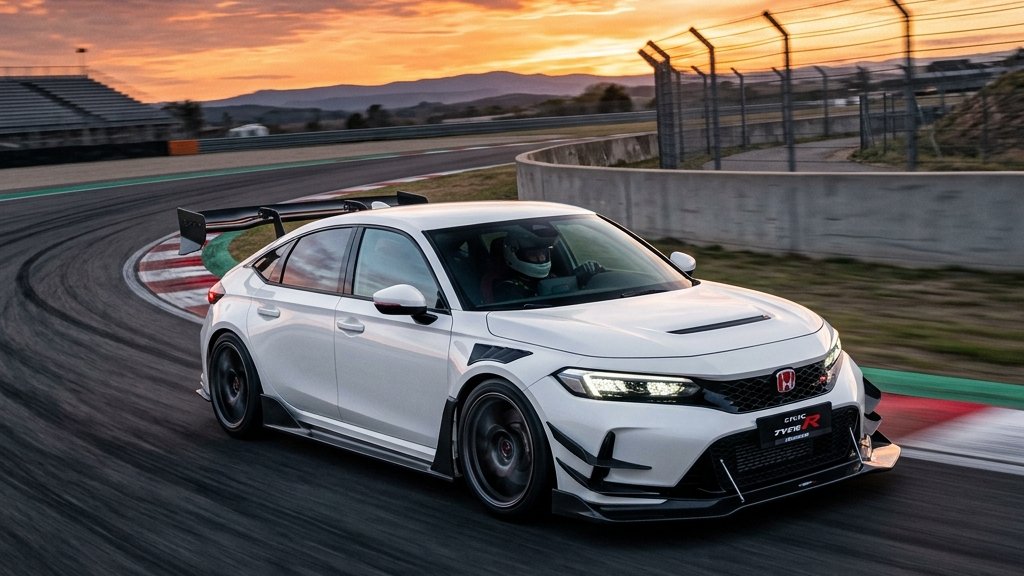
Background: Why a Hybrid Type R Sounds Plausible
The Type R name has never simply meant the largest engine or the quickest acceleration number. Its identity rests on responsive controls, disciplined weight management, strong brakes, and repeatable performance. From earlier naturally aspirated models to today’s turbocharged hatchback, the objective has been to make a practical road car feel precise under demanding driving.
Electrification could support that mission. An electric motor can supplement torque before a turbocharger reaches its strongest operating range, recover energy during braking, and potentially broaden performance without requiring a larger combustion engine. Tightening emissions requirements also give manufacturers reasons to investigate alternatives to purely gasoline-powered performance cars.
However, the mainstream Civic Hybrid does not prove that a Type R hybrid is imminent. Honda’s efficiency-oriented two-motor hybrid technology has different priorities from a track-focused drivetrain. Shared branding does not establish shared transmissions, cooling requirements, battery specifications, or production timing.
The Existing FL5 Is the Essential Reference Point
In U.S. specification, the FL5 Civic Type R produces 315 horsepower and 310 lb-ft of torque from a turbocharged 2.0-liter four-cylinder engine. It uses a six-speed manual transmission, front-wheel drive, and a helical limited-slip differential. Published curb weight is approximately 3,188 pounds, while standard tires measure 265/30 ZR19.
Those details explain why hybridization would be a major engineering decision rather than a simple power upgrade. The existing combination already balances traction, steering feedback, packaging, and driver involvement. Adding electrification must improve the whole package, not merely its headline output.
Specifications: Confirmed Benchmark Versus Hybrid Speculation
| Category | Established U.S.-Spec FL5 Benchmark | Proposed 2027 Hybrid |
|---|---|---|
| Powertrain | 2.0-liter turbocharged gasoline four-cylinder | Hybrid configuration unverified |
| Output | 315 hp; 310 lb-ft | No verified combined output |
| Transmission and drive | Six-speed manual; front-wheel drive | Manual, automatic, and AWD claims unverified |
| Energy storage | No traction battery | Capacity, chemistry, and charging capability unknown |
| Aerodynamics | Functional cooling and aerodynamic bodywork; fixed rear wing | No verified aero package or downforce figures |
| U.S. pricing reference | 2023 launch MSRP: $42,895, excluding $1,095 destination | No verified hybrid MSRP |
Electrified Track Monster: What Would Make It Work?
Electric Assistance Must Be Repeatable
A motor-assisted Type R could feel stronger when accelerating out of slower corners. Yet peak combined horsepower is only part of the story. Engine and motor output cannot automatically be added together: their maximum contributions may occur at different speeds, and battery or inverter limits can restrict simultaneous delivery.
Track credibility depends on sustained assistance. A system that delivers impressive acceleration for one straight but reduces output after several laps would undermine the Type R reputation. Battery temperature, state of charge, inverter cooling, and energy-management software would therefore matter as much as the advertised power figure.
Weight and Packaging Could Decide the Outcome
A compact, high-power battery would be more consistent with a lightweight performance brief than a large pack designed for substantial electric-only range. Nevertheless, motors, power electronics, cooling circuits, and protective structures all add mass. Their placement affects center of gravity, axle loading, luggage space, and crash engineering.
An electrically driven rear axle could theoretically provide all-wheel drive, but it would also introduce considerable cost and complexity. It should not be treated as an inevitable upgrade. A carefully developed front-drive hybrid could remain more faithful to the Type R formula than a heavier AWD alternative.
Honda’s broader electrification landscape also requires careful distinctions. The 2027 Honda CR-V FCEV: Hydrogen Fuel-Cell Electric Crossover Range, Plug-In Specs, and Price discussion concerns a different propulsion pathway; fuel-cell technology does not establish the architecture of a gasoline-electric performance hatchback.
Could a Manual Transmission Survive?
Hybridization does not inherently prohibit a manual gearbox. Honda previously paired a manual transmission with its Integrated Motor Assist system in the CR-Z. That precedent establishes technical possibility, not confirmation that a future Type R would follow the same approach.
A modern high-output installation would still need coordinated clutch operation, torque delivery, regeneration, and emissions control. An automatic might simplify some functions, but losing the manual would change one of the Type R’s defining attractions.
Downforce Aero: Function Matters More Than Wing Size
The FL5 already demonstrates an integrated approach to aerodynamics through its front-end treatment, underbody airflow management, rear wing, and cooling provisions. A successor would need to develop those elements together. A dramatic wing alone cannot establish either total downforce or good aerodynamic balance.
Downforce is speed-dependent, and the front-to-rear distribution matters enormously. Increasing rear aerodynamic load without a corresponding front-end strategy can shift high-speed behavior toward understeer. Greater drag can also reduce straight-line speed and increase energy consumption.
Cooling Air Is Part of the Aero Problem
Hybrid hardware would potentially add heat sources to an already demanding turbocharged installation. Engineers must move air through heat exchangers while controlling pressure, drag, and lift. Larger openings are not automatically better: duct sealing and effective hot-air extraction can matter just as much.
Treat numerical downforce claims cautiously unless they identify vehicle speed, configuration, and testing methodology. Rendered splitters, oversized diffusers, and speculative active wings are illustrations—not proof of a production aerodynamic package.
Real-World Performance Beyond the Headline Numbers
For an owner attending track days, brake consistency and thermal durability may matter more than a marginal acceleration improvement. Regenerative braking can recover energy, but its contribution varies with battery charge, temperature, speed, and system limits. Friction brakes must remain capable when regeneration is restricted.
Additional weight also increases demands on tires and brakes. Buyers should look for repeated-lap testing, predictable pedal feel, and transparent maintenance guidance. A single qualifying-style lap does not reveal how a car behaves through a full afternoon of sessions.
Electric sports-car speculation poses related questions, as explored in 2027 Honda S2000 EV: Electric Roadster Revival, RWD Architecture, and Target Release. That revival narrative is separate from evidence about a future Type R, even where the engineering challenges overlap.
MSRP: What Should Buyers Expect?
No verified MSRP should be assigned to an unconfirmed 2027 Type R hybrid. The historical $42,895 U.S. launch price for the 2023 FL5 provides context, not a current quotation or a forecast. Destination charges, taxes, registration, accessories, and dealer adjustments must be considered separately.
Hybrid components could create upward pricing pressure, but manufacturing scale, equipment choices, exchange rates, and market positioning would influence the result. A precise predicted sticker price would imply knowledge that the available evidence does not support.
Apply the same caution to future-technology coverage such as 2027 Toyota Solid-State Battery EV: Groundbreaking 700-Mile Range Technology Preview and 2027 Toyota Compact Cruiser EV: Retro Off-Roader Styling, Battery Architecture, and Expected MSRP. Targets, concepts, and expected prices are not equivalent to certified specifications or retail availability.
Verdict: A Compelling Possibility, Not a Proven Product
A hybrid Type R could be exceptional if electrification improves response without sacrificing steering clarity, manageable weight, or sustained circuit performance. The decisive evidence would be official specifications, homologated market availability, transparent pricing, and independent repeated-lap testing.
Until those arrive, judge the rumors against the established FL5 rather than treating them as a replacement for it. The most convincing electrified Type R would not simply post a larger horsepower number. It would preserve the precision and durability that make the existing car special.