2027 Honda Pilot Black Edition: Three-Row Utility, Trail Driving Modes, and Panoramic Roof
A family SUV earns its reputation through ordinary work: accommodating child seats, carrying luggage without blocking visibility, and making a wet highway journey feel uneventful. The Honda Pilot Black Edition adds a more distinctive appearance to that practical brief, pairing three-row versatility with dark exterior detailing and upscale cabin equipment. Its appeal is not that it transforms the Pilot into a sports SUV, but that it makes a useful vehicle feel more special.
This guide to the 2027 Honda Pilot Black Edition: three-row utility, trail driving modes, and panoramic roof separates established Pilot engineering from model-year details that still require confirmation. The specifications below describe the recent-generation Pilot Black Edition as a reference, not a verified 2027 specification sheet. Final pricing, equipment, fuel-economy ratings, and availability should be checked against Honda’s market-specific 2027 documentation.
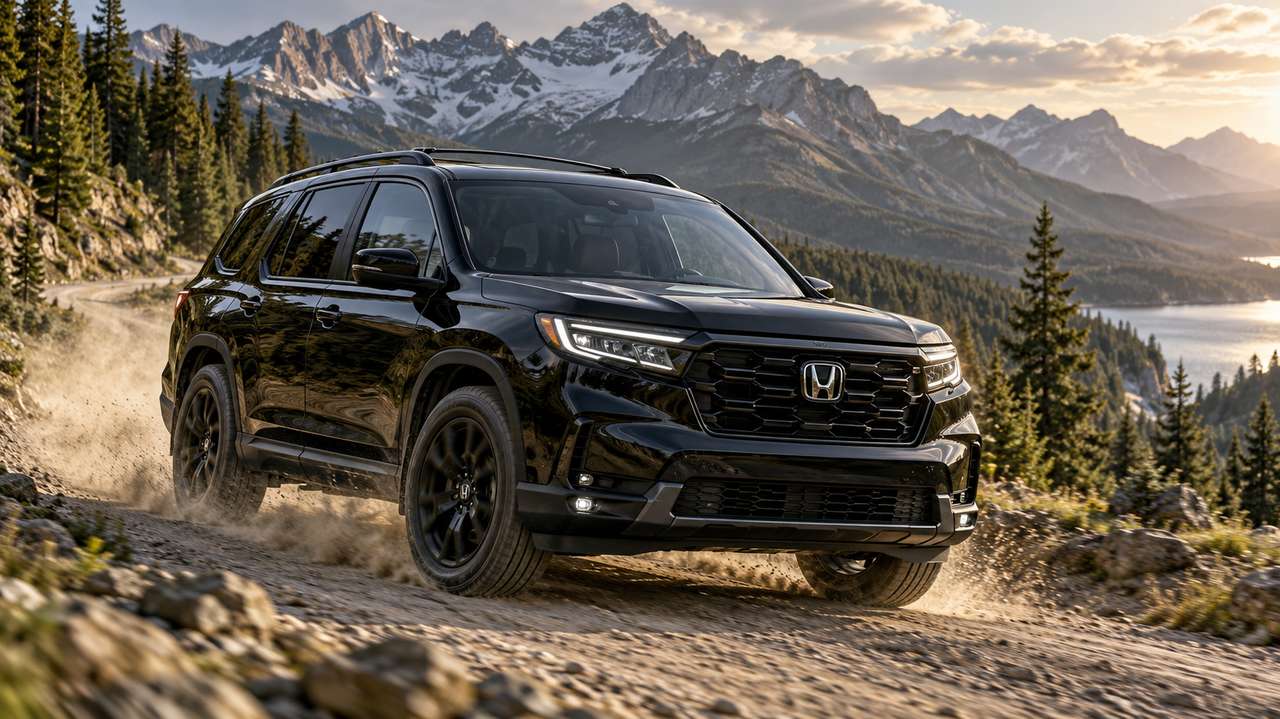
Background: Where the Black Edition Fits
The current-generation Pilot uses a transverse-engine, unibody architecture designed primarily for passenger comfort and packaging efficiency. That distinguishes it from truck-based SUVs whose separate frames and low-range transfer cases prioritize heavier towing or more demanding off-road work. For most families, the Pilot’s approach delivers the more relevant benefits: manageable step-in height, accommodating passenger space, and predictable road manners.
In recent U.S. lineups, the Black Edition has occupied the premium end of the Pilot range. Its identity centers on black-finished exterior components, distinctive wheels, and cabin detailing, including red accents. Buyers should understand the distinction between this appearance-and-equipment flagship and the TrailSport: the latter is the more purposefully configured choice for rough surfaces.
Market context matters, too. Trim names and standard features can differ between countries, so a Canadian listing or an earlier U.S. review should not be treated as definitive evidence of 2027 U.S. equipment.
Specifications: A Useful Reference, Not a 2027 Promise
The recent Pilot Black Edition provides a credible starting point for evaluating the upcoming model. However, carrying a specification forward without confirmation can obscure meaningful changes in seating, infotainment, or standard equipment.
| Category | Recent Black Edition Reference | What to Verify for 2027 |
|---|---|---|
| Engine | 3.5-liter naturally aspirated V6; 285 horsepower and 262 lb-ft of torque | Final output and powertrain availability |
| Transmission and drive | 10-speed automatic; i-VTM4 all-wheel drive | Standard drivetrain and calibration changes |
| Seating | Up to eight, with a removable second-row center seat | Seating configuration and storage arrangement |
| Drive modes | Normal, ECON, Sport, Snow, Tow, Trail, and Sand | Mode availability and operating guidance |
| Maximum towing | Up to 5,000 pounds when properly equipped | Equipment requirements and load restrictions |
| Roof and wheels | Panoramic roof and black-finished 20-inch wheels | Standard equipment, tire specification, and options |
Three-Row Utility: Look Beyond the Seat Count
A Second Row That Adapts to Family Life
One of the recent Pilot’s strongest packaging ideas is its removable second-row center seat on suitably equipped trims. Installed, it supports an eight-passenger arrangement; removed, it creates a passage between the outboard seats. The ability to store that seat beneath the rear cargo floor is particularly useful because owners need not leave it in the garage whenever plans change.
There are practical qualifications. Child-seat installation can affect access to the third row, and the center seat’s weight and removal procedure deserve a hands-on demonstration. Bring your actual child seats to a dealership rather than assuming that three seating positions guarantee an easy three-across installation.
Third-Row Comfort and Cargo Compromises
The Pilot’s third row is useful for more than emergency occupancy, but comfort depends on passenger height and second-row adjustment. Adults should check knee clearance, foot space, cushion support, and access before committing to regular long-distance use.
With every seat occupied, luggage space inevitably becomes the constraint. A stroller, cooler, and several upright suitcases can expose the difference between a generous-looking specification and a workable holiday load. Test your own bulky items and distinguish cargo volume behind the third row from measurements taken with seats folded. Families who seldom use a third row may find the smaller footprint discussed in 2027 Honda HR-V: Refresh Interior Screens, Hybrid Powertrain Expectations, and MSRP more relevant to their daily needs.
V6 Performance and All-Wheel-Drive Behavior
The established 3.5-liter V6 delivers power without turbocharging. Its character favors smooth, progressive acceleration, although confident passing with passengers and luggage can require a downshift and higher engine speeds. The 10-speed automatic offers closely spaced ratios for acceleration and taller gearing for cruising; the quality of its responses matters more than the gear count alone.
Honda’s i-VTM4 system does more than engage the rear axle when the front tires slip. Its rear-drive hardware can vary torque distribution between the rear wheels, helping the vehicle respond to changing traction and cornering demands. That supports stability, but it does not repeal the limits imposed by tires, speed, and road conditions.
Drivers seeking stronger acceleration and a more overtly performance-oriented chassis should also consider the positioning explored in 2027 Acura MDX Type S: Turbo V6 Super Handling All-Wheel Drive Refresh and Luxury Tech. The Pilot’s priority remains useful family transport rather than performance-brand theater.
Trail Driving Modes: Helpful Calibration, Not Extra Clearance
Drive modes alter how existing systems respond; they do not install different tires or raise the underbody. On recent AWD Pilots, the available settings address distinct situations:
- Normal and ECON: Everyday operation, with ECON emphasizing efficiency-oriented responses.
- Sport: Sharper powertrain response, rather than additional engine output.
- Snow: Calibration intended to make traction easier to manage on slippery winter surfaces.
- Tow: Powertrain behavior suited to towing within the vehicle’s limits.
- Trail and Sand: Different traction-management strategies for uneven or loose surfaces.
For a graded forest road, damp campsite entrance, or uneven gravel approach, Trail mode can be useful. Nevertheless, the driver must assess ruts, exposed rocks, breakover clearance, and safe turnaround opportunities. Sand driving adds the risk of sinking into soft material; selecting the correct mode does not guarantee recovery.
Black Edition Versus TrailSport
The distinction is hardware. Recent TrailSport models add trail-oriented features such as all-terrain tires, increased clearance, and underbody protection. The Black Edition’s road-focused 20-inch wheel package emphasizes appearance and pavement use. Buyers regularly encountering deeply rutted access roads should compare those physical differences before choosing by trim prestige.
Responsible trail use also protects the landscape. Stay on designated routes and avoid driving around puddles onto vegetation: repeated detours widen tracks, compact soil, and damage roots.
Panoramic Roof: Atmosphere With Trade-Offs
A panoramic roof can make a three-row cabin feel less enclosed, especially for passengers seated behind the driver. Its value is experiential rather than numerical: more overhead light and a wider view can improve the sense of space without changing legroom.
Evaluate it in realistic conditions. Check headroom beneath the roof assembly, operate the shade, and listen for wind noise during a highway drive. In strong sunlight, cabin comfort depends on glazing, shade coverage, and air-conditioning performance. Roof glass also requires sensible maintenance: keep seals and drainage areas clean according to Honda’s instructions.
Ownership Costs, Towing, and the Buying Decision
A 5,000-pound maximum tow rating is not permission to attach any trailer carrying that number. Passengers, luggage, accessories, and trailer tongue weight all affect allowable loading. Confirm payload on the actual vehicle’s certification label, then consult the owner’s manual for hitch, braking, and towing requirements.
Likewise, budget beyond purchase price. Large replacement tires, insurance, fuel, and scheduled maintenance shape ownership costs. Do not assume hybrid-level efficiency from an ECON setting. Buyers weighing gasoline convenience against home charging and electric propulsion may find 2027 Acura ZDX EV: Performance Electric SUV Changes, Air Suspension, and Real-World Range a useful alternative perspective, though its seating and mission differ.
Verdict: Choose the Utility First
The Pilot Black Edition’s strongest proposition is the combination of flexible seating, established V6 performance, capable AWD management, and a more polished cabin atmosphere. Trail settings broaden its usefulness on modest unpaved routes, while the panoramic roof adds everyday enjoyment.
For 2027, the prudent approach is to verify the final specification, test the seating with your passengers, and judge the Black Edition against the TrailSport on actual terrain needs. Buy it because its packaging works—not because black trim or a drive-mode label suggests capabilities the underlying hardware cannot deliver.