The 2019 Toyota Alphard was a large, luxury-oriented seven- or eight-seat MPV (multi-purpose vehicle) built mainly for Japan and selected Asian markets. It sat at the top of Toyota’s van range and was sold alongside a sportier twin, the Vellfire. The 2019 car belonged to the third generation, coded AH30, which Toyota produced from 2015 to 2023 and never offered in the United States.

What the 2019 Alphard Was
The Alphard is Toyota’s flagship people-mover: a tall, boxy van with sliding side doors, a large cabin and an emphasis on rear-seat comfort. In Southeast Asia it is often treated as a luxury vehicle, and its pricing and equipment place it closer to a premium car than to a work van. The 2019 model used the third-generation platform, which replaced the previous torsion-beam rear suspension with a double-wishbone setup to improve ride comfort, and Toyota described the car’s development theme as a “luxury vehicle with a large space.”
Model History
Toyota launched the Alphard in May 2002 as a large MPV positioned above its existing vans. A second generation followed in 2008, and the third generation, the AH30, was released on January 26, 2015. That third-generation car grew longer, wider and longer in wheelbase than the model it replaced, and it introduced new four-cylinder and hybrid powertrains. A facelift in 2018 brought a new V6 engine, an eight-speed automatic and updated safety equipment, so the 2019 Alphard is the post-facelift car.
Engines and Powertrains
The third-generation Alphard offered a choice of two gasoline engines and a hybrid. The 3.5-liter V6 was updated for 2018, and the hybrid used Toyota’s Hybrid Synergy Drive.

| Engine | Code | Type | Power |
|---|---|---|---|
| 2.5 | 2AR-FE | Inline-4 gasoline | 177 hp (132 kW) |
| 3.5 | 2GR-FE | V6 gasoline (2015–2017) | 270 hp (201 kW) |
| 3.5 | 2GR-FKS | V6 gasoline (2018–2023) | 296 hp (221 kW) |
| 2.5 hybrid | 2AR-FXE | Inline-4 gasoline + electric motors (system output) | 197 hp (145 kW) |
The hybrid variant used Toyota’s E-Four electric all-wheel-drive system, while the gasoline cars could be ordered with front- or all-wheel drive. The shift from the 2GR-FE to the 2GR-FKS V6 for 2018 was the main mechanical change during the third generation’s life.
Size, Seating and Layout
The Alphard seated seven or eight depending on configuration, with second-row captain’s chairs available on upper trims. Compared with the previous generation, the third-generation car grew by about 60 mm in length, 20 mm in width and 50 mm in wheelbase, and it was slightly lower. Toyota flattened the floor to allow the second-row seats to slide a long distance, which is one reason the Alphard is prized for passenger comfort rather than outright luggage capacity.
Markets and Availability
Toyota makes the Alphard primarily for Japan, but it also sells it in Brunei, Indonesia, Thailand, Malaysia, Singapore, the Philippines and Hong Kong. Russia is the model’s only European market, and there it was offered with the 3.5-liter V6. The Alphard is also sold in other left-hand-drive markets including China and Taiwan, and in the Middle East. It was not sold in the United States or Western Europe.

Design, Interior and the Vellfire
The third-generation Alphard is easily recognized by its very large chrome grille and upright body. Its twin, the Vellfire, shares the mechanical package but uses more aggressive styling and is marketed as the sportier alternative. From 2019 a more upscale version of the same platform was sold as the Lexus LM, which pushed the package toward chauffeur use.

Inside, the Alphard prioritizes comfort with available power sliding doors, rear entertainment, and premium trim levels such as the Executive Lounge. The hybrid’s low-speed electric running suits the stop-start nature of dense city traffic, which is why the hybrid is popular in the markets where the car is sold. Buyers who want a smaller, more sporting Toyota from the same era can read our 2019 Toyota Yaris Gazoo Review, while those after a conventional North American people-mover should see our 2019 Toyota Sienna AWD Review.
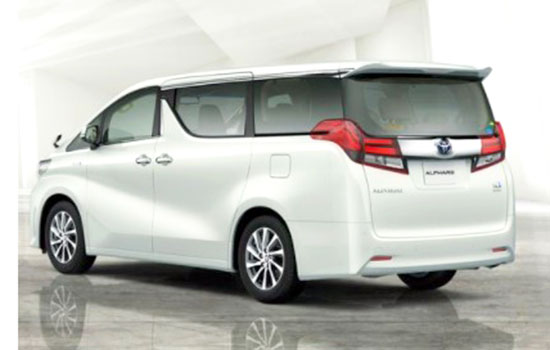
Fuel economy varied by engine and drive type, and Toyota quoted Japanese-market consumption figures rather than US EPA numbers, because the Alphard was not sold in North America. The hybrid was the most economical option in city use and the V6 the least. Since the car was built for Japan, most information about the 2019 Alphard is published in Japanese, and buyers should check the model code before comparing cars: a hybrid appears as AYH30W, while a 2.5-liter gasoline Alphard is AGH30.
Trim levels in Japan ran from relatively simple X and G grades up to the luxurious Executive Lounge, and the Vellfire offered its own parallel range. Equipment could include power sliding doors on both sides, a power tailgate, twin sunroofs, rear entertainment screens and captain’s chairs with heating and ventilation. That breadth of specification is one reason the Alphard occupies a different position from a standard family minivan.
The Alphard was not designed for towing or for rugged use; it was built to carry passengers in comfort over long distances. Its popularity in Japan and across Asia comes from that focus, and from the status that the nameplate carries in those markets.
In the markets where the Alphard is sold, Toyota also offered factory accessories and Welcab versions modified for wheelchair access, reflecting the model’s role in chauffeur and family transport. The Alphard built its reputation on space, quietness and comfort rather than performance or efficiency.
The 2019 Alphard’s closest internal competitor was the Vellfire, and the two were often sold through different Toyota dealer networks in Japan, together competing against large MPVs from other Japanese brands.