In Taiwan and Southeast Asia, Toyota sells its compact sedan under the name Corolla Altis. The 2019 Corolla Altis was the twelfth generation of the Corolla in its sedan form, coded E210, and it brought two firsts: a new platform and, for the first time in the region, a hybrid powertrain. This article sets out the verified engines, dimensions and pricing of that generation.

What the Altis Name Means
The E210 Corolla was introduced in 2018, with the hatchback shown at the Geneva Motor Show and the sedan unveiled in November 2018 in the United States and at the Guangzhou International Motor Show in China. Toyota builds two sedan versions: a “Prestige” model for China, Taiwan, Europe, the Middle East, Africa, South America and Southeast Asia, and a “Sporty” model for North America, Japan and Australia. Taiwan and Southeast Asia receive the Prestige model as the Corolla Altis. The sedan entered production in January 2019, launched in Taiwan on 27 March 2019 and in the Philippines on 9 September 2019.
For related reading, see the 2019 Toyota Corolla Altis Review and the 2019 Toyota Camry XSE V6 Review.
Platform and Exterior
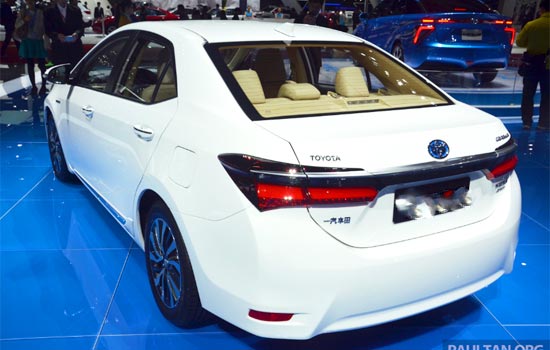
The twelfth-generation Corolla rode on the TNGA GA-C platform shared with the Prius and C-HR. The international sedan measured 4,630 mm long, 1,780 mm wide and 1,435 to 1,455 mm tall, on a 2,700 mm wheelbase. Compared with the previous generation, the rear suspension changed from a torsion beam to an independent double-wishbone setup. All Altis variants came with alloy wheels, projector headlights with LED daytime running lights and LED taillights; the 1.6 V and 1.8 V Hybrid trims added 17-inch two-tone alloy wheels, automatic LED headlights, LED fog lights and rain-sensing wipers.
Interior and Equipment
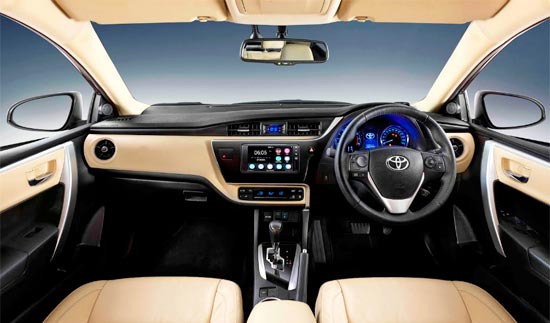
Every variant included a 7-inch touchscreen infotainment system, a six-speaker audio system and one-touch up/down power windows on all four doors. The 1.6 G added steering-wheel controls, a 4.2-inch color multi-information display and automatic climate control, while the 1.6 V and 1.8 V Hybrid added synthetic leather upholstery, passive entry with push-button start, an electronic parking brake with auto hold and cruise control. Safety equipment included seven airbags and electronic stability control as standard, and the top 1.8 V Hybrid added the Toyota Safety Sense suite with automatic emergency braking, adaptive radar cruise control and lane-keeping assistance.
Engine and Hybrid Powertrain

Most 2019 Corolla Altis models used a 1.6-liter 1ZR-FE four-cylinder engine producing 121 hp and 153 Nm of torque, paired with either a six-speed manual or a CVT. The flagship 1.8 V Hybrid paired a 1.8-liter 2ZR-FXE Atkinson-cycle engine making 98 hp and 142 Nm with a 600-volt electric motor contributing 72 hp and 163 Nm. Because hybrid system output is not a simple sum, total system power was 121 hp, delivered through an electronically controlled CVT. The hybrid used a nickel-metal hydride battery charged by the engine and by regenerative braking.
Price and Release Date

The all-new Corolla Altis went on sale in the Philippines on 9 September 2019. Pricing from the launch period started at about PHP 1,045,000 for 1.6-liter models, while the 1.8 V Hybrid flagship was listed at PHP 1,580,000. Buyers should compare the 1.6-liter gasoline against the hybrid on total cost, because the hybrid carried a significant price premium over the equivalent gasoline trim.
Key Specifications
| Specification | 2019 details |
|---|---|
| Platform | TNGA GA-C |
| 1.6 engine | 1.6-liter 1ZR-FE, 121 hp / 153 Nm |
| Hybrid engine | 1.8-liter 2ZR-FXE, 98 hp / 142 Nm |
| Hybrid motor | 72 hp / 163 Nm |
| Hybrid system output | 121 hp |
| Transmissions | 6-speed manual or CVT; eCVT for hybrid |
| Wheelbase | 2,700 mm |
| Length | 4,630 mm |
| Width | 1,780 mm |
| Seats | 5 |
Where the Altis Was Sold
The Prestige sedan that becomes the Corolla Altis in Taiwan and Southeast Asia launched across those markets during 2019 and early 2020. After entering production in January 2019, it launched in Taiwan on 27 March 2019, Thailand on 3 September 2019, the Philippines on 9 September 2019, Indonesia on 12 September 2019, Malaysia on 9 October 2019, Brunei on 2 January 2020 and Singapore on 9 January 2020. The Prestige body uses a front fascia closer to that of the Camry, while the Sporty body sold in North America, Japan and Australia uses styling derived from the hatchback. That difference is why a European or American Corolla sedan does not look identical to an Altis.
Because the Altis shares its platform, engines and hybrid system with the wider Corolla family, many mechanical parts are common across markets. The hybrid in particular used the same 1.8-liter Atkinson-cycle engine and electric motor as the Prius of the period, which is one reason Toyota positioned the Altis Hybrid as a mainstream entry into electrified motoring in the region.
On the road, the twelfth-generation platform change matters more than any single specification. The switch to the GA-C platform and an independent double-wishbone rear suspension improved ride and handling compared with the previous Altis, and Toyota stated that the body was 60 percent stiffer and the center of gravity 2 cm lower. These are structural improvements that a test drive reveals more clearly than a specification sheet.
The hybrid also changes the driving experience, because its electric motor provides strong low-speed response and allows short distances of electric-only running under light load. The hybrid uses a nickel-metal hydride battery that is charged by the engine and by regenerative braking, so no external charging is required.
Pricing placed the 1.8 V Hybrid at a premium over the 1.6-liter gasoline variants, so the choice between them is largely a question of running costs and equipment rather than performance, since both produce 121 hp. The hybrid’s advantage is strongest in stop-and-go city traffic, where regenerative braking recovers energy that a gasoline car would otherwise waste as heat.