The 2019 Toyota Camry was the second model year of the eighth-generation car, known internally as the XV70. It was a mainstream mid-size sedan sold worldwide and built on Toyota’s TNGA GA-K platform. The XV70 also marked Toyota’s return to the large-sedan market in Western Europe, where it replaced the discontinued Avensis. Because the XV70 was launched for the 2018 model year, 2019 was a carryover year with minor changes rather than a redesign.
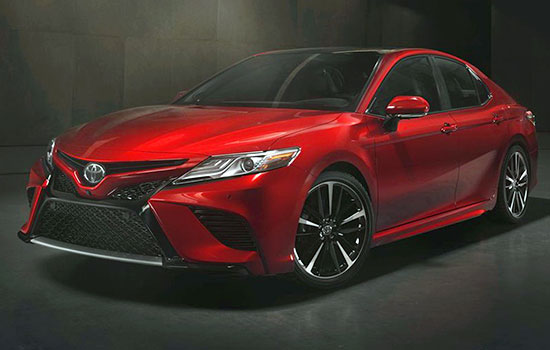
Eighth-Generation Camry (XV70)
The XV70 Camry was introduced at the 2017 North American International Auto Show and went into production in June 2017, reaching US showrooms in late July 2017 as a 2018 model. The eighth generation was an all-new design on the GA-K platform rather than a reworking of the previous car; Toyota said only the emblem was shared with the old model. The sedan measured 4,880–4,910 mm long, 1,840 mm wide and 1,445 mm tall on a 2,820 mm (111.2-inch) wheelbase, with a curb weight of roughly 1,480 to 1,660 kg. Production continued until October 2024, when the XV80 successor took over.
Launch timing varied widely by market. The Camry went on sale in the US in late July 2017 and in Australia on 21 November 2017, following the closure of Toyota’s Australian manufacturing operations. It launched in Thailand on 29 October 2018, in the Philippines on 10 December 2018, in Indonesia and Singapore in January 2019, in India and Brunei on 18 January 2019, and in Vietnam on 23 April 2019.
Design and Development
Toyota developed the XV70 on the TNGA GA-K platform that also underpinned the Avalon, the Lexus ES and later the RAV4. A lower center of gravity, a stiffer body and a multi-link rear suspension were intended to sharpen the car’s responses compared with earlier Camrys. Toyota claimed the only major component shared with the previous generation was the Toyota emblem.
Interior and Technology
Inside, the XV70 Camry used a driver-focused dashboard with a lower seating position than before. The car introduced Toyota’s Entune 3.0 infotainment system, which added connected services delivered over 4G LTE cellular data. Higher trims brought a larger touchscreen, navigation, a head-up display, wireless phone charging and a premium audio system, while physical knobs kept climate and volume control simple.
Rear-seat space remained one of the Camry’s strengths, with a wide trunk and a 60/40 split-folding rear seat. Upper trims added leather upholstery, heated and ventilated front seats and a panoramic glass roof.

Exterior and Platform
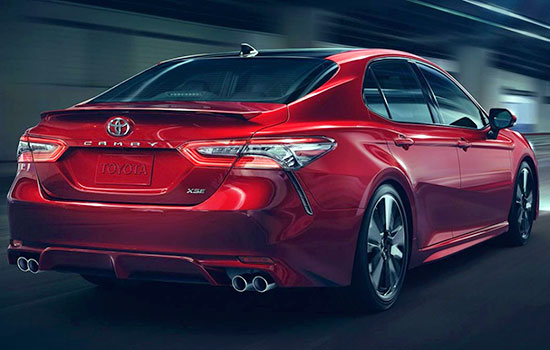
The eighth-generation Camry adopted a lower, wider stance with a long hood and a fast roofline, part of a broader styling shift at Toyota under president Akio Toyoda. The aim was to move the Camry away from its traditionally conservative image. Each trim level used a slightly different front fascia, so sportier versions such as the SE and XSE looked distinct from the comfort-oriented LE and XLE.

Engines and Transmissions
In the United States the 2019 Camry offered a four-cylinder, a V6 and a hybrid:
- 2.5-liter A25A-FKS four-cylinder: 203 hp and 184 lb-ft, rising to 206 hp with the optional quad exhaust; eight-speed automatic.
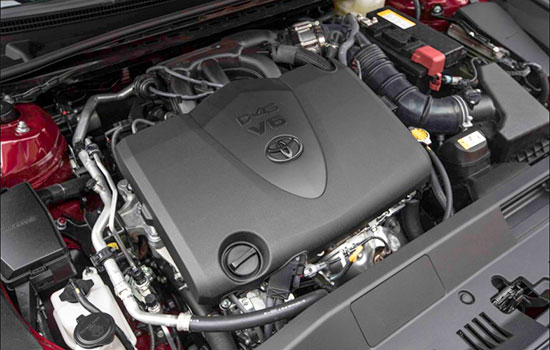
- 3.5-liter 2GR-FKS V6: 301 hp and 267 lb-ft; eight-speed automatic.
- 2.5-liter four-cylinder hybrid: combined 208 hp; electronically controlled CVT.
Some markets also used a 2.0-liter four-cylinder, and a carryover 2.5-liter engine rated at 178 hp appeared in certain regions. The V6 and the 2.5-liter four-cylinder drove the front wheels through an eight-speed automatic, while the hybrid used a power-split CVT.
Hybrid Model
The Camry Hybrid combined a 2.5-liter Atkinson-cycle four-cylinder with electric motors. Toyota relocated the battery pack from the trunk to beneath the rear seats, which freed cargo space and lowered the car’s center of gravity. In the US the LE Hybrid was rated at 51 mpg city, 53 mpg highway and 52 mpg combined on the EPA test cycle — a large gain over the previous generation.
Trim Levels and Safety
US trim levels for 2019 included L, LE, SE, XLE and XSE, plus XLE V6 and XSE V6, with the hybrid sold as LE, SE and XLE. Toyota Safety Sense was standard across the range, bringing a pre-collision system with pedestrian detection, full-speed radar cruise control, lane departure alert with steering assist and automatic high beams. Blind-spot monitoring and rear cross-traffic alert were available on higher trims. All-wheel drive and a sporty TRD version were added for the 2020 model year, not 2019.
Safety Ratings
Independent testing reflected the new structure. In ASEAN NCAP testing of the 2018 Camry, the car scored 49.004 points for adult occupant protection, 22.68 for child occupant protection and 19.75 for safety assist. North American models carried Toyota Safety Sense as standard, including automatic emergency braking and adaptive cruise control.
Pricing and the European Return
The XV70 Camry returned to Western Europe in April 2019 after a 14-year absence, taking the place of the discontinued Avensis. European buyers were offered chiefly the hybrid powertrain, marketed for its low fuel consumption and company-car tax advantages. In other markets the Camry continued to be offered with the four-cylinder and V6 as well.
Facelift and Later Years
A facelift arrived for the 2021 model year, unveiled on 15 July 2020 and on sale that October. It dropped the base L trim, added an XSE Hybrid, brought Android Auto compatibility and introduced Toyota Safety Sense 2.5+. The Camry was withdrawn from the United Kingdom in November 2021, and after 43 years on sale it was discontinued in Japan at the end of 2023.
Related Toyota model reviews on this site: 2019 Toyota Avensis Interior Review, Car Review, and 2019 Toyota Premio Review.