The Toyota Fortuner, also sold in some markets as the SW4, is a body-on-frame mid-size SUV built on the same IMV platform as the Hilux pickup. It has been in production since 2004. For the 2019 model year, the Fortuner was a carryover of the second-generation model (coded AN150 for four-wheel-drive and AN160 for two-wheel-drive versions) that had been launched in 2015; the facelift of that generation did not arrive until June 2020.

Model History
The Fortuner was introduced in 2004 and is part of Toyota’s Innovative International Multi-purpose Vehicle (IMV) program, alongside the Hilux and Innova. The first-generation model (AN50/AN60) was produced from November 2004 to December 2015 and used a range of gasoline and diesel engines across different markets. The second generation, which carried into 2019, was unveiled on 16 July 2015 in Australia and Thailand and adopted Toyota’s “Keen Look” design language. Development of the second-generation vehicle was led by executive chief engineer Hiroki Nakajima.
Engines
The second-generation Fortuner launched in 2015 with two new diesel engines from Toyota’s GD family and updated gasoline engines. The GD diesels feature common-rail direct injection and a variable-nozzle turbocharger. The available engines were:
- 2.4-liter 2GD-FTV turbodiesel inline-four
- 2.8-liter 1GD-FTV turbodiesel inline-four
- 2.7-liter 2TR-FE gasoline inline-four with Dual VVT-i
- 4.0-liter 1GR-FE gasoline V6 in selected markets
Unlike the first generation, which used a full-time four-wheel-drive system, the second-generation Fortuner moved to a part-time 4×4 setup. Transmission choices were a six-speed manual or a six-speed automatic. Toyota also strengthened the ladder frame with larger cross sections and fitted double-wishbone front suspension and a five-link rear suspension with coil springs.

2019 Pricing and Variants (Philippines)
In the Philippines, one of the Fortuner’s largest markets, the 2019 line-up started at ₱1,633,000 for the 2.4-liter diesel with a manual transmission. The 2.4 automatic was listed at ₱1,638,000, and the 2.8-liter automatic at ₱2,286,000. The 2.4-liter 2GD engine in the Philippine 2.4 G produces 147 horsepower and 400 Nm of torque and drives the rear wheels, while the 2.8-liter 1GD-FTV produces about 174 horsepower and 450 Nm.
| 2019 Fortuner (Philippines) | 2.4 | 2.8 |
|---|---|---|
| Engine | 2.4-liter 2GD-FTV (2.4 G) | 2.8-liter 1GD-FTV (2.8) |
| Power | 147 hp | About 174 hp |
| Torque | 400 Nm | About 450 Nm |
| Drivetrain | Rear-wheel drive | Rear- or four-wheel drive |
| Wheels / tires | 17-inch, 265/65R17 | Varies by grade |
| Brakes | Disc front and rear | Disc front and rear |
| Fuel tank | 80 liters | 80 liters |

Interior and Seating
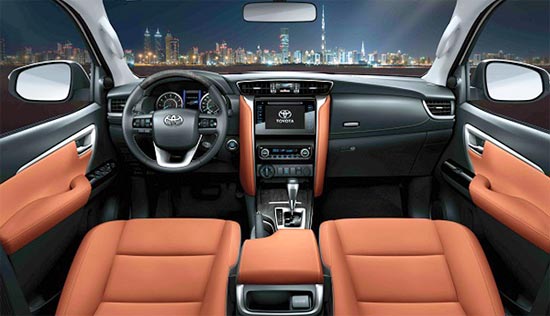
The second-generation Fortuner seats seven passengers in three rows. Toyota deliberately gave it an interior distinct from the Hilux, with an upright dashboard, synthetic leather trim with stitching and a color multi-information display. The third row uses a 50:50 split bench that folds to expand the cargo area. Standard equipment across the range included digital automatic climate control, a glove box with a chiller function, all-auto power windows, and a tilt-and-telescopic steering wheel, along with Eco and Power driving modes that adjust throttle response.
Off-Road and Safety Equipment
As a body-on-frame SUV, the Fortuner is designed for rough-road use. It has a double-wishbone front suspension and a five-link coil-spring rear suspension, and the rear differential lock has its components mounted inside the differential housing for better off-road protection. Standard safety equipment included anti-lock brakes, electronic brakeforce distribution, dual front airbags plus a knee airbag, and rear parking sensors. In 2017 Toyota upgraded the Fortuner to disc brakes at all four corners in all markets.
The 2020 Facelift and GR Sport
The facelifted second-generation Fortuner debuted on 4 June 2020 for the Thai market, alongside the facelifted Hilux. It introduced a flagship sub-model called the Legender (known as VRZ in Indonesia and Malaysia, LTD in the Philippines, Diamond in South America and Black Onyx in Russia), replacing the earlier TRD Sportivo grade. The 2.8-liter 1GD-FTV diesel was upgraded in the facelift to 201 horsepower and 500 Nm of torque, and a GR Sport version followed in 2021.
Summary
A 2019 Toyota Fortuner is the second-generation AN150/AN160 model as it stood before the 2020 facelift, offered with 2.4- and 2.8-liter diesels and, in some markets, 2.7-liter four-cylinder or 4.0-liter V6 gasoline engines. It was the best-selling car in the Philippines in 2017 and remains a common sight across Southeast Asia, Australia, India, the Middle East, South America and Africa.
Design, Exterior and Global Markets
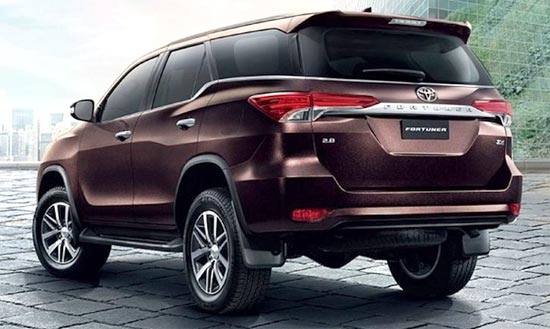
The second-generation Fortuner adopts Toyota’s “Keen Look” styling, with slim headlights that can be specified with bi-beam LED projectors and blacked-out D-pillars that create a “floating roof” effect. Toyota’s designers drew on the brand’s Land Cruiser and Land Cruiser Prado heritage to distinguish the Fortuner from rival body-on-frame SUVs. The front grille is surrounded by the headlights, and the body sits taller than the first-generation model.
Global Markets
The second-generation Fortuner went on sale in Australia in October 2015, offered only with four-wheel drive and the 2.8-liter turbo diesel, in GX, GXL and Crusade grades with a six-speed manual or six-speed automatic. It reached the Middle East in March 2016, where gasoline engines dominate: the UAE received 2.7-liter and 4.0-liter gasoline units with a six-speed automatic, while Saudi Arabia was also offered the diesel engines. In Indonesia the Fortuner was sold in grades such as VRZ and SRZ, and in Argentina the model continued under the SW4 name, assembled locally. Toyota Philippines, meanwhile, launched the second generation on 14 January 2016 with the 2.4- and 2.8-liter diesels and an updated 2.7-liter gasoline engine.