The Toyota Harrier is a mid-size crossover SUV that Toyota has produced since December 1997 and has sold mainly in Japan. Early Harriers were rebadged versions of the Lexus RX, but from 2013 the model became a separate line built on RAV4 underpinnings. The 2019 Harrier belongs to the third generation, coded XU60, which was produced from November 2013 to May 2020 and was facelifted in June 2017.

Harrier and the Lexus RX: A Shared History
For its first two generations the Harrier and the export-market Lexus RX were the same vehicle under different badges, sold through Toyota’s Toyopet Store dealerships in Japan before Lexus launched locally. The second generation arrived in February 2003, and when the third-generation Lexus RX became a distinct model in late 2008, the Harrier continued on the older XU30 platform before finally moving to its own platform with the XU60 in 2013. From that point the Harrier was positioned as a more road-focused, upmarket alternative to the RAV4, comparable to the luxury Lexus NX with which it shared components.
The Third Generation and the 2019 Model
The XU60 Harrier arrived in Japan in December 2013 for gasoline models and January 2014 for hybrids, using the New MC platform of the XA40-generation RAV4 rather than the Lexus RX platform. A mid-cycle facelift in June 2017 dropped the Grand trim, made Elegance the base grade and added the Progress trim at the top of the range, along with a new turbocharged engine. The 2019 car therefore reflects the facelifted XU60 line. It was never sold new in the United States, where the nameplate was absent and the related model appeared later as the Venza.
Interior
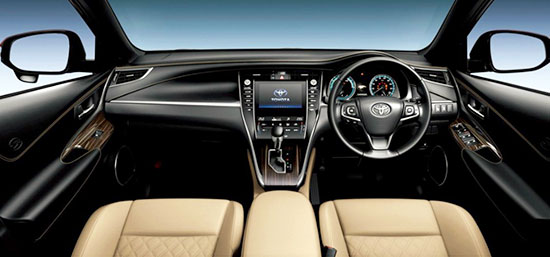
The Harrier is a five-seat crossover positioned above the RAV4 as a quieter, more luxurious offering. Japanese trim levels after the facelift ran from the base Elegance through Premium to the flagship Progress, with a Metal and Leather Package and a Style NOIR special edition offered on some grades. Toyota Safety Sense P, bundling adaptive cruise control, lane departure assist, a pre-collision system and automatic high beam, was standard across the range. Top versions could be specified with a JBL audio system and an eight-inch touchscreen infotainment unit, and the rear bench folded to expand the load area.
Exterior and Dimensions
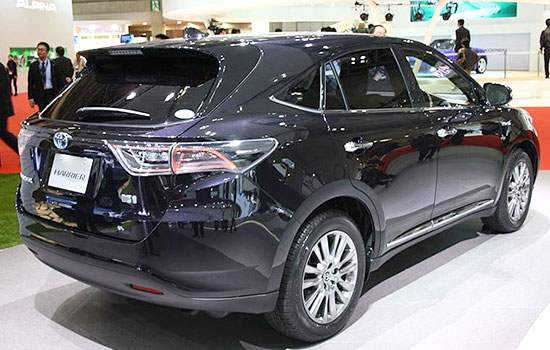
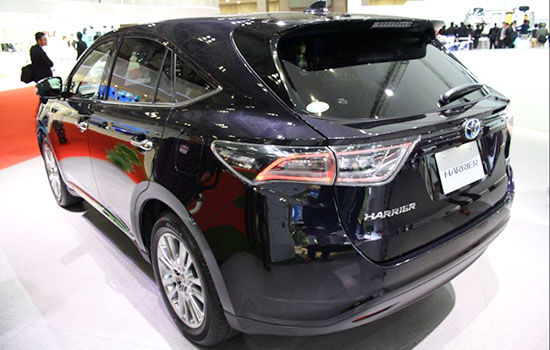
The XU60 Harrier measures 4,720 to 4,770 mm (185.8 to 187.8 in) long, 1,835 mm (72.2 in) wide and 1,690 mm (66.5 in) tall, on a 2,660 mm (104.7 in) wheelbase, and weighs between 1,560 and 1,810 kg (3,439 to 3,990 lb). From the 2017 facelift Toyota offered performance dampers intended to reduce body roll at higher speeds. The Harrier’s name comes from the eastern marsh harrier, a bird of prey found in Hokkaido and northern Honshu, and a stylized bird emblem appeared on the grille up to the end of the XU60 generation.
Engines and Performance
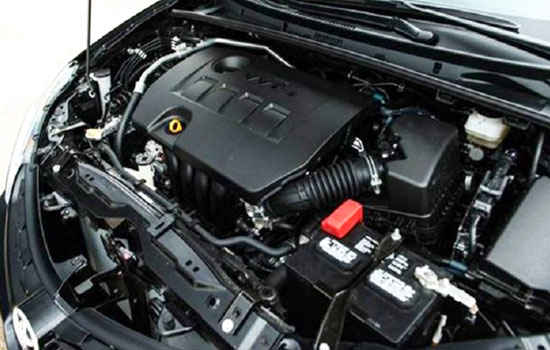
Three powertrains were offered in the XU60 Harrier. The 1,986 cc 3ZR-FAE naturally aspirated four-cylinder made 111 kW (149 hp) at 6,100 rpm and 193 Nm of torque at 3,800 rpm through a Super CVT-i transmission. The turbocharged 1,998 cc 8AR-FTS, added with the 2017 facelift, produced 170 kW (231 PS) at 5,200 to 5,600 rpm and 350 Nm between 1,650 and 4,000 rpm through a six-speed automatic; it was the engine used in the export-market Harrier. The hybrid paired a 2,493 cc 2AR-FXE four-cylinder rated at 112 kW with a 105 kW front motor and a 50 kW rear motor for a combined system output of 145 kW (roughly 197 hp), driving all four wheels through an eCVT.
The hybrid was the only XU60 Harrier with standard all-wheel drive, while the naturally aspirated and turbocharged gasoline versions were offered in both front- and all-wheel-drive forms. The model used MacPherson struts at the front and a double-wishbone rear, shared with the RAV4 and NX, and no diesel or manual-transmission version was offered.
Market Availability and Pricing
Toyota began exporting the Harrier outside Japan for the first time with the XU60, launching it in Singapore in July 2017 and Malaysia in November 2017 with the 2.0-liter turbo engine, a six-speed automatic and front-wheel drive. In Malaysia it was priced from RM238,000 for the 2.0T Premium and RM259,900 for the 2.0T Luxury. In Japan, Harrier sales reached 36,249 units in 2019, and about 2,593 were registered in Malaysia that year.
Sales and Position
The Harrier has consistently ranked among Toyota’s best-selling models in Japan. Annual Japanese sales were about 64,920 in 2014, 58,732 in 2017 and 36,249 in 2019, before the redesigned XU80 generation lifted the figure to 66,067 in 2020 and 74,575 in 2021. The XU60 was replaced in June 2020 by the fourth-generation XU80 Harrier, which dropped the turbocharged engine in favor of a 2.0-liter gasoline and a 2.5-liter hybrid and formed the basis of the North American Toyota Venza that returned for 2021.
Design and Equipment Highlights
Toyota positioned the XU60 Harrier as a more refined alternative to the RAV4, with a quieter cabin and a stronger focus on comfort than outright utility. Entry grades used cloth upholstery, while upper trims added leather, powered front seats and a power tailgate. All Japanese-market versions came with Toyota Safety Sense P, and the hybrid could drive short distances on electric power alone at low speeds through its hybrid system.
Because the Harrier shared its platform with the RAV4 and Lexus NX, it also shared their general chassis layout and many suspension components, but Toyota tuned it for a softer, more luxurious ride. Steering was electrically assisted, and the model was offered exclusively as a five-seat, five-door SUV with no diesel option anywhere in the lineup.