The sixth-generation Toyota Hiace made its global debut on 18 February 2019 in the Philippines. It was the first Hiace designed specifically for overseas markets, and it replaced the long-running fifth-generation (H200) model. Because the new Hiace arrived in 2019, a 2019 model-year Hiace is the current-generation van — not a rumored future model.

Sixth-Generation Debut
Toyota unveiled the H300-series Hiace in Manila on 18 February 2019, and development was led by chief engineer Takuo Ishikawa. The biggest change was a switch from the cab-over layout that had defined every previous Hiace to a short-hood design in which the engine sits ahead of the driver. Toyota said the new body used design ideas from TNGA (Toyota New Global Architecture), including ring-shaped frame structures for high body rigidity, to improve ride comfort, quietness and durability.
Toyota positioned the van as a “working vehicle” for shuttles, tourism and logistics, with different specifications aimed at passenger transport and cargo use. It went on sale in the Philippines first, before a gradual rollout to other markets.
Engines and Performance
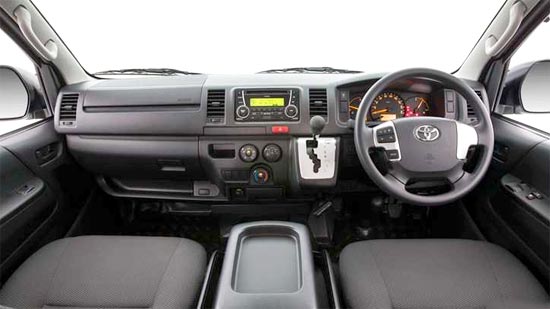
The sixth-generation Hiace was offered with two engine options:
- 2.8-liter 1GD-FTV turbocharged inline-four diesel
- 3.5-liter 7GR-FKS naturally aspirated V6 gasoline
This is an important change from the previous model, which used a 2.5-liter 2KD-FTV or 3.0-liter 1KD-FTV diesel, or a 2.0-liter 1TR-FE or 2.7-liter 2TR-FE gasoline. The 2.7-liter gasoline four-cylinder did not carry over to the sixth generation; the new van paired a 2.8-liter diesel or a larger 3.5-liter V6. A six-speed manual was available on some grades, while other versions used a six-speed automatic, depending on the market. Toyota noted that specifications could vary depending on the target market, so outputs, transmissions and equipment differ between countries.
Dimensions
The new Hiace was offered in two roof and length combinations. Toyota published the following key dimensions:
| Dimension | Normal / Standard Roof | Long / High Roof |
|---|---|---|
| Length | 5,265 mm | 5,915 mm |
| Width | 1,950 mm | 1,950 mm |
| Height | 1,990 mm | 2,280 mm |
| Wheelbase | 3,210 mm | 3,860 mm |
Body Types, Seating and Interior
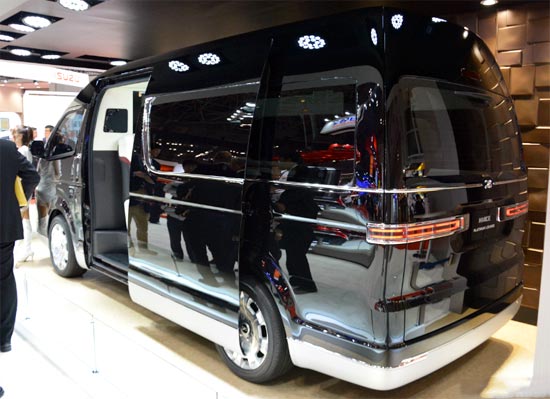
Toyota built the sixth-generation Hiace as a flexible platform for different uses. The Commuter versions could carry up to 17 people, which Toyota described as the most in its class, while the Van versions offered cargo space large enough for pallets from any country or region. A Tourism version added comfort features for passenger work. Interior upgrades included large door pockets and generous under-seat storage.
Safety and Equipment
Toyota Safety Sense — a package of active safety systems — was offered on the new Hiace in certain countries. Toyota claimed performance equivalent to five stars in Euro NCAP testing for the H300. The van’s standard safety equipment drew on systems such as anti-lock braking (ABS), which had been a basic feature of the earlier Hiace line as well. The short-hood layout placed a crumple zone ahead of the driver, a design Toyota highlighted as a safety improvement over the cab-over layout.
Release Date and Market Rollout
The global launch was in the Philippines on 18 February 2019, followed by a phased introduction in other countries, with a focus on emerging markets. Australia received the sixth-generation Hiace on 28 May 2019, while Toyota continued to sell the previous H200 model unchanged in Japan and in several other markets, including the Philippines, Malaysia, Singapore, South Africa, Indonesia, Egypt and Kuwait. The Hiace nameplate dates to 1967 and, by the time the sixth generation launched, Toyota had sold more than 6.24 million units across over 150 countries.
What It Replaced: The Fifth Generation (H200)
The H200-series Hiace had been on sale since 2004 and used a cab-over design. It was offered with 2.5- and 3.0-liter turbo-diesel engines and 2.0- and 2.7-liter gasoline engines, and it remained on sale alongside the new model in several markets. The arrival of the H300 in 2019 therefore marked the first major rethink of the Hiace’s layout in decades, rather than a simple facelift. Buyers shopping for a 2019 Hiace should note that both the outgoing H200 and the new H300 were available that year, depending on the market.
Interior and Comfort
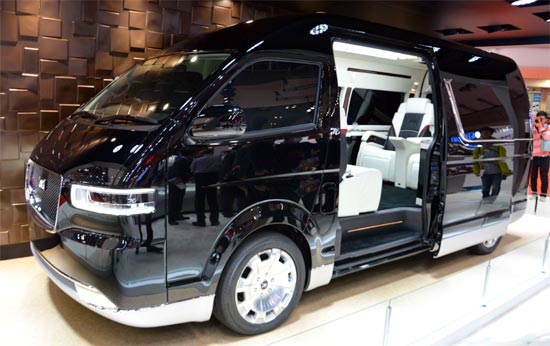
Toyota said the sixth-generation Hiace offered greatly improved ride comfort and quietness, and the cabin was designed to reduce driver fatigue even over long distances. Buyers could choose layouts with multiple rows of seats or with increased storage space, depending on whether the van was used for passengers or cargo. Larger door pockets and generous under-seat stowage were among the practical interior upgrades. The Tourism grades added dedicated comfort features, while the Van grades prioritized load volume.
Chassis and Driving Characteristics
The H300 was built on a platform specially developed for the model, and Toyota described it as extremely durable with excellent basic performance. The short-hood layout moved the engine ahead of the cabin, freeing floor space and adding a front crumple zone, which changed the driving position compared with the previous cab-over van. The Hiace has long been valued for durability and reliability and is used as a van, a minibus and private transport across Asia, the Middle East, Africa, Oceania, Mexico and Latin America, which is why Toyota kept the older H200 on sale in some of those markets after 2019.