The Toyota Highlander is a three-row, mid-size crossover SUV that slots below the full-size Sequoia and above the compact RAV4 in the US line-up. The 2019 model year was the final year of the third-generation Highlander, which was sold from the 2014 model year through 2019. This article explains what the 2019 Highlander offered and, importantly, what actually changed for that year.

What Changed for 2019
The 2019 Highlander was essentially a carryover. The bigger mechanical update had come earlier in the generation: the 2017 model year introduced a revised 3.5-liter V6 and a new eight-speed automatic transmission, along with updated infotainment, and the 2018 model year brought exterior styling revisions. For 2019, Toyota made no major mechanical or styling changes. A completely new fourth-generation Highlander, built on the TNGA-K platform, arrived in late 2019 for the 2020 model year.
Related Toyota SUV coverage includes the 2019 Toyota 4Runner TRD Pro Release Date and Review. For more models, see the Toyota Review index.
Interior and Seating

The Highlander was a three-row crossover that seated seven or eight people depending on whether the second row was configured with a bench or captain’s chairs. The 2019 model was offered in six trims: LE, LE Plus, XLE, SE, Limited and Limited Platinum. Standard equipment on the base LE included Toyota Safety Sense, a 6.1-inch touchscreen, five USB ports, 60/40-split second- and third-row seats and LED taillights. Higher trims added an 8-inch touchscreen with navigation, three-zone climate control, leather-trimmed seats, a power moonroof and a premium audio system.
Exterior and Dimensions

The third-generation Highlander measured 191.1 inches long, 75.8 inches wide and 68.1 inches tall, on a 109.8-inch wheelbase, with a curb weight of about 4,508 pounds. Behind the third row, cargo space measured 13.8 cubic feet, expanding to 42.3 cubic feet with the third row folded. The model was available in front-wheel drive or all-wheel drive; all-wheel drive added $1,460 on V6 trims.
Engine and Efficiency
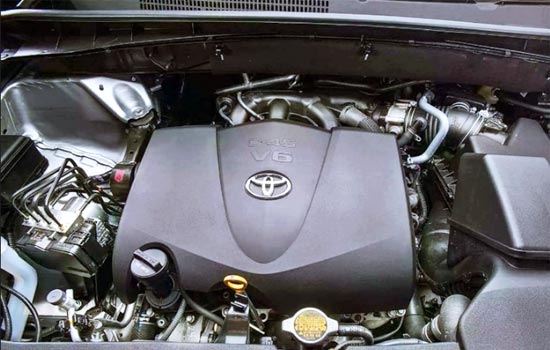
Two engines were offered in the US for 2019. The base engine was a 2.7-liter four-cylinder making 185 hp and 184 lb-ft of torque, paired with a six-speed automatic and available only on the LE with front-wheel drive; the EPA rated it at 20 mpg city, 24 mpg highway and 22 mpg combined. Every other trim used a 3.5-liter V6 producing 295 hp and 263 lb-ft, paired with an eight-speed automatic; that version was rated at 21 mpg city, 27 mpg highway and 23 mpg combined with front-wheel drive. A Highlander Hybrid was also offered and came standard with all-wheel drive.
Price and Release Date
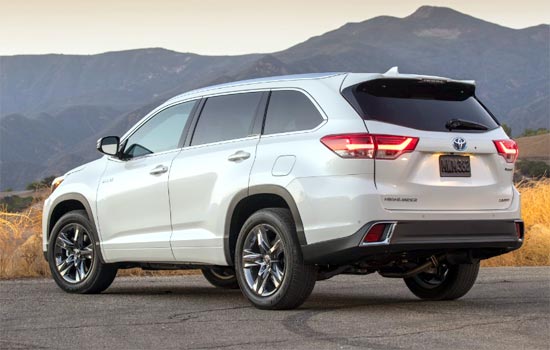
The 2019 Highlander went on sale in 2018 as a carryover. Toyota’s pricing, including the destination charge, started at $32,375 for the LE and $37,305 for the LE Plus, with the XLE from $40,265 and the SE from $41,485. A revised fourth-generation Highlander replaced it for 2020, moving to the TNGA-K platform with a standard V6 and an available hybrid four-cylinder.
Key Specifications
| Specification | 2019 details |
|---|---|
| Base engine | 2.7-liter I4, 185 hp / 184 lb-ft |
| V6 engine | 3.5-liter V6, 295 hp / 263 lb-ft |
| Transmissions | 6-speed automatic (I4); 8-speed automatic (V6) |
| Drive | Front-wheel drive or all-wheel drive |
| EPA (V6 FWD) | 21 mpg city / 27 mpg highway |
| EPA (I4 FWD) | 20 mpg city / 24 mpg highway |
| Wheelbase | 109.8 inches |
| Length | 191.1 inches |
| Curb weight | About 4,508 pounds |
| Seats | 7 or 8 |
Trim Walk and Buying Notes
The 2019 Highlander came in six trims: LE, LE Plus, XLE, SE, Limited and Limited Platinum. The base LE was the only trim available with the four-cylinder engine, and it came only with front-wheel drive. Every other trim used the V6, with all-wheel drive available as an option. Equipment stepped up through the range from the LE, which already included Toyota Safety Sense and a 6.1-inch touchscreen, to the Limited Platinum with the most comprehensive feature list.
As the final year of the third generation, the 2019 Highlander benefits from years of refinement but lacks the newer platform and powertrains of the 2020 model that replaced it. For a used buyer, the third-generation Highlander is valued for its three rows, comfortable ride and standard active-safety equipment. Because the four-cylinder was limited to the base LE, most used examples are V6 models, which also deliver better fuel economy than the four-cylinder in EPA testing.
The Highlander’s main strength was its combination of three rows of seats, a comfortable ride and standard active-safety equipment at a mainstream price. It was one of the first mid-size SUVs to use a car-based, unibody structure, a formula that most of its competitors later adopted. The third-generation model continued that approach with a spacious cabin and a focus on family use rather than off-road capability.
Fuel economy depended heavily on the engine and drivetrain. The V6 with front-wheel drive was actually rated slightly better by the EPA than the smaller four-cylinder, so the base engine’s main advantage was a lower purchase price rather than running costs. The hybrid delivered the best economy of all and came standard with all-wheel drive, making it the most efficient way to get a three-row Highlander.
For a used buyer, the 2019 Highlander is a known quantity: it is the last of a long-running generation, so examples are plentiful and parts are common. The main reason to consider a 2020 or later model is the newer TNGA-K platform and the additional safety and technology features that came with it.