The Toyota Mark X was a real 2019 model — and 2019 was its last. The rear-wheel-drive sedan ended production on 23 December 2019, closing a line that had run since 2004. Anyone expecting a new Mark X generation for 2019 will not find one: the car on sale that year was the second generation, introduced in 2009 and sold almost exclusively in Japan. This article covers what the Mark X was, what powered the final cars and what, if anything, replaced it.

What the Mark X Was
The Mark X was a mid-size sedan aimed primarily at the Japanese domestic market. Toyota built it on the company’s N platform with a choice of rear- or all-wheel drive, and it was the successor to the long-running Mark II, which dates to 1968 and which North Americans knew first as the Corona Mark II and later as the Cressida. The name is pronounced “Mark Ex”, even though the Mark II is “Mark Two”. Toyota offered different engine sizes so that Japanese buyers could choose which annual road tax band they were willing to pay; larger engines came with higher levels of standard equipment.
Outside Japan the Mark X had a small footprint. It was sold in China as the Reiz from 2005 until 2017, produced by Tianjin FAW Toyota, and it was officially imported to Indonesia in limited numbers between 2012 and 2013. It was never part of Toyota’s US line-up, which is why the name is unfamiliar to many American buyers.
The Mark II and Mark X Lineage
The Mark X folded three earlier Toyota sedans into one car. It replaced the Mark II, the sporty Chaser and the luxurious Cresta in a single model, repeating an approach Toyota had previously attempted with the short-lived Verossa. Where the Verossa used inline-six engines, the Mark X moved to V6 power, and it continued the “X” series that traced back to the first dedicated Mark II platform of 1972. That lineage is why the final 2019 car was described as the end of a fifty-year family of Toyota sedans.

Second Generation (2009–2019)
The second-generation Mark X went on sale on 19 October 2009, followed by the Chinese Reiz in September 2010. Buyers could choose a 2.5 L or 3.5 L V6, both featuring dual VVT-i with Toyota’s D-4 direct injection. Rear-wheel-drive models used a six-speed torque-converter automatic, while the “iFour” all-wheel-drive versions used a five-speed automatic. There was no manual in the regular range; only the limited-run GRMN came with a stick. The car rode on a 2,850 mm wheelbase.
Engines and Outputs
| Engine | Layout | Output | Torque |
|---|---|---|---|
| 2.5 L ”4GR-FSE” | V6 | 149 kW (200 hp) | — |
| 3.5 L ”2GR-FSE” | V6 | 234–236 kW (314–316 hp) | — |
| 3.5 L ”2GR-FSE” +M Super Charger | V6, supercharged | 265 kW (355 hp) | 498 N·m |
Grades and Interior
Toyota split the Mark X into three broad families. The Standard models — badged 250G, 250G “F package” and Relax Selection — used the 2.5 L engine and were offered in rear-wheel drive or as the all-wheel-drive 250G Four. The Sports line, badged 250S, 250RDS, 350S and 350RDS, added a rear spoiler, a rear diffuser and model-specific bumpers, and it carried forward the spirit of the earlier Tourer V cars. The Premium cars were launched with the 3.5 L engine and later offered with the 2.5 L as well.
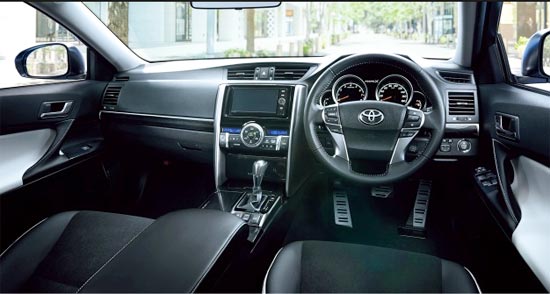
Higher trims came with leather upholstery, heated front seats, stainless-steel door-sill plates and a comprehensive infotainment package that could include navigation, a TV tuner and a 12-speaker audio system. The Mark X also introduced touches such as an LED lighting strip running from the front of the headliner to the rear and an integrated rear-bumper exhaust outlet.
Performance Variants
Toyota’s tuning arm built two notable specials. The Mark X GRMN, named for Gazoo Racing tuned by the Meister of the Nurburgring, was a limited-production 3.5 L car with a six-speed manual gearbox: 100 units were made in 2015 and 350 more in 2019, the 2019 cars producing 234 kW (318 PS). Separately, Toyota’s in-house modifier Modellista offered the Mark X +M Super Charger, which added a supercharger to the 3.5 L engine for 265 kW and 498 N·m. A G’s — later GR Sport — version brought a three-piece body kit, forged 19-inch wheels and four-piston brake calipers.

The Chinese Reiz
The Chinese-market Reiz gave the Mark X a second life abroad. The second-generation Reiz launched in September 2010 with a choice of a 2.5 L ”5GR-FE” or 3.0 L ”3GR-FE” V6, both smaller-displacement units than the Japanese 3.5 L. A facelift arrived in 2013, and Toyota ended Reiz production in China on 27 September 2017. That left the Japanese factory as the only source of new Mark X cars for the final two years of the model’s life.
The 2019 Final Edition and the End of Production
Toyota marked the end of the line with a Mark X special edition announced in April 2019. Production stopped on 23 December 2019, and Toyota reported that about 6.9 million Mark-series cars, including the Mark II, had been built since the Corona Mark II went into production 51 years earlier. With no rear-wheel-drive sedan replacement in the Japanese range, the Mark X is best understood as the end of an era rather than the start of one. Readers can see the related [https://toyotasuggestions.com/2019-toyota-mirai-interior-design-and-review.html 2019 Toyota Mirai Interior Design and Review] on this site.

What Buyers Can Buy Today
Because the Mark X was a Japanese-market car, the realistic route for buyers today is a used domestic-market example imported from Japan, and the model retains a following among enthusiasts of [https://en.wikipedia.org/wiki/RWD rear-wheel-drive] sedans. There was no direct successor; Toyota’s rear-drive sedan role in Japan passed to the Crown, and the Mark X nameplate was retired at the end of 2019.