There was no 2019 Toyota Matrix. Toyota built the Corolla-based hatchback through the 2013 model year in the United States and 2014 in Canada, then retired it. Any page promising a 2019 Matrix redesign, price or release date is describing a model that Toyota never made. What follows is the car’s real history, from its 2002 launch to its 2013 discontinuation, along with the engines and equipment that buyers can still find on the used market.
What the Matrix Was
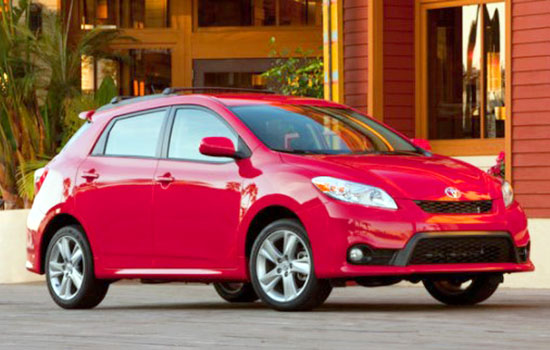
The Toyota Matrix was a compact five-door hatchback, classed as a C-segment car, that Toyota produced from 2002 to 2014. It was assembled by Toyota Motor Manufacturing Canada in Cambridge, Ontario, and it shared its platform, engines and much of its structure with the contemporary Toyota Corolla and the Pontiac Vibe. That family tie is why the two cars were built on the same line and why they share so many specifications. The Matrix was sold in the United States, Canada and, from the second generation, Mexico.
Toyota positioned the Matrix as a more practical, more youthful alternative to a conventional sedan. Its tall hatchback body, generous rear-seat space and foldable seats made it a small family car and a lifestyle vehicle at the same time, a combination that helped it stand out from the Corolla on which it was based.
First Generation (2002–2008)
The first-generation Matrix went into production in February 2002 and ran to December 2007. US buyers could choose between two 1.8 L four-cylinder engines. The base 1ZZ-FE made about 130 hp, while the sporty XRS used the higher-revving 2ZZ-GE, rated at 180 hp and 130 lb-ft. A five-speed manual or a four-speed automatic handled the drive, and an all-wheel-drive version was offered. At the top of the range, the $18,750 XRS added four-wheel disc brakes, six speakers, anti-lock brakes with electronic brake-force distribution and 16-inch alloy wheels.
The first generation rode on a 102.4-inch wheelbase and measured 171.3 inches long, with a base price of $14,670 in 2003. Practical touches included a front passenger seat that folded flat to carry long items and a 115-volt power outlet. Late in the run, Toyota discontinued the 2ZZ-GE engine and temporarily replaced the XRS with the M-Theory edition before the second generation arrived.

Second Generation (2008–2014)
The second-generation Matrix arrived in January 2008 for the 2009 model year and stayed on sale until 2014. It moved to the Corolla E140 platform and gained the option of a larger 2.4 L engine. Toyota sold it in three US trim levels — Standard, S and XRS — while Canada added an XR grade and an AWD model with the 2.4-liter engine. A 2011 facelift brought redesigned front and rear fascias, new wheels, revised seat fabrics and a Bluetooth-capable radio. The XRS grade was dropped from the US line-up for 2011, and sales wound down after the 2013 model year. US model-year coverage ran from 2009 to 2013, while Canadian sales continued into 2014.
Engines and Specifications
| Engine | Displacement | Output |
|---|---|---|
| 2ZR-FE inline-4 | 1.8 L | 132 hp |
| 2AZ-FE inline-4 | 2.4 L | 158 hp |
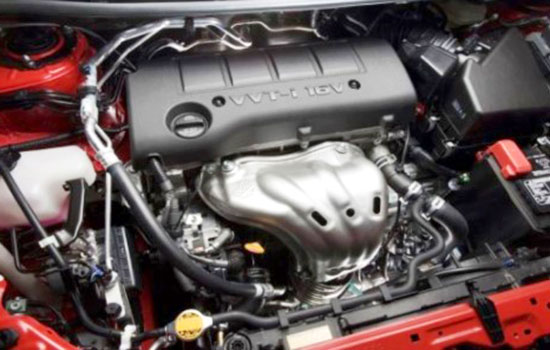
The second-generation Matrix measured 173.0 inches long (171.9 inches with all-wheel drive), 69.5 inches wide and 61.0–61.4 inches tall, on the same 102.4-inch wheelbase as before. Transmissions were a five-speed manual, a four-speed automatic or a five-speed automatic, depending on trim and drivetrain.
Trims and Equipment
The line-up was organized around trim rather than engine size alone. In the first generation, the mid-grade XR added color-matched mirrors and door handles, a leather-wrapped steering wheel and a panic button on the key fob, with options such as a sunroof. In the second generation, the S grade and the Canadian XR sat above the base car, while the XRS remained the performance model until it was cut from the US range for 2011. All-wheel drive remained available in both markets after 2009.
The Matrix and the Pontiac Vibe
The Matrix’s closest relative was the Pontiac Vibe, a badge-engineered version of the same vehicle developed under the Toyota–General Motors partnership. The two cars shared their platform, engines and interior architecture, and because of that shared engineering, recalls on one often covered the other. Owners still treat them as siblings, and parts interchange between many examples of the same generation.
Safety
All Matrix models came with side torso airbags, side curtain airbags, anti-lock brakes and electronic brake-force distribution. The car earned a “Good” rating in frontal and side Insurance Institute for Highway Safety tests, and Toyota added its Smart Stop Technology for the 2011 model year. Two recalls affected the car: the 2009–2011 floor-mat and accelerator-pedal campaign that also covered the Pontiac Vibe, and an October 2012 notice covering a power-window master switch on 2009 models.

Why It Was Discontinued
On 5 August 2013 Toyota announced that it would end Matrix production for the US market after the 2013 model year, citing declining sales, and confirmed that it had no plans to replace the car with another vehicle. Canadian production continued into 2014. Because the decision was final and Toyota did not reverse it, there was no 2019 generation, facelift or concept to report.
What Buyers Can Buy Today
A 2019 Matrix does not exist, so the realistic options are used first- or second-generation cars. Toyota’s compact five-door role in later years passed to models such as the Corolla Hatchback, which occupies a similar space in the line-up for buyers who want a practical small Toyota hatch. Readers comparing discontinued Toyota nameplates may also find the site’s [https://toyotasuggestions.com/2019-toyota-prius-v-rumors-engine-and-price.html 2019 Toyota Prius V Rumors, Engine and Price] and [https://toyotasuggestions.com/2019-toyota-avalon-rumors-and-review.html 2019 Toyota Avalon Rumors and Review] useful.