The Toyota Noah is a seven- or eight-seat minivan that Toyota builds and sells mainly in Japan. Anyone searching for a “2019 Toyota Noah redesign” should know the timeline up front: in 2019 the Noah belonged to the third generation, which ran from 2014 to 2022, and the genuine full redesign did not arrive until January 2022. There was no new Noah generation for the 2019 model year, and Toyota never marketed a distinct 2019 design. The car on sale that year was a facelifted third-generation van.

What the Toyota Noah Is
The Noah is a front-wheel-drive-based compact minivan sold in Japan, where it replaced the older rear-wheel-drive TownAce/LiteAce Noah while keeping the “R” model-code series and generation numbering. It is engineered to fit Japan’s compact-vehicle dimension rules, which cap length at under 4,700 mm, and for most of its life it was developed specifically for that class. The Noah was once exclusive to Toyota Corolla Store dealerships, while its sister models — the Voxy at Netz Store and the Esquire at Toyopet Store — shared the same body and mechanical package. Since 1 May 2020 all three have been available through every Toyota sales channel in Japan. The Noah is not part of Toyota’s United States range, so American buyers have never been able to order one new from a Toyota dealer.
Nameplate History: Four Generations
The Noah line began in November 2001, when the first-generation model adopted a front-wheel-drive layout for the first time and moved onto the Ipsum platform. The second generation followed in June 2007 and the third in January 2014. A facelift arrived in April 2010 for the second generation and again in July 2017 for the third. The fourth and current generation was introduced in January 2022. The Esquire variant, added in October 2014 as a more luxurious take on the same van, was discontinued in 2021, while the Voxy continues alongside the Noah.
First and Second Generations in Brief
The first-generation Noah used a 2.0 L ”1AZ-FSE” direct-injected four-cylinder producing 114 kW, paired initially with a four-speed automatic and, from 2004, a continuously variable transmission. The second generation, launched in June 2007, switched to the ”ZR” family of engines: a 2.0 L ”3ZR-FE” rated at 103 kW and a Valvematic 2.0 L ”3ZR-FAE” rated at 114 kW, both driving through a CVT. These early generations established the formula — front-wheel drive, a low floor and sliding doors — that defines the Noah today.
In Indonesia, a facelifted second-generation Noah was launched on 11 December 2012 under the name Toyota NAV1, filling the gap between the Kijang Innova and the Alphard. It was discontinued in January 2017 and replaced by the third-generation Voxy imported from Japan in August of that year.

Third Generation (2014–2022): What the 2019 Noah Actually Was
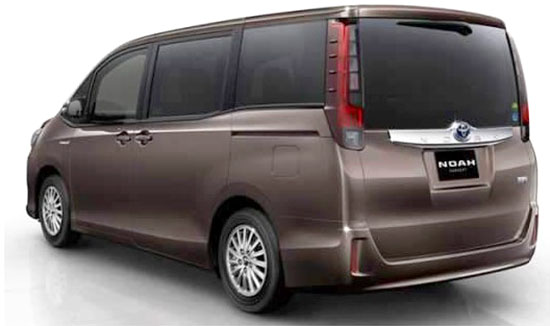
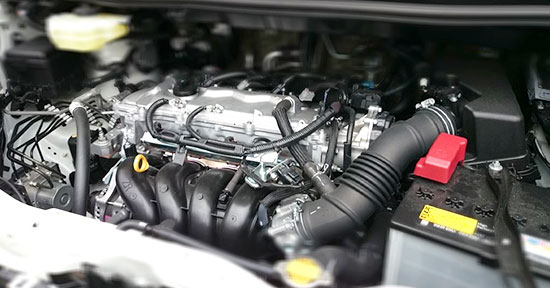
Toyota introduced the third-generation Noah and Voxy on 20 January 2014. It was the first Toyota minivan with one-touch sliding doors and the first Noah with an engine start-stop system to save fuel. At launch Toyota offered three grades — X “V Package”, X and Si — and every grade could be ordered in front- or all-wheel drive. Two powertrains were available, and both were carried into the 2019 model year:
| Engine | Layout | Output |
|---|---|---|
| 2.0 L ”3ZR-FAE” Valvematic | Gasoline inline-4 | 112 kW (152 PS) |
| 1.8 L ”2ZR-FXE” | Hybrid inline-4 | 73 kW engine-only; 100 kW (136 PS) combined |
| ”5JM” electric motor | Hybrid assist | 60 kW |
A continuously variable transmission (CVT) drives the gasoline model, while the hybrid uses an electronically controlled eCVT. The third-generation Noah rides on a 2,850 mm wheelbase and is offered with seven- or eight-seat interiors, with sliding second-row seats that can be configured for either passenger room or cargo. These are the figures that describe the actual 2019 car.
Interior, Space and Comfort
The Noah is designed around family transport, so passenger space matters more than a large trunk. The low, flat floor and tall roofline make it easy to move between the rows, and the one-touch sliding side doors were added precisely so that children and older passengers can get in and out in tight Japanese parking spaces. Toyota markets the van in seven-seat and eight-seat forms; the difference is whether the second row uses two captain’s chairs or a three-place bench. With the rear rows folded, the cargo area grows substantially, which is why the model is popular with large households and small businesses alike.
Facelift and the 2019 Model Year
The Noah, Voxy and Esquire received [[Toyota Safety Sense]] C in January 2016, which added collision warning, lane-assist and high-beam assist. A facelift followed on 3 July 2017 with redesigned lights, hood, bumper and front fenders. That facelifted third generation is what Toyota sold in 2019, which is why there is no separate “2019 Noah” design to speak of. The model year brought no change of platform or engine; buyers who ordered a 2019 Noah received the same mechanical package that had been on sale since 2014, wearing the 2017 styling updates.
The Fourth Generation (2022–Present)
The real redesign came on 13 January 2022, when Toyota launched the fourth-generation Noah and Voxy on the TNGA GA-C platform. The gasoline engine became a 2.0 L ”M20A-FKS” unit rated at 125 kW (168 PS), and the 1.8 L hybrid system’s combined output rose to 103 kW (140 PS). The wheelbase stayed at 2,850 mm, but every model grew to 1,730 mm wide — roughly 35 mm wider than the lower third-generation variants. Grades for the new Noah are X, G, Z, S-G and S-Z, and the stylised “N” badge on the nose was replaced by Toyota’s corporate emblem.
Which Noah Can Buyers Actually Purchase?
The Noah remains a Japan-market vehicle. A used 2019 Noah is therefore a facelifted third-generation car with either the 2.0 L gasoline engine or the 1.8 L hybrid, and it is generally found through Japanese domestic-market dealers and used-import channels rather than Toyota’s US or European showrooms. Buyers comparing it with other Toyota people-movers can also read up on the [https://toyotasuggestions.com/2019-toyota-previa-engine-price-and-release-date.html 2019 Toyota Previa Engine, Price, and Release Date] and the [https://toyotasuggestions.com/2019-toyota-rukus-price-and-release-date.html 2019 Toyota Rukus Price and Release Date], two other Japanese models whose production had already ended before 2019.