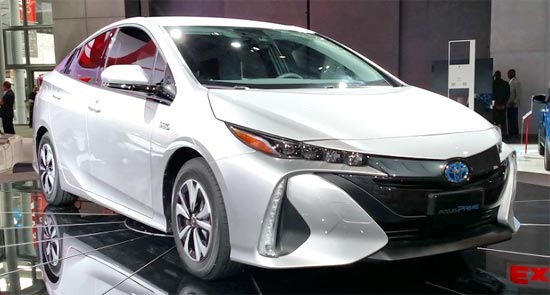
The 2019 Toyota Prius Prime was the plug-in hybrid version of the Prius, and the car that introduced many buyers to Toyota’s modern plug-in technology. It was part of the second generation of the Prius Plug-in Hybrid, sold in North America under the Prius Prime name from the 2017 through 2022 model years. Unlike the standard Prius, the Prime could be charged from an outlet and driven on electricity alone for short trips, while still working as an efficient hybrid once the battery was depleted.

What Makes It a Plug-In
The key difference between the Prius Prime and a regular Prius is the size of the battery and the ability to charge it externally. The Prime used an 8.8 kWh lithium-ion battery, compared with the 0.75 kWh pack in the standard front-wheel-drive Prius. That larger battery allowed the car to travel up to 25 miles on electricity alone under EPA testing. When the charge ran low, the Prime operated as a conventional hybrid, using the gasoline engine and regenerative braking to keep the car moving efficiently.
Interior, Seating and Cargo
Inside, the Prime shared much of its layout with the standard Prius, including a centrally mounted instrument display and a large central touchscreen. The most visible difference was the rear seating: the Prime was rated for four occupants because the larger battery raised the floor and eliminated the center rear position. Cargo space measured about 19.8 cubic feet behind the rear seats, which was less than the standard Prius hatchback because of the Prime’s more sedan-like roofline and battery packaging. Standard equipment included heated front seats, a 7-inch touchscreen, navigation, push-button start and Toyota’s safety suite.

Charging
The Prius Prime used a 3.3 kW onboard charger and could be charged from a standard 120-volt household outlet or a 240-volt charging station. Toyota quoted roughly five and a half hours for a full charge on 120 volts, or a little over two hours on 240 volts. A full charge was enough for the car’s 25-mile electric range. The Prime did not support DC fast charging, and its charge port was located on the right rear quarter panel.
Electric Range and Efficiency
The EPA rated the 2019 Prius Prime at 133 MPGe when running on electricity and 54 mpg combined when running as a hybrid. Electric-only range was 25 miles, and Toyota quoted a total driving range of about 640 miles with a full tank and a full charge. Those figures made the Prime one of the most efficient plug-in hybrids of its time, and its hybrid-mode efficiency was actually higher than the standard Prius of the same year.
Powertrain and Battery
The Prime paired a 1.8-liter four-cylinder engine (Toyota code 2ZR-FXE) with two electric motor-generators and Toyota’s power-split hybrid system. Combined output was 121 horsepower, the same figure as the standard Prius. Power went to the front wheels only; unlike the regular Prius, the Prime was not offered with all-wheel drive. The battery was mounted under the rear seats and floor, which kept the center of gravity low but left the Prime with seating for four rather than five.

Prius Prime vs. the Standard Prius
Both cars used the same 1.8-liter engine and hybrid architecture, so the driving experience was similar. The Prime was heavier because of its larger battery, which made it slightly slower in a straight line than the standard Prius. In exchange, the Prime could drive on electricity alone for the first 25 miles after a charge and carried a much higher fuel-economy rating in hybrid mode. The standard Prius, by contrast, offered available all-wheel drive and more cargo room. Buyers who could charge regularly got far more value from the Prime.
How It Compared to Rival Plug-Ins
The Prius Prime’s main competitors were the Hyundai Ioniq Plug-In Hybrid and the Kia Niro Plug-In Hybrid. The Prime’s 25-mile electric range was lower than some rivals, but its hybrid-mode efficiency of 54 mpg combined was higher. The Prime also benefited from Toyota’s long track record with hybrid systems and its standard advanced safety equipment. Its main weakness was the four-seat layout, which made it less practical for families than the five-seat standard Prius or a crossover plug-in hybrid.
Trims and Pricing
The 2019 Prius Prime came in three trims: Plus, Premium and Advanced. With destination charges included, the Plus started at $28,280, the Premium at $29,980 and the Advanced at $34,280, according to CarsDirect. Cars.com listed the range as roughly $27,350 to $33,350 before destination. The Advanced added a head-up display, a surround-view camera, a premium JBL audio system, blind spot monitoring and parking assist. All trims shared the same powertrain, so the higher prices bought comfort and technology rather than more power.
What Buyers Can Expect
Since the second-generation Prius Prime was produced from 2017 to 2022, the 2019 model is a used car today. Buyers should confirm the battery still holds a full charge and check the charging cable and port, since those are the parts unique to a plug-in. The Prime makes the most sense for drivers with short commutes who can charge at home, because they can cover much of their daily mileage on electricity. For drivers who rarely plug in, the standard Prius or Prius AWD-e is the simpler choice.