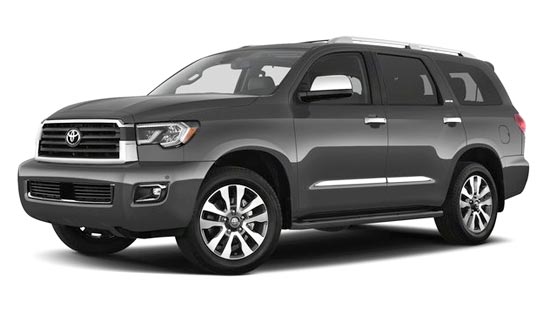
The 2019 Toyota Sequoia Limited is the mid-range trim of the second-generation Sequoia, a body-on-frame full-size SUV that Toyota built from the 2008 through 2022 model years. Positioned above the SR5 and TRD Sport and below the Platinum, the Limited paired the standard 5.7-liter V8 with a long list of comfort and convenience features. For 2019 the model was a carryover of the 2018 refresh, so its mechanical package was unchanged from the year before.
Because the 2019 Sequoia did not introduce a new generation or a new engine, its specifications are shared with every other second-generation Sequoia sold from 2008 onward. That consistency is useful for buyers: a 2019 Limited has the same 381-horsepower V8, the same six-speed automatic, and the same towing rating as the surrounding model years, so the differences come down to equipment rather than performance.
Overview and Model History
Toyota unveiled the second-generation Sequoia at the November 2007 Los Angeles Auto Show, with US sales beginning that December for the 2008 model year. Like the original 2001–2007 Sequoia, it was derived from the Toyota Tundra pickup and used body-on-frame construction with a four-wheel independent suspension. Toyota aimed it squarely at the Ford Expedition and the Chevrolet Tahoe and GMC Yukon.
The Sequoia sat between the mid-size 4Runner and the premium Land Cruiser in Toyota’s North American SUV line until the Land Cruiser was dropped after 2021, after which the Sequoia became the brand’s flagship SUV in the region. It was built mainly for North America and sold in left-hand drive only.
Toyota refreshed the Sequoia for the 2018 model year with a new front grille and lower bumper, standard LED headlights, daytime running lights and fog lights, and a cabin update that added Optitron gauges, a 4.2-inch multi-information display, and a leather-wrapped steering wheel. The refresh also added the TRD Sport grade between the SR5 and Limited. The 2019 model carried all of that forward without major changes.

Engine and Performance
Every 2019 Sequoia used the 5.7-liter i-Force V8, rated at 381 horsepower at 5,600 rpm and 401 pound-feet of torque at 3,600 rpm. A six-speed automatic transmission sent power to the rear wheels or, on four-wheel-drive models, to all four through a two-speed transfer case that provided a low range for off-road use.
The powertrain was engineered around towing and hauling rather than fuel economy. Toyota rated the Sequoia to tow up to 7,400 pounds when properly equipped, a figure the manufacturer applied consistently to 5.7-liter V8 models in the 2015–2020 period. Independent testing recorded a 0–60 mph time of roughly 6.5–6.7 seconds, quick for a vehicle of this size and weight.
Limited Trim Equipment
The Limited added a substantial set of features over the SR5. According to trim data for the 2019 model year, it included 20-inch alloy wheels, chrome exterior accents, a power liftgate with jam protection, leather-trimmed seating, a 10-way power-adjustable driver’s seat, a four-way power front passenger seat, and a premium audio system.
Buyers who wanted the sportier appearance package instead could choose the TRD Sport, covered in the 2019 Toyota Sequoia TRD Sport Price and Redesign article. The TRD Sport used the same V8 and added black exterior trim and 20-inch black wheels, so it changed the look rather than the performance.

Pricing
Cars.com lists the 2019 Sequoia Limited at $57,545 with rear-wheel drive and $60,770 with four-wheel drive. For context, the base SR5 started at $49,050, the off-road-styled TRD Sport at $51,765, and the top Platinum at $64,760 with rear-wheel drive or $67,985 with four-wheel drive. The Limited’s position in the middle of that range made it the value-oriented choice for buyers who wanted leather and 20-inch wheels without the Platinum’s extra cost.
Interior and Cargo Space
The Sequoia’s three-row cabin was one of the roomiest in the full-size SUV class. It seated up to eight people, or seven when second-row captain’s chairs were specified. Edmunds lists 18.9 cubic feet of cargo volume behind the third row and a maximum of 120.1 cubic feet with the second and third rows folded.
The third row could be folded to expand the load area, and the seating layout gave the Sequoia genuine eight-passenger capability that rivals could not always match. For a broader walkthrough of the model, the 2019 Toyota Sequoia Review covers the full range.

Safety Technology
The 2018 refresh made Toyota Safety Sense-P standard across the Sequoia line, a bundle that includes a pre-collision system with automatic braking, lane departure alert with steering assist, automatic high beams, and dynamic radar cruise control. A blind spot monitor with rear cross-traffic alert also became standard. Those features carried over to the 2019 model, so even the base SR5 included a comprehensive set of driver-assistance systems.
Fuel Economy and Dimensions
The 2019 Sequoia was EPA-rated at 13 mpg city, 17 mpg highway, and 15 mpg combined with rear-wheel drive; four-wheel-drive versions were rated at 14 mpg combined. The large displacement V8 and roughly 5,700-pound curb weight explain the modest figures.
It measured 205.1 inches long on a 122.0-inch wheelbase, 79.9 inches wide, and 77.0 inches tall, with a curb weight of roughly 5,700–5,900 pounds depending on trim and drivetrain. Despite its size, the second-generation Sequoia’s independent rear suspension helped it achieve a relatively tight turning circle for its class.
What Happened After 2019
Second-generation Sequoia production continued through the 2022 model year. The third-generation Sequoia arrived for 2023 on a new body-on-frame platform, replacing the V8 with a 3.4-liter twin-turbo V6 hybrid rated at 437 horsepower and offering up to 9,520 pounds of towing capacity. Toyota sold 10,289 Sequoias in the United States during the 2019 model year, according to production data, making the V8 era’s later years relatively low-volume. Used 2019 Limited models now represent the final stretch of the naturally aspirated V8 Sequoia. More general coverage is available in the site’s Car Review section.