The fifth-generation Toyota Supra, sold under the Gazoo Racing banner as the GR Supra, went on sale in 2019. It marked the return of a nameplate that had been absent since the A80 Supra ended production in 2002 and was developed jointly with BMW, with which Toyota shared the platform also used by the BMW Z4. US-market cars were sold as the 2020 GR Supra, but the car was revealed and launched internationally in 2019.

The Return of the Supra
Toyota had previewed a Supra successor with the FT-HS concept in 2007, roughly a decade after the fourth-generation car was discontinued. On 12 July 2018 a camouflaged pre-production Supra appeared at the Goodwood Festival of Speed, confirming a collaboration with BMW and that the new car would be more focused on track performance than the Z4 it was related to. An earlier FT-1 concept, shown in 2014, had also previewed the car’s proportions, and Toyota said at the time that a production version could carry a price near $60,000. The A90 GR Supra is assembled by Magna Steyr in Graz, Austria, the first Toyota sports car built under the Gazoo Racing sub-brand, and it reached Japanese showrooms in May 2019.
Engine and Powertrain
The headline engine is a 3.0-liter turbocharged inline-six supplied by BMW and known internally as the B58. It produces 335 hp and 365 lb-ft of torque, sent to the rear wheels through an eight-speed automatic transmission with paddle shifters. Toyota later extended the range with a 2.0-liter turbocharged four-cylinder, also sourced from BMW, which arrived in Europe after launch. For the 2021 model year the 3.0-liter car was updated with a revised engine making 382 hp and 368 lb-ft.

Performance
Toyota quoted a 0–60 mph time of 4.1 seconds, making the GR Supra the quickest Toyota production vehicle at the time of launch. Curb weight is 3,397 pounds, with a 50:50 front-to-rear weight distribution engineered for balanced handling. Adaptive suspension, an active rear differential, and launch control were fitted as standard on the 3.0 grades. The short wheelbase and wide track were chosen to give the car agility at the expense of outright interior space.
Chassis and Handling
The A90 uses a front-engine, rear-wheel-drive layout with a double-joint-type MacPherson strut front suspension and a multi-link rear. The stiff body structure and near-perfect weight distribution were central to Toyota’s claim that the Supra was tuned as a serious driver’s car rather than a grand tourer. An electronically controlled limited-slip rear differential helps the car put its power down out of corners. The Supra shares its platform, engine, and eight-speed automatic with the BMW Z4, but the two cars were tuned differently: Toyota positioned the Supra as the more focused, track-oriented car.
| Grade | US starting price (2019 launch) |
|---|---|
| GR Supra 3.0 | $49,990 |
| GR Supra 3.0 Premium | $53,990 |
| GR Supra Launch Edition | $55,250 (1,500 units) |
Design and Dimensions
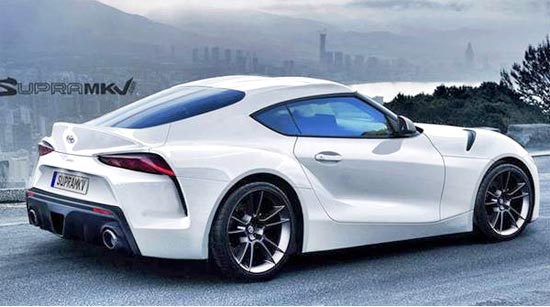
The A90 uses a two-seat coupe body with a short wheelbase and wide tracks, dimensions chosen for agility rather than outright size. The design drew inspiration from the earlier FT-1 concept, though Toyota’s chief designer at the time, Nobuo Nakamura, noted the production car differed from that show car in many ways. Standard safety equipment across the range included forward collision warning, automatic emergency braking with pedestrian detection, lane departure warning, and automatic high beams.
Interior and Technology
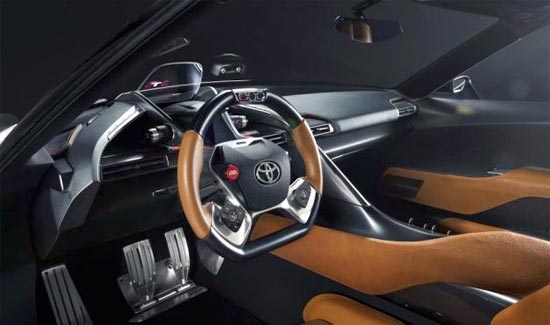
Despite the compact exterior, the cabin places the driver low and central, with a driver-focused layout and a color head-up display on higher trims. Entry cars used a smaller touchscreen, while the 3.0 Premium added a wider display with navigation, wireless Apple CarPlay, wireless phone charging, and a premium audio system. The Supra was a strict two-seater, so practicality was always secondary to packaging the inline-six and its cooling.
European Launch and the Supra 900 Club
The GR Supra’s European debut came at the 2019 Geneva Motor Show, and demand was such that Toyota capped the first year of European production at 900 units. The company opened priority ordering through a “Supra 900 Club,” and the 2019 European allocation quickly sold out, with waiting lists forming beyond the initial batch.
What Buyers Should Know
Because the engine, transmission, and much of the electrical architecture come from BMW, servicing and parts follow the joint platform rather than Toyota’s own inline-six history. The 3.0-liter six is the version most enthusiasts seek, while the 2.0-liter emphasizes lower weight and running costs. The GR Supra continued in production into the following decade, with a final edition announced for the end of the run, and prospective buyers should check for the optional Driver Assist package that added adaptive cruise control, blind spot monitoring, and rear cross traffic alert.
The Supra Lineage
The Supra name dates back to 1978, when Toyota launched the Celica Supra as a six-cylinder version of the Celica. It became a standalone model with the A70 generation and reached its most famous form with the A80 of 1993 to 2002, which used the 2JZ inline-six and became a favorite of tuners worldwide. That reputation is why the return of an inline-six Supra in 2019 carried so much weight, even though the new engine came from BMW rather than Toyota’s own 2JZ line.