The 2019 Toyota Tacoma was a mid-size pickup truck priced and positioned between compact trucks and full-size models such as the Tundra. It was the fourth model year of the third-generation truck, which Toyota introduced for 2016 on the N300-series platform. For 2019 the design carried over with only minor changes, so buyers got the same engines, transmissions, and body as the 2016-2018 trucks, along with a small price increase over the previous year.

The Third Generation, Explained
Toyota moved the Tacoma to a new third-generation truck for the 2016 model year, replacing the second-generation design that dated to 2005. The third generation used the N300-series platform and was produced through 2023 before a fully redesigned fourth-generation truck arrived for 2024. Within that run, 2019 sits in the middle: mechanically the same as the launch trucks, but with a growing list of standard features and additional TRD Pro packages.
What Changed for 2019
The changes for 2019 were modest. All Tacomas gained dual USB inputs for the audio system. Toyota also introduced new TRD Pro packages for the TRD Off-Road and TRD Sport trims, adding equipment such as a high-mount desert air intake, an upgraded stereo, a redesigned skid plate, and a moonroof. The base price rose by $435 versus 2018. Otherwise, the truck was unchanged, so a 2019 model is not the “new truck” that some articles described.

US Pricing by Trim
Starting prices in the United States rose steadily across the range, and the figures below exclude the destination fee:
- SR: from $25,850.
- SR5: from $27,625.
- TRD Sport: from $32,545.
- TRD Off-Road: from $33,800.
- Limited: from $37,790.
- TRD Pro Double Cab: roughly $42,690 and up, depending on transmission and region.
Adding four-wheel drive, a larger cab, or the V6 engine increased the price substantially. The V6 alone added several thousand dollars over the base four-cylinder, and four-wheel drive added more again. The most expensive configuration in Canada was the Double Cab V6 TRD Off-Road with the TRD Pro package, at $56,435. Prices above exclude the destination fee, which was about $1,045 in the United States for 2019.
Standard Features
Standard equipment on the 2019 Tacoma included a touchscreen display audio system with Bluetooth, a backup camera, a multi-information display, steering-wheel-mounted audio and phone controls, and a windshield mount for a GoPro camera. Higher trims added navigation, dual-zone automatic climate control, leather seating, heated front seats, a power moonroof, and a Qi wireless charging pad. For 2019 every truck gained a second USB input, giving two ports for the audio system.
Engines
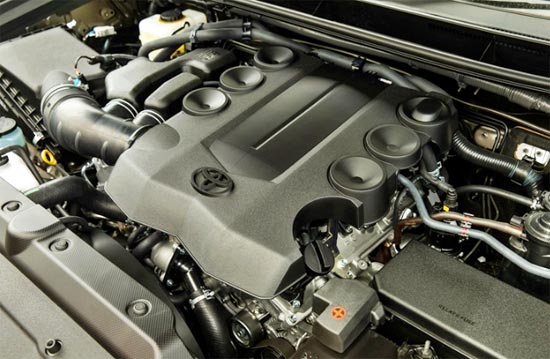
Two engines were offered. The 2.7-liter four-cylinder produced 159 hp and 180 lb-ft of torque and was rear-wheel drive only. The 3.5-liter V6 produced 278 hp and 265 lb-ft of torque and was available with rear- or four-wheel drive. A six-speed automatic was standard on most trims, with a six-speed manual offered on certain V6 configurations. V6 trucks came with a Class IV weight-distribution hitch, a seven-pin wiring harness, and trailer sway control.
The 2.7-liter is Toyota’s 2TR-FE, a 16-valve four-cylinder with variable valve timing; the 3.5-liter is the 2GR-FKS, a 24-valve V6 with direct and port fuel injection (D-4S) and an Atkinson-cycle mode. EPA ratings reflected the difference: a rear-wheel-drive four-cylinder truck was rated around 20 mpg city and 23 mpg highway, while a four-wheel-drive V6 with the manual transmission dropped to about 17/21 mpg.
Used prices track condition and configuration closely on the Tacoma. Four-wheel-drive V6 trucks and TRD models command the strongest money, while the base rear-wheel-drive four-cylinder is the value choice. Because the truck changed little from 2016 to 2023, a well-kept 2019 example is often hard to distinguish from a newer one apart from the odometer.

Frame, Body, and Suspension
The third-generation Tacoma used a fully boxed frame and a body of high-strength steel, a layout built for durability and off-road use rather than maximum payload. Suspension was an independent double-wishbone setup at the front and a leaf-spring rigid axle at the rear. V6 four-wheel-drive trucks added a two-speed transfer case and, on TRD Off-Road and TRD Pro models, a locking rear differential.
Configurations
Buyers chose between the Access Cab, with rear-hinged half doors and a six-foot bed, and the Double Cab, with four full doors and a five-foot or six-foot bed. Rear-wheel drive was standard on four-cylinder trucks; four-wheel drive was optional on the V6 and effectively the norm on higher trims. Towing capacity ranged up to about 6,800 lb for rear-wheel-drive V6 trucks and around 6,400 lb for four-wheel-drive Double Cabs, with a maximum payload of about 1,620 lb.
On dimensions, the Access Cab and short-bed Double Cab share a 127.4-inch wheelbase and 212.3-inch length, while the long-bed Double Cab measures 140.6 inches between the axles and 225.5 inches overall. Width is 74.4 to 75.2 inches and height is 70.6 inches. Curb weight falls between roughly 4,425 and 4,480 pounds.
Buying a 2019 Tacoma Today
Because the third generation continued through 2023, the 2019 truck is mechanically similar to later years of the same generation. That can make it easier to find parts and service and to compare condition across model years. Shoppers should confirm cab, bed, drivetrain, and engine, since those choices affect towing, payload, and fuel economy significantly. Sales figures underline the model’s following: Toyota sold 248,810 Tacomas in the United States in 2019 and 12,536 in Canada. Related reading: our 2019 Toyota Tacoma New Engine Review and our 2019 Toyota Tundra Rumors Redesign and Release Date.

For more Toyota model guides and reviews, see the Toyota Review homepage.