The Toyota TS050 Hybrid is the LMP1 hybrid sports prototype with which Toyota Gazoo Racing competed in the FIA World Endurance Championship (WEC) from 2016 to 2020. It is a purpose-built race car, not a road model, so a reference to a “2019 TS050” describes the car as it raced across the 2018–19 and 2019–20 seasons rather than a showroom model year.

What the TS050 Hybrid Is
The TS050 succeeded the TS040 Hybrid and was built to the 2016 LMP1 rules. Its most significant design change was a switch from the TS040’s naturally aspirated V8 to a turbocharged V6, together with a move from supercapacitor storage to lithium-ion batteries that let the car run in the more powerful 8-megajoule hybrid sub-class. Its successor is the GR010 Hybrid, which moved Toyota into the Hypercar class. The car is documented in detail on Wikipedia.
Engine and Hybrid System
The powertrain is a 2.4-liter direct-injection, twin-turbocharged V6 – the engine is coded RHV Ph8.97 and was supplied with Denso injection. It is paired with an 8-megajoule hybrid system that recovers energy under braking through front and rear motor-generators and stores it in a lithium-ion battery. Toyota quoted the internal-combustion engine at 368 kW (500 PS) and the hybrid boost at 368 kW (500 PS), for a combined output of 736 kW, or about 1,000 PS (roughly 986 hp).
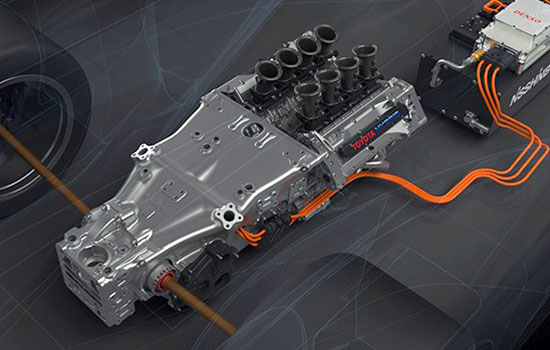
TS050 Hybrid key specifications
- Class: LMP1-H (Le Mans Prototype – Hybrid)
- Engine: 2.4-liter twin-turbocharged, direct-injection V6
- Hybrid: 8 MJ system with front and rear motor-generators; lithium-ion battery
- Combined power: about 736 kW / 1,000 PS
- Gearbox: six-speed sequential (seven-speed in 2016)
- Dimensions: 4,650 mm long, 1,900 mm wide, 1,050 mm tall; 2,950 mm wheelbase
- Bodywork: carbon-fiber composite

Records and Race Results
The TS050 delivered Toyota’s first overall victory at the 24 Hours of Le Mans. The landmark win came in 2018, on Toyota’s 20th attempt, when the No. 8 car of Sebastien Buemi, Kazuki Nakajima and Fernando Alonso started from pole and completed 388 laps. Toyota finished first and second that year.
In the 2018–19 “super season” the same No. 8 crew won Le Mans again with a one-two finish, and Buemi, Nakajima and Alonso took the drivers’ World Championship. In September 2020 the TS050 completed a Le Mans hat-trick, winning by five laps with Buemi, Nakajima and Brendon Hartley, which also secured a third WEC teams’ title for Toyota.
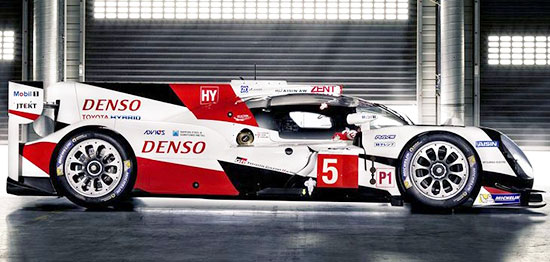
Development Across Seasons
For 2017 the car was substantially redesigned: only the monocoque was carried over, with a new 2.4-liter engine whose block, head and combustion chamber were reworked for a higher compression ratio and better thermal efficiency. The 2018–19 update concentrated on reliability and on a lighter battery and cooling system. Ahead of 2019–20, Toyota fitted new high-power lithium-ion cells and an updated electrolytic solution, reshaped the front for lower drag and higher downforce, and revised the battery management to keep hybrid boost consistent over a full 24-hour race.
Why There Is No “2019 Model” in the Showroom Sense
The TS050 was never sold to the public, so it has no model years, prices or fuel-economy figures in the way a road car does. Each season’s car was an evolution of the last, identified by the championship year it contested. Anyone researching a “2019 TS050” is looking at the version that ran the 2018–19 and 2019–20 WEC seasons, culminating in the Le Mans wins of 2019 and 2020.
Season Debut and Class Context
The TS050 made its race debut in 2016 as Toyota’s third all-new WEC car since it returned to top-class endurance racing in 2012. It raced against factory hybrid entries from Porsche and Audi, and later against non-hybrid privateer LMP1 teams. Under the rules, hybrid cars such as the TS050 ran a smaller energy allowance than the privateers but were permitted 8 MJ of hybrid electric energy per lap, which the car used to save fuel and to deploy boost out of corners. Toyota described the program as a proving ground for road-car hybrid technology, noting that the TS050’s battery could generate roughly 300 kW, more than ten times the output of a contemporary Prius.
Chassis and Hardware
The TS050 uses a carbon-fiber composite monocoque with independent double-wishbone pushrod suspension front and rear, torsion-bar springs and carbon ventilated brakes at every corner. It runs RAYS magnesium alloy wheels with Michelin radial tires. The regulations restricted hybrid cars more tightly than privateer LMP1 entries: at Le Mans, non-hybrid cars were allowed 210.9 MJ per lap against 124.9 MJ for the TS050, plus the 8 MJ of hybrid electric energy the car could deploy each lap.
Summary
The TS050 Hybrid is defined by a 2.4-liter twin-turbo V6 and an 8-megajoule hybrid system producing about 1,000 PS combined, packaged in an LMP1-H chassis measuring 4,650 mm long. It is remembered for three consecutive Le Mans wins from 2018 to 2020 and two world championships, together with the hybrid technology Toyota carried into the GR010 and, indirectly, into its road cars. No road-going version was ever offered, so questions about the TS050 concern its race record rather than servicing or pricing, and its specifications were fixed by the LMP1 rulebook rather than by model-year marketing.