In Canada, the 2019 Toyota Yaris name covered two different cars. The Yaris Hatchback was built by Toyota in France and descended from the Japanese-market Vitz (XP130). The Yaris sedan was a rebadged Mazda2 built in Mexico. Both were front-wheel-drive subcompacts with 1.5-liter four-cylinder engines, but they used different engines, transmissions and body styles. This article reviews the Canadian lineup and its engine specifications.
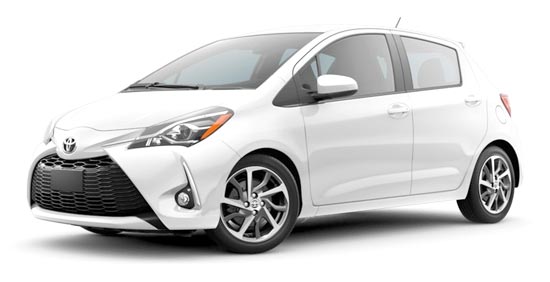
Two different Yaris models
The split matters when comparing specifications. The Canadian Yaris Hatchback was a Toyota design with a Toyota-built 1.5-liter engine, a five-speed manual or a four-speed automatic, and three-door or five-door bodies. The Yaris sedan was designed and built by Mazda, with Mazda’s 1.5-liter SkyActiv engine and six-speed transmissions. Aside from the badge and similar output figures, they are separate cars.
Engine specifications
Both engines are rated at 106 hp and 103 lb-ft of torque, but they make that power in different ways:
- Yaris Hatchback: Toyota 1.5-liter four-cylinder with variable valve timing and sequential multiport fuel injection; 106 hp at 6,000 rpm; five-speed manual or four-speed automatic; front-wheel drive.
- Yaris Sedan: Mazda 1.5-liter four-cylinder SkyActiv-G with direct injection; 106 hp at 6,000 rpm and 103 lb-ft at 4,000 rpm; six-speed manual or six-speed automatic; front-wheel drive.

Hatchback trims and features
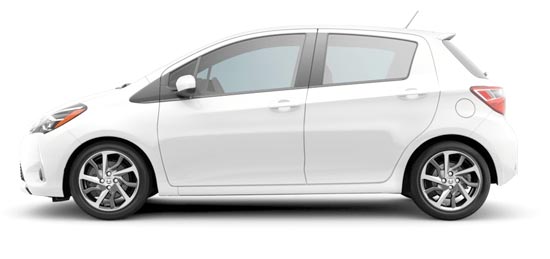
The Canadian Yaris Hatchback came in three trims. The three-door CE was the entry model, the five-door LE added air conditioning and cruise control, and the five-door SE added sportier equipment. Standard features across the range included heated front seats, power windows and locks, a 6.1-inch Display Audio system with USB and Bluetooth, and 60/40 split-folding rear seats.
- 3-Door CE: CAD $15,630 manual; $16,625 automatic.
- 5-Door LE: CAD $16,955 manual; $17,955 automatic.
- 5-Door SE: CAD $18,605 manual; $19,605 automatic.
Efficiency
Natural Resources Canada estimated the Yaris Hatchback at 7.8 L/100 km in the city and 6.5 L/100 km on the highway with the five-speed manual, and slightly higher with the automatic. The Yaris sedan was more efficient thanks to its six-speed transmissions, rated at roughly 7.8/6.0 L/100 km with the manual and 7.3/5.8 L/100 km with the automatic.

Safety
The Canadian Yaris Hatchback came with the Toyota Safety Sense C package, grouping a pre-collision system, lane departure alert and automatic high beams. The Star Safety System, nine airbags and a backup camera were standard as well. The sedan, being a Mazda design, used Mazda’s low-speed pre-collision system along with six airbags and a backup camera.
Interior and technology
Both cars are modest inside, but they cover the essentials. The hatchback pairs a six-speaker audio system on higher trims with a multi-information display and heated seats. The sedan adds a 7-inch touchscreen with a rotary controller, satellite radio and two USB ports. Heated front seats, Bluetooth and steering-wheel controls were common to both.
What happened next
For the 2020 model year, Toyota replaced the Toyota-built Canadian hatchback with a Mazda2-based Yaris Hatchback in both Canada and the United States. The Mazda-based Yaris was then discontinued in the US in June 2020, with Toyota Canada confirming the end of sales that July. The Yaris sedan and hatchback are therefore no longer sold new in Canada; only used examples remain.
Exterior and interior
The Yaris Hatchback used Toyota’s European-influenced styling with a three-door or five-door body, while the Yaris sedan adopted a Mazda-style grille to match its Mazda2 origins. Inside, the hatchback offered a driver-focused instrument layout and a multi-information display, and the sedan offered a 7-inch touchscreen with a rotary controller. Heated front seats, Bluetooth and steering-wheel controls were common across the range, which matters in a Canadian winter.
Owner costs and warranty
Toyota Canada covered the Yaris with a comprehensive warranty of 3 years or 60,000 km and a powertrain warranty of 5 years or 100,000 km, along with roadside assistance for 3 years or 60,000 km. Fuel economy was a strong point: the sedan with the automatic was rated near 7.3 L/100 km in the city and 5.8 L/100 km on the highway, among the thriftiest non-hybrid figures in the segment.
Buying used
Because both Mazda-based Yaris models and the Toyota-built Canadian hatchback have ended production, a 2019 Yaris is now a used-only proposition in Canada. Buyers should confirm which car they are looking at — the Toyota-built hatchback and the Mazda-based sedan have different engines, transmissions and service requirements, even though both carry the Yaris name for 2019.
For Canadian buyers, the practical result is a simple choice: the Toyota-built hatchback offers five-speed manual simplicity and a five-seat body, while the Mazda-based sedan offers better fuel economy and a more modern infotainment setup. Both are inexpensive to insure and maintain relative to larger cars.
When the Mazda-based Yaris replaced the Toyota-built hatchback for 2020, it also ended the three-door body and the four-speed automatic. Buyers who prefer the simpler Toyota hatchback therefore have a narrow window of model years to choose from. Both versions, however, share the same basic appeal: a small, cheap, easy-to-park car that suits Canadian city driving.
Canadian pricing put the Yaris near the bottom of Toyota’s range, below the Corolla hatchback and sedan. All trims came with the same 1.5-liter four-cylinder and front-wheel drive, so the main decisions for buyers were body style, transmission and trim level.
The Yaris remained one of the least expensive ways into a new Toyota in Canada, and its low fuel consumption kept running costs down for owners.