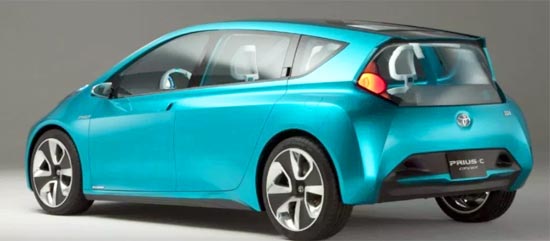
The Toyota Prius c (the “c” stood for “city”) was a subcompact hybrid hatchback that Toyota sold in North America for the 2012 through 2019 model years. Toyota has confirmed that the Prius c was discontinued after 2019, so there was no 2020 model. Production of the closely related Toyota Aqua continued in Japan until 2021, and the nameplate was also dropped in Australia in early 2020, but the U.S. and Canadian line ended with the 2019 car. This article covers what the Prius c was, how it was engineered, and what the final model offered.
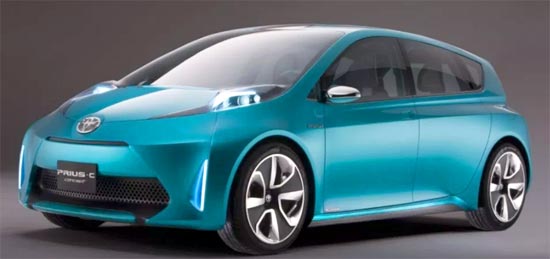
A Distinct Member of the Prius Family
The Prius c was not a trim level of the regular Prius. Toyota developed it as a separate model, smaller and less expensive than the standard Prius, to sit alongside the Prius v wagon and the Prius Plug-in Hybrid in a four-model Prius family. The production Aqua was shown at the 2011 Tokyo Motor Show, the U.S. version debuted at the 2012 North American International Auto Show in Detroit, and sales began in March 2012. In Japan the same car was the Toyota Aqua, and it became one of the country’s best-selling new cars.
Production Timeline and the Missing 2020 Model
The Prius c went on sale in 2011 in Japan and in 2012 in the United States, Canada, Australia and several Asian markets. Total production ran from December 2011 until 2021, but the North American model years were 2012 to 2019 only. Toyota’s official Prius c page states that “Prius c has been discontinued, making the 2019 the last model year.” Anyone looking for a 2020 Prius c is really looking at the 2019 model, or at Toyota’s other small hybrids such as the Corolla Hybrid, which replaced it in the U.S. lineup.
Interior and Equipment
The Prius c came with a 3.5-inch multi-information display and, on later models, a touchscreen infotainment system with Bluetooth, a USB port and a rearview camera. Automatic climate control, keyless entry and a six-speaker audio system were available. Standard safety equipment on the final cars included stability control, a backup camera and lane departure warning, but the Prius c did not offer the full Toyota Safety Sense suite that later Toyota models adopted.

Dimensions and Practicality
The Prius c was a true subcompact. It rode on a 100.4-inch wheelbase, measured about 160 inches long and roughly 67 inches wide, and weighed around 2,530 pounds. Despite the small footprint it seated five people and offered about 17 cubic feet of cargo space behind the rear seats, roughly matching a compact sedan’s trunk. Rear-seat legroom was limited, as expected in this class.

Powertrain and Specifications
The Prius c used a 1.5-liter four-cylinder engine (Toyota code 1NZ-FXE) running on the Atkinson cycle, combined with Toyota’s Hybrid Synergy Drive. Total system output was 99 horsepower, with 82 lb-ft of torque, sent to the front wheels through a continuously variable transmission. A 0.9 kWh nickel-metal hydride battery stored energy recovered during braking. The car’s small size and low weight made it one of the most efficient vehicles without a plug on sale in the United States.

Fuel Economy
The U.S. Environmental Protection Agency rated the 2019 Prius c at 48 mpg city, 43 mpg highway and 46 mpg combined. That combined figure was higher than the larger regular Prius of the same era in city driving and placed the Prius c among the most fuel-efficient cars available without plug-in charging. The American Council for an Energy-Efficient Economy (ACEEE) also recognized the Prius c for its low emissions on its annual greenest-cars list.
How It Compared to the Standard Prius
Where the standard Prius was a compact car, the Prius c was a subcompact built on Toyota’s B platform, shared with the contemporary Yaris. That made it shorter and narrower, easier to park and cheaper to buy, but it offered less interior room and less power. The regular Prius made about 121 horsepower and had a larger 1.8-liter engine, while the Prius c made 99 horsepower from its 1.5-liter unit. In return, the Prius c was rated higher in city fuel economy, which suited its intended role as an urban car.
Sales and Reputation
The Aqua/Prius c was a major seller in Japan, where the Aqua was the top-selling new car for three consecutive years from 2013 to 2015. Globally, Toyota reported more than 1.3 million sales of the model by early 2017, making it Toyota’s second-best-selling hybrid after the regular Prius at that time. In North America, however, sales slowed as buyers moved toward crossovers and as Toyota’s own Corolla Hybrid offered similar economy in a larger, more conventional package. That shift, rather than any fault in the car, is what ended the Prius c line in the United States.
Price and What Buyers Can Expect
The 2019 Prius c started at $21,530 for the base L model, according to Toyota’s published pricing, with the LE adding equipment and a higher price. Because the car was discontinued, there is no newer version to shop for. Used examples of the 2019 Prius c are now among the last of the line, and buyers should expect a small hybrid that prioritizes fuel economy over power and rear-seat space. The natural replacements in Toyota’s lineup were the Corolla Hybrid and the standard Prius.