The 2020 Toyota Prius was part of the fourth generation of the world’s best-known hybrid, a car built on the Toyota New Global Architecture (TNGA) and sold from the 2016 through 2022 model years. For 2020 the Prius carried over its gasoline-electric powertrain with small technology updates rather than a full redesign. It remained one of the most fuel-efficient cars on sale in the United States without a plug, and it offered something unusual for a compact hybrid: available all-wheel drive.

Fourth-Generation Prius at a Glance
The fourth-generation Prius arrived in 2015 and went on sale in the U.S. in January 2016. Toyota designed it to improve fuel economy, lower the center of gravity and sharpen the ride compared with the previous model. The car used a 0.75 kWh lithium-ion battery in front-wheel-drive form and a 1.2 kWh nickel-metal hydride battery in the all-wheel-drive version. The body was longer, wider and lower than the third-generation Prius, and the front suspension used a double-wishbone setup at the rear for the first time.
Hybrid Powertrain
The Prius paired a 1.8-liter four-cylinder gasoline engine (Toyota code 2ZR-FXE) with Toyota’s Hybrid Synergy Drive, a system that combines an electric motor, a generator and a power-split device. Combined system output was 121 horsepower. The gasoline engine ran on the Atkinson cycle for efficiency, and the car used an electronically controlled continuously variable transmission rather than conventional gears. Toyota said the engine’s thermal efficiency exceeded 40 percent, among the highest of any production gasoline engine.

Prius AWD-e
For the 2019 model year, Toyota added an all-wheel-drive version of the Prius called AWD-e. Unlike the mechanical all-wheel-drive systems used in some crossovers, the Prius AWD-e added a small independent electric motor to the rear axle. The system engaged automatically at low speeds, roughly up to 43 mph, and was designed to help with traction in snow and rain rather than for off-road driving. It was the first Prius with all-wheel drive to be sold in the United States. Toyota chose a nickel-metal hydride battery for the AWD-e because it performs better in the cold, where all-wheel-drive buyers are most likely to live.
Fuel Economy
The EPA rated the 2020 Prius as follows:
- Front-wheel drive (LE): 54 mpg city, 50 mpg highway, 52 mpg combined
- Front-wheel drive (L Eco): 58 mpg city, 53 mpg highway, 56 mpg combined
- All-wheel drive (AWD-e): 52 mpg city, 48 mpg highway, 50 mpg combined
The L Eco was the most efficient version, helped by lighter equipment and a slightly different specification. Even the all-wheel-drive model returned 50 mpg combined, which was better than nearly every other new car that did not plug in. The Prius also ran on regular gasoline.

Interior and Technology
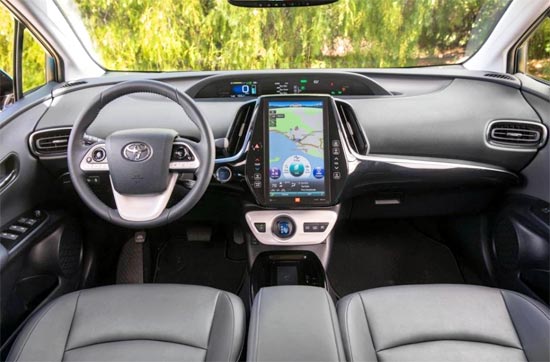
For 2020, Toyota made a seven-inch touchscreen with Apple CarPlay, Amazon Alexa compatibility and Toyota’s Safety Connect telematics standard. The interior layout was unconventional by traditional standards: a centrally mounted instrument cluster and a small shifter on the dash freed up space between the front seats. Available equipment included heated front seats, a wireless phone charger, adaptive cruise control and blind spot monitoring. Toyota Safety Sense P, including pre-collision warning and lane departure alert, was standard on the Prius. Cargo space was generous for a compact car, helped by the liftback body style and a low load floor.
How the Hybrid System Works
The Prius never needs to be plugged in. Its battery is charged by the gasoline engine and by regenerative braking, which captures energy that would otherwise be lost as heat when the car slows down. At low speeds and light loads the car can run on the electric motor alone for short distances. The power-split device blends engine and motor output continuously, which is why the Prius has no conventional gearbox. The engine also shuts off automatically when the car is stopped, such as at a traffic light.
Prius vs. Other Toyota Hybrids
By 2020 Toyota sold several hybrids, and the Prius sat between them in size and price. The smaller Prius c had already been discontinued after 2019, while the Corolla Hybrid offered similar economy in a more conventional sedan-and-hatchback shape. The Camry Hybrid and Avalon Hybrid were larger and more powerful but less efficient. The Prius Prime, a plug-in version, added roughly 25 miles of electric-only range. The standard Prius remained the benchmark for efficiency among Toyota’s non-plug-in models.
Trims and Pricing
Toyota expanded the Prius lineup for 2020. The L Eco started at $24,325, the LE at $25,535, and the LE AWD-e at $26,935. The XLE was priced at about $28,375, the XLE AWD-e near $29,375, and the range-topping Limited reached into the low $30,000s. These prices did not include the destination charge, which added several hundred dollars. The lineup gave buyers a clear choice between maximum efficiency in the front-drive L Eco and all-weather traction in the AWD-e models.
What Buyers Can Expect
The fourth-generation Prius was on sale from 2016 to 2022, so the 2020 model sits in the middle of that run. It is a used car today, but it benefits from Toyota’s long hybrid warranty and a reputation for durability. Buyers should decide whether they want front-wheel drive or AWD-e, since the rear-motor system suits cold climates but reduces fuel economy slightly and cannot be added later. As with any used hybrid, a battery health check and a full service history are worth requesting.