The 2021 Toyota C-HR is a subcompact crossover built around a highly sculpted body and a coupe-like roofline. This article focuses on the two areas Toyota emphasized most: the exterior design, including the Nightshade Edition and the available colors, and the interior layout, materials, and technology. The C-HR reached the United States for the 2018 model year and received its styling update for 2020, so the 2021 version carried those looks forward with a new blacked-out trim option; see the 2021 Toyota C-HR redesign and release date overview for the model-year changes.

Exterior Design

The C-HR measures 172.6 inches long, 70.7 inches wide, and 61.6 inches tall, riding on a 103.9-inch wheelbase. Its body uses deeply sculpted surfaces, a floating roofline, and rear door handles hidden in the C-pillars to read as a coupe rather than a conventional SUV. The front end pairs slim LED headlights with a large lower grille, and the rear uses a sloping tailgate with a spoiler. Toyota applied production techniques borrowed from concept-car building to preserve that shape at scale.
Nightshade Edition and Trim Styling
The 2021 model added a Nightshade Edition that blacked out much of the exterior. It uses black 18-inch alloy wheels, black lug nuts, black door handles, a black chin spoiler, and black badges, and it is built on the XLE’s equipment level. Standard LE and XLE models use body-color trim with 17-inch or 18-inch wheels, while the Limited adds larger 18-inch alloys and chrome accents. The Nightshade was one of several factory appearance packages Toyota offered across its lineup that year.
Color Options
Toyota offered the 2021 C-HR in Blizzard Pearl, Blue Eclipse Metallic, Magnetic Gray Metallic, Black Sand Pearl, and Silver Knockout Metallic. The Nightshade Edition was available in Black Sand Pearl, Blizzard Pearl with a black roof, Magnetic Gray Metallic with a black roof, and Supersonic Red with black. Two-tone paint schemes with a contrasting roof were part of the C-HR’s design concept, emphasizing the floating-roof look created by the blacked-out pillars.
Interior and Materials
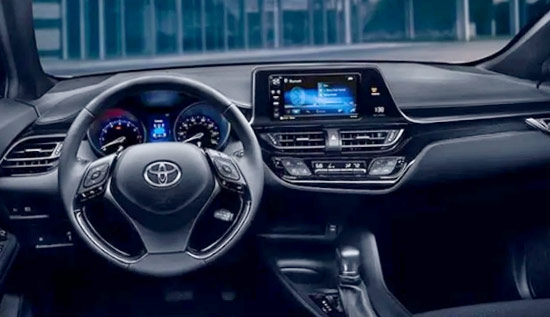
The C-HR seats five and uses a dashboard angled toward the driver, with a diamond-pattern theme carried through the door panels and headliner. Standard equipment includes an 8-inch touchscreen, dual-zone automatic climate control, a 60/40-split folding rear seat, and satellite radio with a trial subscription. Higher trims add leather upholstery, heated front seats, a power-adjustable driver’s seat, and ambient lighting. The Nightshade Edition uses black fabric with gunmetal trim, matching its exterior treatment.
Technology and Connectivity
Every 2021 C-HR includes an 8-inch multimedia touchscreen with Android Auto and Apple CarPlay, plus Bluetooth audio streaming and a six-speaker audio system. Higher trims add a blind spot monitor with rear cross-traffic alert, proximity keyless entry, and push-button start. Toyota Safety Sense 2.5 is standard across the range, adding pre-collision braking with pedestrian and cyclist detection, full-speed adaptive cruise control, lane tracing assist, and automatic high beams. Toyota did not offer a hybrid or all-wheel-drive version in the United States.
Cargo and Dimensions
Cargo space behind the rear seats is modest for the segment, and maximum volume with the second row folded is about 37 cubic feet, according to Kelley Blue Book. The sloping tailgate and high load floor reduce usable space compared with boxier rivals. Front-seat passengers have generous room, while rear headroom and outward visibility are limited by the roofline and thick rear pillars. Ground clearance and overall footprint place the C-HR among the smaller subcompact crossovers.
Pricing and Availability

Toyota announced the 2021 C-HR in September 2020, and it reached dealers that fall. Pricing started around $21,695 for the LE, with the XLE, Nightshade Edition, and Limited positioned above it. The model is front-wheel drive only and uses a 2.0-liter four-cylinder rated at 144 horsepower. Toyota discontinued the C-HR in the United States and Canada after the 2022 model year, so the 2021 and 2022 cars are the final first-generation versions sold in North America.
Safety and Driver Assistance
Toyota Safety Sense 2.5 came standard on the 2021 C-HR, replacing the earlier 2.0 version. The suite includes a pre-collision system with pedestrian and daytime cyclist detection, full-speed adaptive cruise control, lane departure alert with steering assist, lane tracing assist, and automatic high beams. The updated package also added emergency steering assist and intersection support. Blind spot monitoring with rear cross-traffic alert was standard on the XLE and above, and every C-HR included 10 airbags and a rearview camera.
Comfort and Rear Seat
Front passengers get supportive seats and generous legroom, while the rear bench is best suited to two adults because of the narrow center position and the sloping roof. The rear seat folds in a 60/40 split to expand cargo capacity, and higher trims add heated front seats and a power-adjustable driver’s seat. Toyota tuned the suspension for a comfortable ride rather than sharp handling, which suits the C-HR’s role as a style-focused city crossover.
How It Compares
The C-HR’s closest rivals in the United States were the Honda HR-V, Jeep Renegade, Subaru Crosstrek, and Chevrolet Trax. Most of those offered all-wheel drive, which the C-HR did not, and several offered more cargo space. The C-HR countered with standard active safety, distinctive styling, and a comfortable ride. Toyota positioned it below the RAV4, and after the Corolla Cross arrived for 2022, the C-HR was retired from the U.S. market.
Is the C-HR Right for You?
The 2021 C-HR suits buyers who want distinctive styling and standard safety technology in a compact, easy-to-park package with a comfortable ride. It is less suited to those who need all-wheel drive, maximum cargo space, or strong acceleration. Its 2.0-liter engine and CVT deliver adequate but not quick performance, and the hybrid drivetrain sold overseas was never offered in the United States. For a front-wheel-drive city crossover with a design-led identity, it remains a coherent package.