The 2021 Toyota C-HR was not a redesigned car. It was the fourth model year of the first-generation C-HR, which arrived in the United States for 2018, and it carried over the refreshed exterior that Toyota had introduced for 2020. Buyers hoping for an all-new C-HR in 2021 instead got a lightly updated version with a new Nightshade Edition and a broader safety suite. A true second-generation C-HR did not arrive until 2023, and that car was not sold in North America.

Why There Was No 2021 Redesign
Toyota redesigned the C-HR’s front end for the 2020 model year, giving it a new fascia, headlamps, bumper, grille and spoiler. The 2021 car reused all of it, so the visual changes were limited to trim and color. The C-HR remained on the TNGA GA-C platform shared with the Corolla and Lexus UX. The second-generation C-HR that Toyota eventually revealed in 2023 was built in Turkey and sold in Europe and Australia, not the United States, where the larger Corolla Cross took over the C-HR’s role.
What the 2021 Model Year Actually Updated
For 2021 Toyota concentrated on equipment rather than mechanical changes. The new Nightshade Edition added black 18-inch wheels, black door handles and a black chin spoiler. Toyota made Toyota Safety Sense 2.5 standard on every trim. New paint colors included Oxide Bronze, while Knockout Silver Metallic and Hot Lava were dropped. The engine, transmission, platform and dimensions were all carried over unchanged from 2020.
Engine Specs

In U.S. form the 2021 C-HR used a 2.0-liter naturally aspirated four-cylinder producing 144 hp at 6,100 rpm and 139 lb-ft of torque at 3,900 rpm. Power went to the front wheels through a continuously variable transmission with a simulated-gear function, which the EPA lists as a seven-speed automatic. All-wheel drive was not offered on the U.S. car. Toyota quoted EPA ratings of 27 mpg city, 31 highway and 29 combined, on regular gasoline.
The 2.0-liter engine in the U.S. C-HR was unrelated to the 1.2-liter turbo and 1.8-liter hybrid offered in other markets; it was a larger, naturally aspirated unit chosen for low-end smoothness and durability.
Hybrid and AWD Availability by Market
The U.S. C-HR was the simplest version of the car. In Europe and Japan, Toyota also offered a 1.8-liter hybrid system making about 122 hp, and some markets had a 1.2-liter turbocharged engine. A four-wheel-drive layout was available in Japan and Taiwan, but only with the 1.2-liter turbo, and the European hybrid was front-wheel drive. None of those powertrains reached U.S. showrooms, so American buyers got a single engine, one transmission and front-wheel drive only.
Exterior and Dimensions
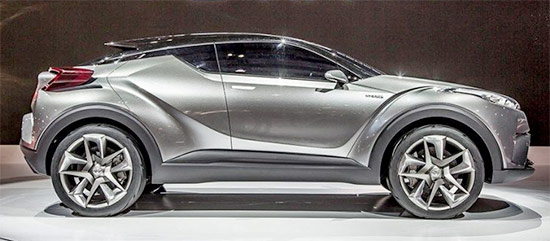
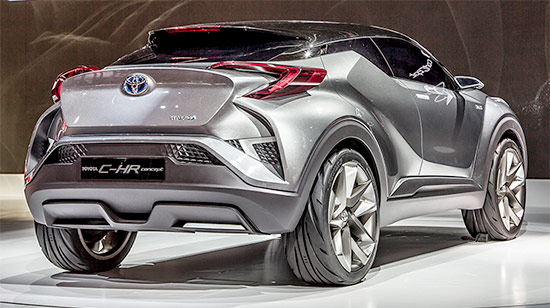
The C-HR’s defining traits are its steeply raked roofline, chiseled body sides and concealed rear door handles, which give it a coupe-like look despite its five-door layout. The first-generation car measured about 171.7 to 172.6 inches long, 70.7 inches wide and 61.6 inches tall, riding on a 103.9-inch wheelbase. Rear-quarter canards, underbody covers and taillight fins were part of the aerodynamic package. The 2021 Nightshade Edition added black 18-inch wheels, black door handles, a front chin spoiler and black badges.
Interior
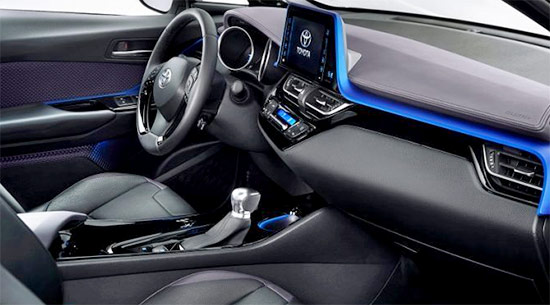
The cabin seats five with an 8-inch touchscreen, Apple CarPlay and Android Auto, dual-zone automatic climate control and a rear backup camera. For 2021 Toyota made Toyota Safety Sense 2.5 standard on every trim, adding daytime bicyclist detection, low-light pedestrian detection and intersection support to the pre-collision system, plus road sign assist and full-speed adaptive cruise control. Blind Spot Monitor and Rear Cross Traffic Alert were standard on the XLE, Nightshade and Limited but not the base LE.
Safety Ratings
The C-HR came with ten airbags, the Star Safety System of stability and traction control, Hill-Start Assist Control and a rear backup camera on all grades. The Insurance Institute for Highway Safety rated the first-generation C-HR well in its crash tests, and Toyota’s decision to make the more capable Safety Sense 2.5 suite standard for 2021 meant even the base LE gained the enhanced pedestrian and cyclist detection that had previously been reserved for other models.
C-HR vs Corolla Cross
The decision not to sell the second-generation C-HR in the United States followed the arrival of the Corolla Cross for 2022. That model was longer, roomier and more conventional than the C-HR, and it was offered with front- or all-wheel drive and a hybrid option. Toyota judged that the Corolla Cross covered the same customers more effectively, so the C-HR ended its North American run after the 2022 model year. The C-HR badge continued in Europe and Australia on the 2023 second-generation car.
What the First-Generation C-HR Was Known For
The C-HR was praised for its bold design and standard safety equipment, and criticized for its modest power, tight rear seat and lack of all-wheel drive in North America. Those traits were consistent across its U.S. run from 2018 to 2022, and they explain why the model stayed a niche choice rather than a volume seller. For buyers who valued styling over space and traction, the 2021 C-HR delivered the same package that had defined the car since launch.
Release Date and Pricing
Toyota announced the 2021 C-HR on September 2, 2020, and the car reached dealers later that year. Pricing started at about $21,695 for the LE and ran to about $26,750 for the Limited, with the XLE near $23,730 and the Nightshade Edition near $24,495. The model was discontinued in North America after the 2022 model year, as the Corolla Cross became Toyota’s small crossover for the U.S. market.