The 2021 Toyota Camry was not a new generation but a mid-cycle refresh of the eighth-generation XV70 sedan, which had gone on sale in 2017. Toyota announced the 2021 changes on 15 July 2020 and put the car on sale in the fall of that year. Rather than a clean-sheet redesign, the update revised the front styling, moved the interior to a new floating touchscreen layout, dropped the base L grade and added a sporty XSE Hybrid. The Camry remained Toyota’s best-selling car and one of the most popular mid-size sedans in the United States.

Redesign or Refresh?
A true redesign would have meant a new platform, new body and new nameplate generation. The XV70 Camry, built from June 2017, stayed in production through October 2024 and only received the 2021 facelift before a fully redesigned ninth-generation Camry arrived later. For 2021 Toyota changed the front fascia, gave the sporty SE and XSE grades a bolder honeycomb grille with side-vent inserts, added new colors and wheel designs, and updated the cabin. Mechanically, the car carried over the same platform and the same three powertrains, so it is accurate to describe the 2021 model as a facelift rather than an all-new design.
Powertrains
Toyota kept three powertrains for 2021, and Car and Driver reported them unchanged from the prior year:
- 2.5-liter four-cylinder (A25A-FKS): 203 horsepower at 6,600 rpm and 184 lb-ft of torque at 5,000 rpm on the LE and SE, or 206 hp on the XLE and XSE
- 3.5-liter V6 (2GR-FKS): 301 horsepower at 6,600 rpm and 267 lb-ft of torque at 4,700 rpm
- Hybrid: a 2.5-liter four-cylinder (A25A-FXS) with two electric motors and a lithium-ion battery, rated at 208 horsepower combined
- Eight-speed automatic on the gas models; an electronically controlled continuously variable transmission on the hybrid

All-wheel drive, which Toyota had introduced to the Camry for 2020, remained available on the four-cylinder LE, SE, XLE and XSE grades; the V6 and the hybrid stayed front-wheel drive only. The V6 was the quickest option and was also fitted to the sport-tuned TRD grade that had joined the range for 2020.
Exterior
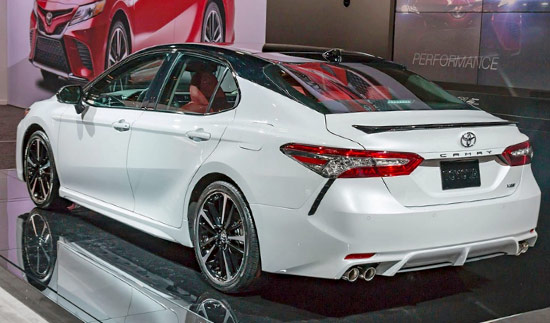
The 2021 Camry wore a lightly restyled nose. The LE and XLE kept a comfort-oriented look with a new front fascia, while the SE and XSE received a distinctly different lower bumper with a honeycomb-style grille and side vent inserts, plus new side-vent accents. Toyota added fresh paint colors and wheel designs across the range, and the hybrid XSE rode on gloss-black 19-inch wheels. The silhouette, dimensions and proportions were carried over from the 2018–2020 car.

Interior and Technology
The most visible 2021 change was inside. Toyota replaced the previous in-dash screen with a new floating or tablet-style multimedia display, offered in 7-inch and 9-inch sizes, positioned on top of the dashboard rather than integrated into it. The 9-inch unit was standard on higher grades and paired with Android Auto, Apple CarPlay and Amazon Alexa compatibility. Toyota also said the XLE grade received a new herringbone seat pattern and fresh leather upholstery, and the hybrid battery remained packaged beneath the rear seats so that the trunk volume matched the gas models.
The other major upgrade was safety technology. Every 2021 Camry introduced Toyota Safety Sense 2.5+, an updated version of Toyota’s standard driver-assist suite. Compared with the earlier system, TSS 2.5+ could detect a preceding bicyclist in daytime and a preceding pedestrian in low-light conditions, and it added intersection support to the pre-collision system. The suite still bundled full-speed adaptive cruise control, lane departure alert with steering assist and automatic high beams.

Dimensions, Body and Fuel Economy
The XV70 Camry measured 192.1 to 193.3 inches long, 72.4 inches wide and 56.9 inches tall on a 111.2-inch wheelbase. Curb weight ranged from about 3,262 to 3,659 pounds depending on the engine and drivetrain. The car seated five people and offered 15 cubic feet of trunk space, a figure the hybrid matched because Toyota mounted its battery beneath the rear seat rather than in the trunk. The 2021 facelift did not change any of these dimensions.
Fuel economy varied widely across the range. Car and Driver reported EPA ratings of 28 mpg city and 39 mpg highway for the front-drive four-cylinder LE and SE, up to 22 mpg city and 33 mpg highway for the V6, and 51 mpg city and 53 mpg highway for the base LE hybrid. The hybrid’s upper trims traded some of that efficiency for heavier equipment.
Release Date, Grades and Pricing
The 2021 Camry reached dealers in the fall of 2020 and was built at Toyota Motor Manufacturing Kentucky in Georgetown, with some early production also sourced from Japan. The L grade was discontinued, making the LE the entry model, and the hybrid range gained an XSE grade. Toyota also reduced hybrid prices relative to 2020 while raising them modestly on some gas trims.
Prices before destination charges started at $24,970 for the Camry LE. The SE was $26,485, the SE Nightshade Edition $27,185, the XLE $29,870 and the XSE $30,420. The hybrid line began at $27,270 for the LE, rising through the SE at $28,785 and the XLE at $32,170 to the new Hybrid XSE at $32,720.
Related Toyota reviews on this site: 2019 Toyota Tacoma 4×4 Double Cab Review, 2021 Toyota Camry Atara SX Release Date Canada, and Car Review.