The Toyota Rush is a seven-seat mini SUV developed for emerging markets and sold in Indonesia, Malaysia, the Philippines and other parts of Southeast Asia. It is closely related to the Daihatsu Terios and is not offered in the United States. The current third-generation Rush, coded F800 and F850, was introduced in Indonesia in November 2017, and the 2021 model year is a carryover of that design.

Because the Rush is built and priced for Southeast Asia, its specification is defined by that region rather than by U.S. standards. It is a body-on-frame-style compact SUV with a tall, boxy body, rear-wheel drive and seating for seven across three rows. It is positioned below the larger Fortuner in Toyota’s line-up.
The Rush nameplate
The Rush has been part of Toyota’s emerging-market range since the late 1990s. Its first generation, coded J100/F500 and launched in 1997, was a rebadged version of the Daihatsu Terios, the small four-wheel-drive SUV that also appeared as the Toyota Cami in Japan. A second generation, the J200/F700, arrived in 2006 and was sold widely across Asia under both Toyota and Daihatsu brands, with several facelifts during its long life. The current F800/F850 generation dates from 2017 and moved the model from a compact off-roader to a seven-seat family SUV.
The Rush is not the same vehicle as the Toyota Avanza, a van-based people mover that is also built for the same markets. The two share a maker and a general buyer profile, but the Rush uses a distinct taller SUV body and a rear-wheel-drive layout, while the Avanza lineage is a separate front-engine, rear-drive MPV platform.
Engine and drivetrain
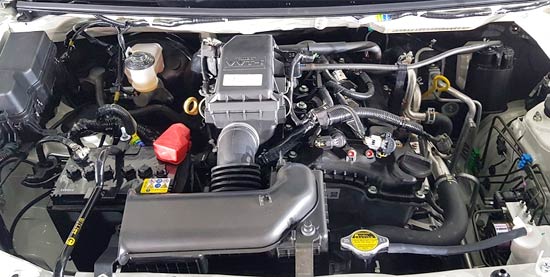
The third-generation Rush uses a single engine in all markets: a 1.5-liter 2NR-VE naturally aspirated inline-four with Dual VVT-i. In Indonesia it is rated at 105 PS (about 103 horsepower) at 6,000 rpm and 136 Nm (100 lb-ft) of torque, with no mechanical changes across the range. It drives the rear wheels through either a five-speed manual gearbox or a four-speed automatic.

Dimensions and seating
The second-generation Rush marked a significant growth in size over the earlier F700 model. Per the technical record, the new car measures 4,435 mm long, 1,695 mm wide and 1,705 mm tall on a 2,685 mm wheelbase, compared with 4,055 mm, 1,695 mm, 1,690 mm and 2,580 mm for its predecessor. Its ground clearance is 220 mm, and it seats seven. Malaysian cars came with 17-inch alloy wheels and 215/60 tires as standard.

Exterior
The styling pairs a tapered chrome grille with slim LED headlamps and LED daytime running lights, blacked-out pillars and body cladding that gives the car a crossover look rather than a pure SUV one. Around the back, wrap-around LED tail lamps meet black window trim and a roof spoiler. A Toyota-branded side-hinged tailgate carries the spare wheel on some grades. Indonesian cars were available in the TRD Sportivo specification until 2021, when it was replaced.
Interior and equipment
The cabin is finished mainly in dark materials with silver and chrome accents, and leather upholstery is fitted to higher grades while lower grades use fabric. Amenities include a touchscreen infotainment head unit, rear air-conditioning vents for the second row, and flat-folding second and third rows to expand the cargo space. Safety equipment includes six airbags on higher grades, stability control, hill-start assist and, in Malaysia, a pre-collision system.
The Rush was crash-tested by ASEAN NCAP in 2018 and earned a five-star rating, Paultan reported, covering adult and child occupant protection.
2021 GR Sport
In August 2021 Toyota introduced a Rush GR Sport in Indonesia, replacing the long-running TRD Sportivo grade. The GR Sport added a model-specific body kit, a start-stop system and revised cosmetic details, but the engine, transmission and suspension were unchanged, so performance is identical to other Rush variants.
Market status and price
The Rush is sold through Toyota dealers in Indonesia, Malaysia, the Philippines and neighbouring markets, where it competes with vehicles such as the Honda BR-V. It has never been part of Toyota’s U.S. range. The third-generation Rush is manufactured in Indonesia and assembled in Malaysia from kits, Paultan noted when the Malaysian range launched. When the third-generation Rush was launched in Malaysia in October 2018, UMW Toyota priced the two local grades with estimates starting from RM93,000 for the 1.5G and RM98,000 for the 1.5S, per Paultan’s launch report. Prices in other markets vary with local taxes and equipment.

Rivals and buyer appeal
The third-generation Rush competes in Southeast Asia’s crowded seven-seat compact segment. Its closest rival is the Honda BR-V, a similarly priced seven-seat model; when the Rush launched in Malaysia, Paultan compared the two directly, noting that the Rush is slightly shorter but taller than the BR-V and offers more ground clearance. The Rush also faces the Mitsubishi Xpander and Xpander Cross and the Toyota Avanza in the same price band.
The model’s appeal rests on a combination of seven seats, a raised ride height, a low running cost and Toyota’s service network in the region. Its limitations are a modest 1.5-liter engine and a four-speed automatic on most variants, both of which are older designs than the continuously variable and multi-speed transmissions used by newer rivals. Buyers in markets where the Rush is sold should treat it as a practical family transport rather than a performance or heavy-duty off-road vehicle.
Related Toyota guides on this site: 2020 Toyota Altis Review, 2020 Toyota Tacoma Redesign and Review and Toyota Review.