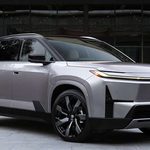
The 2019 Toyota Camry is the second model year of the eighth-generation sedan, which carries the internal code XV70. The redesign itself debuted at the 2017 North American International Auto Show and went on sale in 2017 as a 2018 model, so “all-new” describes the 2018 car. For 2019, Toyota carried the same platform and powertrains forward and broadened standard smartphone connectivity rather than reshaping the formula.

Platform and Styling
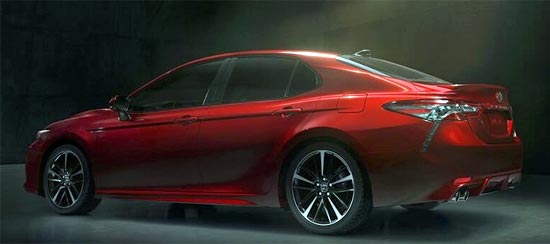
The eighth-generation Camry was the first car to take full advantage of Toyota New Global Architecture (TNGA), riding on the GA-K platform. Compared with the previous generation, the wheelbase grew by about two inches while the roof and hood were lowered, which cut the center of gravity and gave the sedan a wider, more planted stance. A double-wishbone rear suspension replaced the older design, and Toyota said the changes improved handling response and ride quality.
Engine Options and Performance
Three powertrains were offered for 2019, and all of the gasoline engines used an eight-speed automatic transmission while the hybrid used an electronically controlled continuously variable transmission (e-CVT).
- 2.5-liter four-cylinder (A25A-FKS, Dynamic Force): 203 hp and 184 lb-ft
- 2.5-liter four-cylinder in SE and XSE form: 206 hp and 186 lb-ft
- 3.5-liter V6: 301 hp and 267 lb-ft
- Hybrid: 2.5-liter four-cylinder plus electric motor, 208 hp combined

Fuel Economy
Efficiency was a strong point of the eighth-generation Camry, particularly for the base four-cylinder and the hybrid. EPA estimates for 2019 broke down as follows:
- 2.5-liter four-cylinder (L): 29 mpg city / 41 mpg highway / 34 mpg combined
- 2.5-liter four-cylinder (LE, SE, XLE, XSE): 28 mpg city / 39 mpg highway / 32 mpg combined
- 3.5-liter V6: about 26 mpg combined
- Hybrid (LE): 51 mpg city / 53 mpg highway / 52 mpg combined
What Changed for 2019
The biggest 2019 update was technology rather than hardware. Toyota made Apple CarPlay standard on every Camry trim for 2019, and the XLE V6 added Entune 3.0 Premium Audio with embedded navigation. No new engines or transmissions were introduced that year. Buyers who want the full hybrid breakdown can read our 2019 Toyota Camry Hybrid XSE Release Date, Price and Specs page.
Trim Levels and the TRD
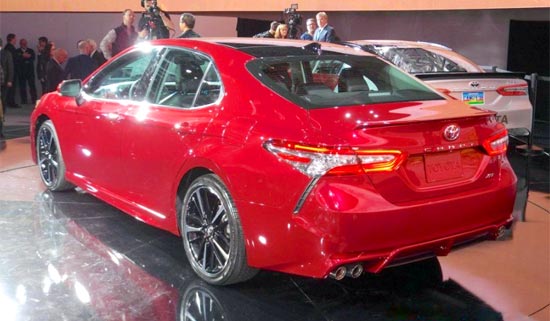
The 2019 Camry lineup included the L, LE, SE, XLE, and XSE, plus the Hybrid LE, Hybrid SE, and Hybrid XLE. The sporty Camry TRD, which pairs the 3.5-liter V6 with a stiffer chassis and a body kit, was added for the 2020 model year, not 2019. Australian buyers saw a different range, including the 2019 Toyota Camry RZ Review.
Safety
Toyota Safety Sense P was standard across the range, bundling pre-collision warning with pedestrian detection, lane departure alert with steering assist, dynamic radar cruise control, and automatic high beams. Toyota also fitted 10 airbags, a backup camera, and the six technologies of its Star Safety System, which together help explain the Camry’s strong safety reputation in the segment. A standard backup camera, a tire pressure monitoring system with auto location, and an anti-theft system rounded out the safety package across all trims.
Specifications at a Glance
| Powertrain | Power | Transmission | EPA combined |
|---|---|---|---|
| 2.5L four-cylinder | 203 hp (206 hp SE/XSE) | 8-speed automatic | 32–34 mpg |
| 3.5L V6 | 301 hp | 8-speed automatic | ~26 mpg |
| 2.5L hybrid | 208 hp | e-CVT | 52 mpg |
The table summarizes the three 2019 Camry powertrains. The hybrid stands out for fuel economy, roughly doubling the combined figure of the V6 while giving up about 90 hp.
Interior and Features
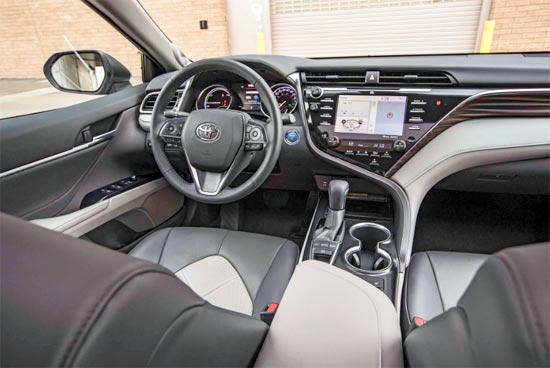
Inside, the eighth-generation Camry moved to a lower, more driver-oriented layout. Higher trims used a trio of linked displays: a 10-inch color head-up display on top models, a seven-inch multi-information display in the instrument cluster, and an eight-inch audio and navigation touchscreen set into a flush center console. Rear-seat room and a 15-cubic-foot trunk kept the sedan practical for families.
The 2019 Camry in Context
The Camry was the best-selling car in America for 15 consecutive years as of the eighth generation’s launch, and the 2019 model competed directly with the Honda Accord and Nissan Altima in the midsize sedan segment. The redesign’s lower stance and available V6 were intended to shed the Camry’s reputation for blandness without sacrificing reliability or value.
The 2.5-Liter Dynamic Force Engine
The base four-cylinder was an all-new design for the eighth generation. Toyota described it as a long-stroke, high-compression unit with multi-hole direct fuel injectors and electric variable valve timing (VVT-iE), achieving a world-leading thermal efficiency of about 40 percent. It was paired with a newly developed Direct Shift eight-speed automatic that locks up directly in gears two through eight to cut torque-converter losses.
Hybrid Detail
The Camry Hybrid used Toyota’s Hybrid Synergy Drive with a 2.5-liter Atkinson-cycle engine, an electric motor, and an e-CVT. For the eighth generation the battery pack moved from the trunk to beneath the rear seat, lowering the center of gravity. The hybrid’s transmission offered a Sport mode with simulated six-speed shifts, and the SE grade added paddle shifters.
Trim Walk
The lineup spanned value and sporty models. The L and LE were the entry trims, the SE and XSE added sportier suspension tuning, larger wheels, and paddle shifters, and the XLE and XSE were the higher-content models with a three-setting drive-mode selector. The Hybrid came in LE, SE, and XLE grades.