The global midsize pickup truck segment is undergoing one of the most fierce competitive transformations in modern automotive history. Long dominated by stalwart incumbents such as the Toyota Hilux, Ford Ranger, Isuzu D-Max, and Chevrolet Colorado, the traditional body-on-frame utility landscape is about to face an aggressive, highly unconventional challenger. The upcoming 2027 Kia Tasman represents the South Korean automaker’s first dedicated, ground-up foray into the serious global workhorse pickup arena, marrying heavy-duty commercial utility with groundbreaking progressive design and cutting-edge cockpit ergonomics.
Rather than following the soft, car-derived unibody architecture seen on light lifestyle trucks like the Hyundai Santa Cruz, Kia engineers engineered the Tasman from day one on a rigid, ladder-frame chassis. The pickup is purposefully targeted at demanding international markets spanning Australia, the Middle East, Southeast Asia, South Africa, and Latin America. Alongside exciting new vehicle previews such as the high-tech compact sedan cockpit in the 2027 Kia K4 GT-Line and sports styling seen in the 2027 Honda Prelude hybrid coupe, the Kia Tasman demonstrates Kia’s ambitious determination to disrupt traditional vehicle segments with daring engineering.
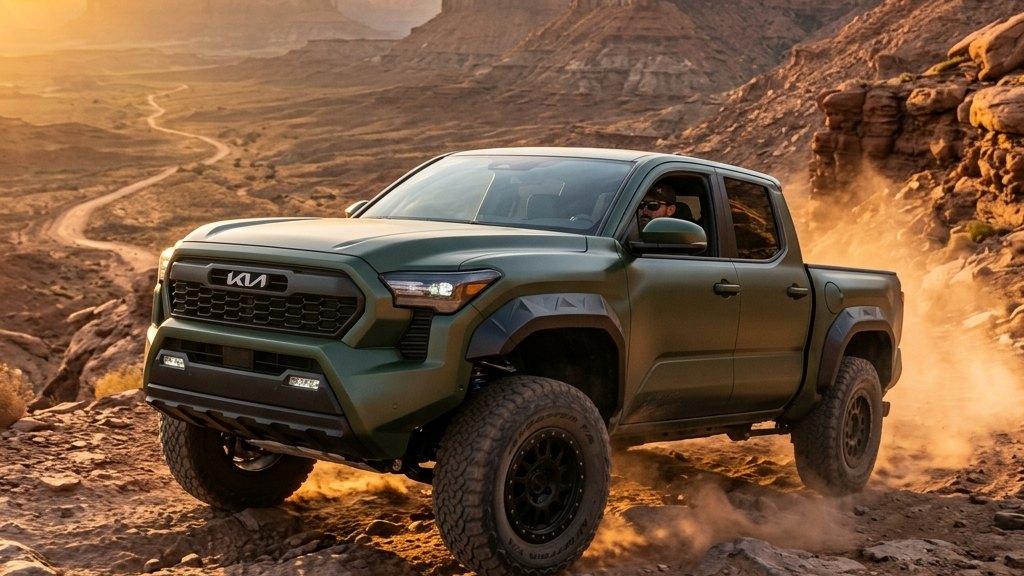
Exterior Architecture: Radical Industrial Design Philosophy
Visually, the 2027 Kia Tasman unapologetically rejects the copycat aerodynamic contours that dominate current midsize haulers. Adopting Kia’s progressive “Opposites United” styling philosophy with a distinct industrial utilitarian twist, the Tasman features a towering, upright front fascia with an aggressive vertical tiger-nose grille mesh, flanked by ultra-thin vertical signature Star Map LED daytime running lights positioned at the extreme outer fenders.
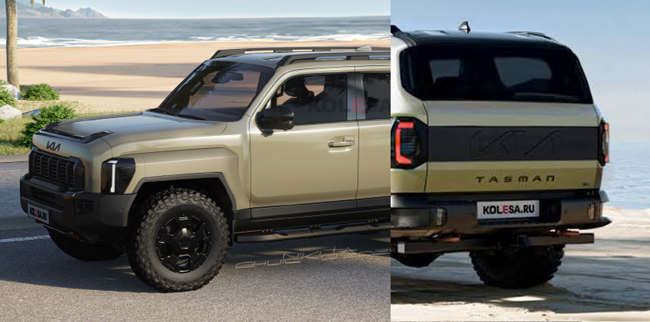
Perhaps its most talked-about design element is the boxy, squared-off wheel arch cladding that extends aggressively across the front fenders and rear quarter panels. These rugged composite flares not only incorporate integrated functional storage cubbies and charging ports on premium trims, but also provide superior stone-chip protection over rocky off-road terrain. High ground clearance, abbreviated front and rear overhangs, and integrated bed step bumpers ensure the Tasman backs up its polarizing aesthetic with authentic trail-ready departure angles.
Chassis, Powertrain Options, and Towing Capability
Underneath its bold sheet metal, the 2027 Kia Tasman utilizes a reinforced high-strength steel ladder frame chassis engineered to satisfy grueling global durability standards. In extensive development testing across the Australian Outback, deep sand dunes in the UAE, and icy Swedish proving grounds, the platform demonstrated benchmark structural rigidity.
Depending on regional market requirements, the Tasman offers two proven, punchy internal combustion powertrains, with dedicated hybrid and fully electric variations scheduled to join the portfolio later in the lifecycle:
- 2.2-Liter CRDi Turbo-Diesel Four-Cylinder: Delivering an estimated 207 horsepower and an immense 325 lb-ft (440 Nm) of low-end pulling torque. Paired with a robust 8-speed automatic transmission, this workhorse diesel is tuned for relentless low-rpm towing, sustained highway hauling, and exceptional fuel efficiency under heavy payloads.
- 2.5-Liter Smartstream Turbocharged Gasoline Engine: Shared with Kia’s performance-oriented passenger models, this punchy four-cylinder produces approximately 277 horsepower and 311 lb-ft (421 Nm) of torque, sprint-tuned for buyers desiring rapid acceleration and refined suburban cruising manners.
- Target Work Capacities: The Tasman matches class benchmarks with an official maximum braked towing capacity of 3,500 kg (7,716 lbs) and a functional payload rating exceeding 1,000 kg (2,204 lbs) inside a durable composite-lined bed equipped with a 240V onboard inverter.
Expected 2027 Kia Tasman Technical Specifications
The following table outlines the expected mechanical dimensions, performance targets, and competitive metrics for the upcoming 2027 Kia Tasman lineup across its primary double-cab configurations:
| Specification Metric | 2.2L Turbo-Diesel CRDi (4×4) | 2.5L Turbo Gasoline T-GDi (4×4) | Upcoming Tasman EV / Hybrid (Est.) |
|---|---|---|---|
| Engine Configuration | 2.2L Inline-4 Variable Geometry Turbo | 2.5L Inline-4 Direct Injection Turbo | Dual-Motor Electric AWD / Turbo-Hybrid |
| Peak Power Output | 207 hp @ 3,800 rpm | 277 hp @ 5,500 rpm | 350 hp combined (Projected) |
| Peak Torque Output | 325 lb-ft (440 Nm) @ 1,750-2,750 rpm | 311 lb-ft (421 Nm) @ 1,600-4,000 rpm | 480 lb-ft instantaneous torque |
| Transmission System | 8-Speed Heavy-Duty Torque Converter Auto | 8-Speed Automatic with Paddle Shift | Single-Speed Direct Drive / e-CVT |
| Four-Wheel Drive System | Part-Time 4WD with 4L/4H and Rear Locker | Full-Time Torque-on-Demand AWD w/ Low Range | Electronic Dual-Motor Torque Vectoring |
| Water Wading Depth | 800 mm (31.5 inches) with snorkel prep | 800 mm (31.5 inches) standard air intake | 800 mm sealed IP67 battery enclosure |
| Max Braked Towing | 3,500 kg (7,716 lbs) | 3,500 kg (7,716 lbs) | 3,500 kg targeted towing capacity |
| Target Price Range (USD) | $36,000 – $49,000 (Base Work to Off-Road) | $38,000 – $52,000 (Mid-Spec to X-Line) | $55,000 – $65,000 (Fully Electric Flagship) |
Advanced 4×4 Off-Road Technology and Terrain Modes
Kia has left no stone unturned in outfitting the Tasman with serious all-terrain hardware. Premium off-road trims (dubbed X-Pro) feature an electronically locking rear differential, underbody steel skid plates, and dedicated all-terrain tires wrapped around 17-inch reinforced alloy rims.
The Tasman’s electronic Terrain Mode system includes driver-selectable presets for Sand, Mud, Snow, and Rock, which dynamically calibrate throttle sensitivity, gear shift mapping, electronic stability control, and brake torque vectoring. Furthermore, a 360-degree Ground View Monitor uses high-resolution cameras to display a transparent bird’s-eye view of obstacles situated directly beneath the front tires and oil pan when negotiating steep mountain ledges.
Interior Luxury, Digital Displays, and Daily Practicality
Step inside the cabin, and the Tasman immediately separates itself from the spartan, scratch-prone interiors historically associated with commercial utility vehicles. The dashboard is crowned by Kia’s signature panoramic dual-screen display, integrating a 12.3-inch digital instrument cluster and a 12.3-inch ccNC infotainment touchscreen with wireless Apple CarPlay and Android Auto.
Kia designers focused heavily on everyday modular storage: the center console folds open into a flat tabletop desk ideal for laptop work on job sites, while folding rear seat cushions reveal hidden lockable storage bins for power tools and valuable gear. Acoustic laminated windshield glass, dual-zone climate control, ventilated vegan leather seating, and a premium Harman Kardon surround audio system elevate long-distance highway comfort to luxury SUV standards, mirroring the rapid electrification and cabin evolution seen across next-generation rivals like the 2027 Toyota bZ electric lineup and the refreshed 2027 Nissan Juke hybrid compact.
Market Positioning and Global Launch Timeline
The 2027 Kia Tasman is scheduled to initiate global market rollouts beginning late 2025 across Australia and Korea, followed by widespread availability across Southeast Asia, the Middle East, and Latin America throughout 2026 and 2027. By delivering uncompromised 3.5-ton towing, exceptional off-road prowess, and an ultra-modern luxury interior at a highly competitive price point, the Tasman is primed to establish Kia as a dominant new heavyweight in the international pickup truck arena.
Conclusion
With its polarizing, rugged aesthetic, genuine body-on-frame durability, heavy-duty towing metrics, and sophisticated digital cockpit, the 2027 Kia Tasman is not merely another lifestyle curiosity. It is a formidable, purpose-built midsize pickup truck engineered to challenge the established global hierarchy, delivering peerless value, durability, and daily refinement to work crews and overland adventure enthusiasts alike.