For decades, the mid-size sedan segment was defined by practical yet uninspiring commuters. Amidst sea of predictable family haulers, the Mazda 6 consistently carved out a dedicated following of automotive enthusiasts who refused to sacrifice driving dynamics, chassis communication, and sculptural aesthetic beauty for daily utility. When Mazda phased out the internal combustion Mazda 6 from major North American and European markets in recent years to focus heavily on its premium crossover lineup (CX-50, CX-70, and CX-90), long-standing brand loyalists lamented the apparent demise of Hiroshima’s iconic flagship sports sedan.
However, the global automotive landscape is entering an exhilarating new phase. Automotive industry reports, trademark filings (such as the Mazda 6e moniker in European intellectual property registries), and joint-venture architecture announcements confirm that the legendary sedan is preparing for a triumphant revival as the 2027 Mazda 6 EV. Engineered from the ground up to embody Mazda’s cherished Jinba Ittai philosophy (horse and rider as one), this next-generation electric fastback merges a rear-wheel-drive balanced platform, athletic fastback proportions, and sophisticated solid-state-ready battery packs. This exciting debut reflects the broader resurgence of driver-focused four-door cars, competing alongside exciting modern machines like the 2027 Kia K4 GT-Line turbo sedan in global showrooms.
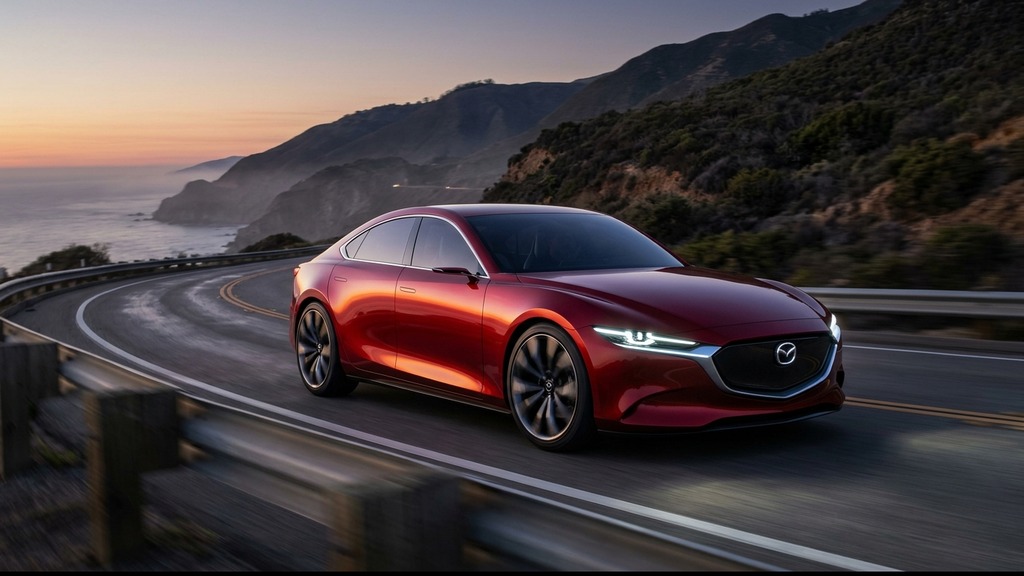
Kodo Soul of Motion Meets Clean Aerodynamic EV Architecture
Visually, the 2027 Mazda 6 EV represents an evolutionary leap for the brand’s acclaimed Kodo design language. Freed from the packaging constraints of a bulky longitudinal engine block and transmission tunnel up front, Mazda’s design studio has sculpted an extraordinarily low-slung front cowl with razor-thin adaptive matrix LED headlamps and an illuminated, three-dimensional floating five-point grille emblem.
The roofline flows gracefully into a coupe-like fastback silhouette reminiscent of the breathtaking Mazda Vision Coupe concept car. Active aerodynamic elements, including flush motorized door handles, aero-blade alloy wheels, and an active rear spoiler that deploys at highway speeds, allow the electric sedan to achieve a slippery drag coefficient target of approximately 0.22 Cd. This slippery profile is crucial for maximizing highway efficiency, a performance metric that matches the design ethos observed in the forthcoming 2027 Honda Prelude hybrid sports coupe.
Chassis Architecture and Dedicated RWD Electric Powertrains
Unlike compromised front-wheel-drive electric conversions, the 2027 Mazda 6 EV is engineered upon a dedicated modular EV skateboard platform. By situating the heavy battery enclosure structural floor beneath the cabin, engineers achieved an optimal 50:50 front-to-rear static weight distribution and a remarkably low center of gravity.
Mazda is slated to offer two primary powertrain configurations tailored to diverse driving preferences:
- Single-Motor RWD (Standard Touring & Grand Touring): A high-output permanent-magnet synchronous motor mounted directly on the rear axle delivers approximately 255 horsepower and 295 lb-ft of instantaneous torque. This setup guarantees lively, pure rear-wheel-drive steering feel unencumbered by front-wheel drive torque steer.
- Dual-Motor e-AWD (Signature Sport Performance): A secondary electric motor drives the front wheels, creating an intelligent all-wheel-drive system generating a combined 380 horsepower and over 440 lb-ft of torque. Augmented by Mazda’s proprietary e-G-Vectoring Control Plus system, the vehicle actively varies motor torque on each wheel during turn-in to enhance cornering stability.
- Battery Capacities and Range Targets: Standard trims will utilize a 68 kWh lithium iron phosphate (LFP) pack offering durable daily cycling, while premium trims feature an 82 kWh nickel-manganese-cobalt (NMC) pack targeting an EPA-estimated range of 310 miles (approximately 500 km on the European WLTP cycle).
- Suspension and Dynamic Tuning: Up front, an aluminum double-wishbone suspension setup delivers razor-sharp turn-in precision, paired with an independent multi-link rear axle designed to absorb high-frequency road imperfections without dulling chassis feedback.
Expected Specifications, Trims, and Estimated Pricing Table
Below is a projected breakdown of technical specifications, anticipated trim levels, performance metrics, and estimated base pricing for the 2027 Mazda 6 EV lineup:
| Trim Level / Specification | Drivetrain & Motor Setup | Horsepower & Torque | Battery Pack & Est. Range | 0-60 mph Acceleration | Estimated Base MSRP (USD) |
|---|---|---|---|---|---|
| Sport EV (Standard Entry) | Single Motor Rear-Wheel Drive (RWD) | 215 hp / 250 lb-ft | 68 kWh LFP / 250 Miles | 6.8 Seconds | $39,500 |
| Touring EV (Long Range) | Single Motor Rear-Wheel Drive (RWD) | 255 hp / 295 lb-ft | 82 kWh NMC / 310 Miles | 6.1 Seconds | $44,200 |
| Grand Touring e-AWD | Dual Motor Electric All-Wheel Drive | 340 hp / 390 lb-ft | 82 kWh NMC / 285 Miles | 4.9 Seconds | $49,800 |
| Signature Sport e-AWD | High-Output Dual Motor e-AWD | 380 hp / 440 lb-ft | 82 kWh NMC / 270 Miles | 4.2 Seconds | $54,900 |
With an entry price point anticipated under $40,000, the Mazda 6 EV positions itself aggressively against the Tesla Model 3, Hyundai Ioniq 6, and BMW i4, appealing directly to discerning motorists who crave bespoke Japanese craftsmanship over clinical tech minimalist cabins.
Bespoke Interior Craftsmanship and Digital Cockpit
Inside, the cabin of the 2027 Mazda 6 EV rejects the sterile, tablet-only trend dominating contemporary electric vehicles. Instead, the interior honors the traditional Japanese philosophy of “Ma” (the beauty of curated open space). Premium tactile materials abound, including real open-pore ash wood trim, brushed metal air vents, and optional buttery Nappa leather upholstery accented by delicate Japanese Chidori cord-stitching.
A crisp 15.6-inch widescreen OLED display floats gracefully along the upper dashboard, running Mazda’s latest responsive infotainment software with wireless Apple CarPlay, Android Auto, and cloud-connected over-the-air (OTA) update capabilities. Importantly for road safety, Mazda retains physical rotary Commander Control dials on the central console, allowing drivers to manipulate settings without diverting their eyes from the road.
Charging Infrastructure and Global Release Timeline
The 2027 Mazda 6 EV will feature native NACS (North American Charging Standard) charge port integration for the North American market, granting seamless access to thousands of high-speed charging stalls without clunky adapter dongles. Utilizing a state-of-the-art 400V/800V-compatible electrical architecture, high-speed DC fast charging from 10 percent to 80 percent state-of-charge will require just 22 minutes under optimal thermal conditions.
Industry rollout schedules project official automotive expo reveals in late 2026, with primary vehicle manufacturing commencing in early 2027. Deliveries to European and Asian markets are expected in spring 2027, followed closely by North American market arrival for the 2027 model year. For enthusiasts tracking EV advancements, this expansion complements the industry shift seen across rival zero-emission releases, including the 2027 Toyota bZ electric lineup and innovative crossover concepts like the 2027 Nissan Juke hybrid crossover.
By blending timeless Japanese aesthetic elegance, balanced rear-wheel-drive dynamics, and cutting-edge zero-emission battery engineering, the 2027 Mazda 6 EV demonstrates that transitioning to an electrified future does not mean abandoning the soul of pure driving pleasure.