Toyota did not redesign an existing Supra for 2019 — it revived a nameplate that had been dormant since 2002. The fifth-generation Supra, marketed in the United States as the GR Supra, went on sale in 2019 as a 2020 model year car. It was developed jointly with BMW, assembled in Austria, and positioned as Toyota’s flagship sports coupe.

A 17-Year Gap
The previous Supra, the A80, ended production in 2002, so the revival arrived after a gap of about 17 years. Reports of a successor circulated for much of that period, including speculation about a hybrid powertrain and a large V6. The car that finally emerged was a two-seat, front-engine, rear-wheel-drive coupe that shared its architecture and engines with BMW rather than reviving Toyota’s own straight-six family, a decision that shaped almost everything about the car.
Design Origins: the FT-1 Concept
The styling language traces to the FT-1, or “Future Toyota 1,” a concept car shown in 2014. The FT-1 previewed a low, muscular coupe with a long hood and a cab-rearward stance, and the production Supra carried those proportions into a roadgoing shape rather than adopting a retro design. The result was a distinctive double-bubble roof and a short rear deck that echo classic sports-car proportions without copying the earlier Supra.
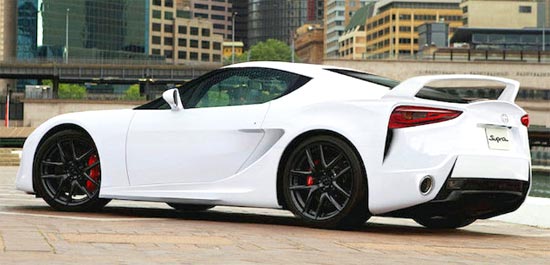
The BMW Partnership and Where It Is Built
The fifth-generation Supra rides on a platform co-developed with BMW that also underpins the G29 Z4. Both cars are built by the contract manufacturer Magna Steyr at its plant in Graz, Austria, on the same line. Toyota used BMW engines, electronics, and some interior hardware — the turbocharged inline-six in the 3.0 is BMW’s B58, and the 2.0-liter four-cylinder is BMW’s B48. Sharing development helped Toyota spread the cost of a low-volume sports car, a common strategy for niche performance models.
Powertrains and Performance
The Supra launched in 3.0 form and added a 2.0-liter four-cylinder for 2021, when the six-cylinder was also uprated. The table below summarizes the main configurations.
| Spec | Supra 2.0 | Supra 3.0 (2020) | Supra 3.0 (2021–2026) |
|---|---|---|---|
| Engine | 2.0L turbo I4 | 3.0L turbo I6 | 3.0L turbo I6 |
| Power | 255 hp | 335 hp | 382 hp |
| Torque | 295 lb-ft | 365 lb-ft | 367 lb-ft |
| Transmission | 8-speed auto | 8-speed auto | 8-speed auto or 6-speed manual |
| 0–60 mph | ~5.0 s | ~4.1 s | ~3.9 s |
All versions drive the rear wheels. The 3.0-liter cars are the performance models, while the 2.0 offers a lighter, less expensive entry into the range. Toyota quoted a 0–60 mph time of about 4.1 seconds for the original 3.0, a figure that improved with the 2021 power increase, and a top speed electronically limited to 155 mph.

What the Supra Is Like to Live With
The cabin is designed around the driver, with a low seating position and a compact, two-seat layout. Because the body is a liftback rather than a notchback coupe, there is a rear hatch and a usable cargo area behind the seats, though space is limited compared with a sedan. Some controls and the infotainment system are shared with BMW, a reminder of the joint development.

The Manual Arrives for 2023
Toyota added a six-speed manual transmission for the 2023 model year, announced on April 27, 2022. It was offered on the Supra 3.0 and 3.0 Premium, and Toyota built a limited A91-MT Edition for 2023 only. The manual was developed with ZF and given a shorter final-drive ratio than the automatic. Enthusiasts who had followed the rumors closely can read our 2019 Toyota Supra Might Get A Manual Transmission and V-6 engine and 2019 Toyota Supra Turbo Engine Specs and Review pieces for the earlier speculation.
The End of the Fifth Generation
The GR Supra was sold from the 2020 through 2026 model years, and production ended in March 2026 after a seven-year run, with no direct successor announced. That makes the fifth generation a comparatively short-lived flagship, and it means used buyers can now choose between the early 335-hp cars, the later 382-hp cars, and the 2023-and-newer manuals. U.S. sales were modest but grew after launch, from 2,884 cars in 2019 to 6,830 in 2021 before tapering again. For context on the wider range, see our Toyota Review index.

Dimensions and Weight
- Length: 172.4 inches
- Width: 73.4 inches
- Height: about 50.9 inches
- Wheelbase: 97.2 inches
- Curb weight: roughly 3,109–3,351 lb depending on engine and transmission
- Seating: two
Trims and Pricing
At launch the 2020 Supra 3.0 started at $49,990, with 3.0 Premium and Launch Edition variants above it. By the time the six-speed manual was added, the 2023 Supra 3.0 listed at $53,595, and the range-topping A91-MT Edition tested at $59,440. Toyota limited the A91-MT Edition to 500 units for the United States, and it came in two exclusive colors with a distinctive Cognac or Hazelnut leather interior.
Technology and Equipment
The 2023 update brought a new premium 12-speaker JBL audio system as standard on the 3.0 Premium and A91-MT trims, along with revised steering and suspension tuning and a new Hairpin+ function. The manual gearbox uses an intelligent Manual Transmission (iMT) system that matches revs on downshifts by default but can be switched off. These details, combined with the shared BMW electronics inside, make the Supra an unusual blend of Toyota branding and German engineering.