The Toyota Auris was a compact car derived from the Corolla and sold mainly in Europe and Japan. Introduced in 2006, it served as Toyota’s C-segment hatchback for more than a decade. Production of the second-generation Auris ended in December 2018, and the nameplate was retired in Europe in January 2019 when Toyota reverted to calling the car the Corolla. Buyers looking for a brand-new 2019 Auris could not find one, because Toyota had already replaced it with the twelfth-generation Corolla.

What the Auris Was
Toyota introduced the Auris in 2006 as the European and Japanese replacement for the Corolla hatchback, while the Corolla sedan continued under its own name. The first-generation car shared its platform with the E150-series Corolla. In Japan the more luxurious version was sold as the Toyota Blade. The name derives from the Latin word for gold, aurum. Toyota Australia and New Zealand opted to keep using the Corolla name for the same car, so the Auris was never sold under that badge in those markets.
In North America the second-generation Auris hatchback was sold first as the Scion iM for the 2016 model year and then as the Toyota Corolla iM for 2017 and 2018, after Toyota retired the Scion brand. The five-door was never marketed there under the Auris name.
The first-generation Auris went on sale in Japan in October 2006 and in Europe in early 2007, replacing the E120-series Corolla hatchback. It came as a three- or five-door hatchback and shared its platform with the E150-series Corolla; in Japan the plusher version was badged Toyota Blade.
Second Generation (E180; 2012–2018)
The second-generation Auris was revealed on 20 August 2012 and went on sale in Japan that same day; European sales began in early 2013 after a debut at the 2012 Paris Motor Show. It used Toyota’s New MC platform and was offered as a five-door hatchback and as an estate called the Touring Sports, plus a five-door panel van in Ireland. The second generation was produced from August 2012 until December 2018.
Interior and Cabin
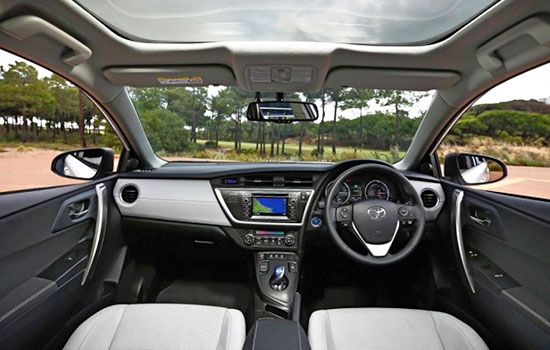
The E180 Auris adopted a wider, lower stance and a more upscale interior than its predecessor. Its dashboard design was later reused on the E170-series Corolla sedan that arrived in 2013. Automatic air conditioning, touchscreen infotainment and a reversing camera were among the features offered across the range, depending on trim.
Exterior and Body Styles
The hatchback measured 4,275 mm long from 2012 to 2015, growing to 4,330 mm after a 2015 facelift. The Touring Sports estate was 285 mm longer than the hatchback and shared its 2,600 mm wheelbase, adding load space while keeping the same footprint in the cabin. A 2015 update refreshed the front styling and interior materials.

Engines and Hybrid
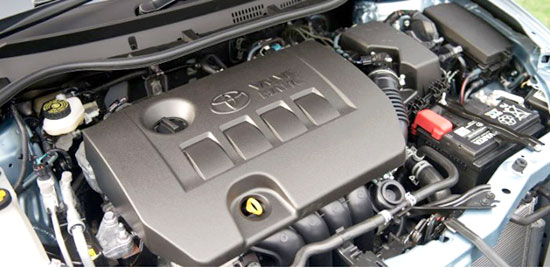
The second-generation Auris was offered with a wide range of gasoline, diesel and hybrid powertrains, including a new 1.2-liter direct-injection turbocharged gasoline engine and an upgraded 1.4-liter diesel.
- Gasoline: 1.2-liter 8NR-FTS turbo four, 1.33-liter 1NR-FE four, 1.6-liter 1ZR-FAE and 1.8-liter 2ZR-FAE.
- Diesel: 1.4-liter 1ND-TV, 1.6-liter 1WW and 2.0-liter 1AD-FTV four-cylinders.
- Hybrid: a 1.8-liter 2ZR-FXE gasoline engine with an electric motor and a power-split transmission.
The hybrid was the headline powertrain: the Auris Touring Sports was described as the first model in its segment to offer a full hybrid option. The system uses Toyota’s power-split architecture, needs no plug-in charging, and recovers energy under braking.
Toyota’s hybrid Auris paired the 1.8-liter Atkinson-cycle gasoline engine with an electric motor and an electronically controlled continuously variable transmission. The new 1.2-liter turbocharged gasoline engine replaced the older 1.33-liter unit as the entry-level choice and was tuned for stronger low-speed torque and lower fuel consumption.
The Touring Sports Estate
The estate variant was first shown at the 2012 Paris Motor Show. It kept the hatchback’s 2,600 mm wheelbase but stretched the body, and its engine range carried over from the hatchback. Toyota positioned the estate as a practical family car with the option of the same hybrid drivetrain.
The Touring Sports measured 4,560 mm long from 2012 to 2015, growing to 4,595 mm after the facelift. That made it roughly 285 mm longer than the hatchback, adding a more versatile load bay while seating five.
Why There Was No 2019 Auris
The third-generation Auris was previewed as a pre-production model at the Geneva Motor Show in March 2018, built on Toyota’s TNGA platform. However, shortly after production began Toyota discontinued the Auris name across Europe in January 2019 and reverted to the Corolla badge for the European market after a twelve-year hiatus. Taiwan was the exception, keeping the Auris name for its imported hatchback until July 2020, when it was renamed the Corolla Sport.
As a result, the last cars to wear the Auris badge were Taiwanese hatchbacks that overlapped with the Corolla-badged model already on sale in Europe.

The Corolla That Replaced It
The model that replaced the Auris is the twelfth-generation Corolla (E210), sold as a hatchback and as a Touring Sports estate in Europe. For buyers who want the newest equivalent of a new Auris, the correct name to search for is the Corolla hatchback or Corolla Touring Sports, not a 2019 Auris.
The E210 Corolla hatchback and Touring Sports went on sale in Europe in early 2019 on the TNGA GA-C platform, using Toyota’s latest hybrid system and the Toyota Safety Sense suite of driver aids. In practical terms, the Corolla of 2019 was the third-generation Auris under a different name.
Related Toyota model reviews on this site: Car Review, 2019 Toyota Altis Review, and 2019 Toyota Premio Review.