The 2019 Toyota C-HR was a subcompact crossover that sat below the RAV4 in Toyota’s global range. It was sold in North America as a front-wheel-drive-only model with a single naturally aspirated 2.0-liter engine, while European and Japanese buyers could choose a small turbocharged gasoline or a hybrid. This article covers the verified 2019 specifications, dimensions, fuel economy, pricing and release details, and corrects some of the speculation that circulated when the car first launched.

What the 2019 C-HR Actually Was
The C-HR was an all-new model unveiled as a concept in 2014 and put into production in 2016, coded AX10 (and AX50 in some markets). Toyota said the name stood for “Coupe High-Rider”, reflecting its raised-riding but coupe-styled body. North America began selling it in 2017 as a 2018 model year vehicle, so the 2019 car was only the second model year in the United States and Canada. It was not a redesign; Toyota updated the line-up and equipment for 2019 but left the mechanical package unchanged, per Wikipedia’s C-HR entry.
The C-HR used Toyota’s TNGA platform, and it was assembled in Japan at Toyota’s Takaoka plant for North America and Asia, and in Turkey for the European market. It was never offered with all-wheel drive in the United States.
In the United States the C-HR competed with the Honda HR-V, the Kia Soul and the Subaru Crosstrek. Consumer Reports described the car as nimble and enjoyable to drive but slow to accelerate, with poor visibility and no all-wheel-drive option — limitations that defined how it was received.
Engine and Performance
In North America the 2019 C-HR came with one engine: a naturally aspirated 2.0-liter inline four-cylinder producing 144 hp at 6,100 rpm and 139 lb-ft of torque at 3,900 rpm, per Edmunds. It drove the front wheels through a continuously variable transmission with a seven-step sequential-shift mode. Because the C-HR had no turbocharger and no hybrid option in the U.S., acceleration was modest; independent testing recorded a 0-to-60 mph time of more than eleven seconds.
Elsewhere the picture was different. European and Japanese versions were offered with a 1.2-liter turbocharged four-cylinder and, in some markets, a 1.8-liter hybrid that reworked the Prius’ gasoline-electric system. Neither of those powertrains was sold in the U.S.

Exterior Design
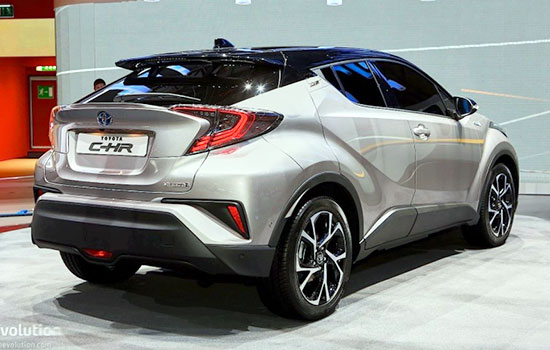
The C-HR’s styling was its defining feature, with a heavily sculpted body, a high beltline, hidden rear door handles and a sloping roofline. Every 2019 model measured 171.2 inches long, 70.7 inches wide and 61.6 inches tall on a 103.9-inch wheelbase, with 5.9 inches of ground clearance, according to Kelley Blue Book. The design limited rear visibility, and there was no all-wheel-drive option in this market.
Toyota added a new “Blue Flame” paint color for 2019 to replace Radiant Green Mica, and the optional R-Code package allowed either a white or a black contrasting roof.

Interior and Equipment
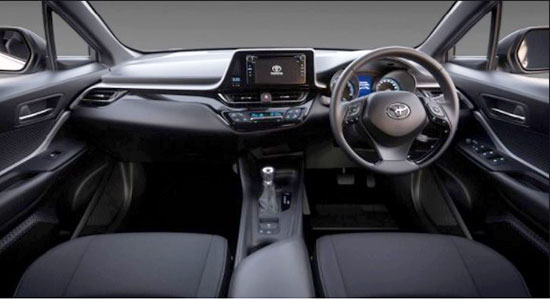
Inside, the 2019 C-HR seated five and used a driver-focused dashboard angled towards the driver. Every model gained an 8-inch touchscreen with Apple CarPlay and Entune 3.0 as standard, and the reversing-camera image was displayed on that screen rather than the mirror used previously. Higher trims added heated front seats, dual-zone automatic climate control, a leather-trimmed steering wheel and, on the Limited, full leather upholstery and ambient lighting. The rear bench was reasonably roomy, but the small rear windows gave the cabin a dark feel, and cargo space was 19.0 cubic feet behind the rear seats and 36.4 cubic feet with them folded.
Dimensions and Fuel Economy
The U.S. Environmental Protection Agency rated the front-wheel-drive 2019 C-HR at 27 mpg city, 31 mpg highway and 29 mpg combined. Key figures, as listed by Edmunds and Kelley Blue Book, were:
| Specification | 2019 C-HR |
|---|---|
| Engine | 2.0L naturally aspirated inline-four |
| Power | 144 hp at 6,100 rpm |
| Torque | 139 lb-ft at 3,900 rpm |
| Transmission | CVT with 7-step shift mode |
| Drivetrain | Front-wheel drive |
| EPA economy | 27 / 31 / 29 mpg |
| Length × width × height | 171.2 × 70.7 × 61.6 in |
| Wheelbase | 103.9 in |
| Curb weight | 3,300 lb |
| Cargo (seats up / down) | 19.0 / 36.4 cu ft |
Trim Levels, Price and Release Date
For 2019 Toyota replaced the two-trim line-up with three: LE, XLE and Limited. The entry-level LE was new and started at $21,145 before destination, the XLE at $23,180 and the Limited at $26,200, according to Edmunds. Including destination, Cars.com listed the starting prices as $22,090, $24,125 and $27,145 respectively. Toyota Safety Sense P was standard across the range, bringing forward collision warning with automatic emergency braking and pedestrian detection, lane departure alert with steering assist, automatic high beams and full-speed adaptive cruise control, along with 10 airbags under the Star Safety System.
The 2019 C-HR went on sale in the United States in 2019 and remained on sale in North America through the 2022 model year, after which Toyota withdrew it before reintroducing a battery-electric C-HR later in the decade.
Summary
The 2019 Toyota C-HR was a style-led subcompact crossover with a single 144 hp 2.0-liter engine, front-wheel drive and a 29 mpg combined EPA rating. Its updates that year were trim and equipment changes rather than mechanical ones, and its main drawbacks were slow acceleration and restricted visibility. Readers comparing it with Toyota’s conventional hatchback can see the 2019 Toyota Auris Review, and the larger sedan range is covered in the 2019 Toyota Avensis Interior Review. The site’s Car Review index collects more Toyota coverage. Overall, its equipment and fuel efficiency were competitive for the segment, but the single powertrain choice limited its appeal in the United States.