“Corolla Altis” is the name Toyota uses for the Corolla sedan in the Philippines and several other Southeast Asian markets. The 2019 calendar year spans two different Altis models in the Philippines: the outgoing eleventh-generation car, which continued to be sold into 2019, and the all-new twelfth-generation model that arrived in September 2019 and was marketed as a 2020 model year. That distinction matters, because the redesign did not take place for the 2019 model year itself.

Two Corolla Altis Models in 2019
For the first part of 2019, Toyota Motor Philippines was still selling the eleventh-generation Corolla Altis, a car that had been on sale locally since 2014. That model used the older, non-TNGA platform and a four-speed or continuously variable automatic transmission depending on variant.
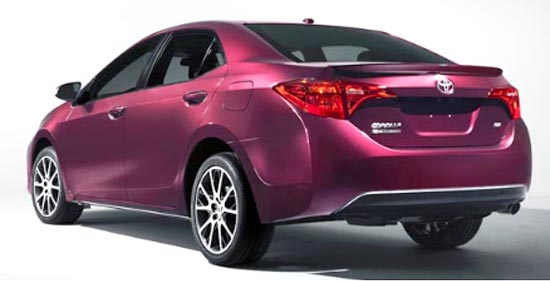
The eleventh-generation Altis was a conservative, rear-seat-focused sedan that appealed to families and fleet buyers. It used an older platform shared with the previous Corolla and Auris, and its cabin emphasised space and durability over style. It was a sensible, low-risk car rather than a design statement.
The genuine redesign arrived on 9 September 2019, when Toyota Motor Philippines launched the twelfth-generation Corolla Altis, known internally as the E210 and built on Toyota’s TNGA GA-C platform. It was branded as a 2020 model. This is the car that most people mean when they talk about the “new” Altis, and it introduced a hybrid version to the nameplate for the first time.
The New Altis Arrives
The twelfth-generation Altis is closely related to the international Corolla sedan. In the Philippines, Toyota used the “Prestige” style of the E210 sedan, which is the version sold across Southeast Asia, Taiwan, Europe and other markets, with a more upright front end than the sportier North American car. The new model was longer, lower and wider than its predecessor.
The move to the GA-C platform brought a windshield base 40 mm lower and a lower dashboard compared with the previous Corolla, changes Toyota made to improve visibility and lower the center of gravity. The seats were positioned 25 mm lower to preserve headroom. Under the skin, the E210 shares its platform with the Toyota C-HR, the previous-generation Prius and the Corolla Cross.

Interior and Equipment
The new Altis cabin used a horizontal dashboard layout with a freestanding touchscreen for infotainment, a redesigned instrument cluster and a new automatic climate control system. Toyota Motor Philippines fitted seven airbags, ABS with electronic brake distribution, brake assist, vehicle stability control and hill-start assist across the range. Parking sensors and a reversing camera were reserved for the upper variants.
The range-topping 1.8-liter hybrid added the Toyota Safety Sense suite, which brought a pre-collision system, lane departure alert, dynamic radar cruise control, automatic high beams and lane tracing assist. Upper variants also gained an electronic parking brake, an eight-way power driver’s seat, an auto-dimming rearview mirror and leather upholstery.
Rear passengers got a 60/40 split-folding seat on most variants, and the trunk, while not the largest in the class, was competitive with rivals such as the Honda Civic and Mazda3.

Engines and Hybrid
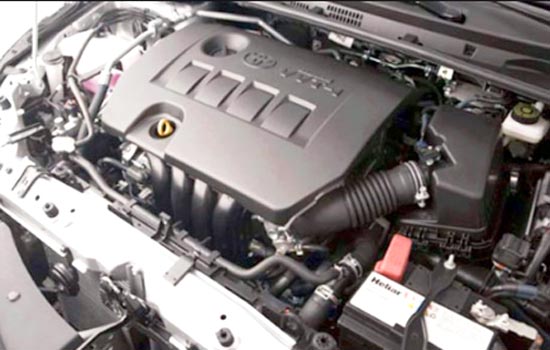
Toyota Motor Philippines offered two engines in the new Altis. The non-hybrid variants used a 1.6-liter four-cylinder, code 1ZR-FE, with Dual VVT-i, while the hybrid used a 1.8-liter engine, code 2ZR-FXE, working with an electric motor.
| Version | Engine | Output | Transmission |
|---|---|---|---|
| 1.6 E / 1.6 G | 1.6 L 1ZR-FE inline-4 | 121 PS (about 119 hp); 153 Nm | 6-speed manual or CVT |
| 1.6 V | 1.6 L 1ZR-FE inline-4 | 121 PS; 153 Nm | CVT |
| 1.8 V Hybrid | 1.8 L 2ZR-FXE + electric motor | 97 PS engine; 121 PS system | eCVT |
The hybrid could run on electricity alone for short distances and offered Eco, Normal and Sport driving modes. Paired with the eCVT, it was the most fuel-efficient version of the Altis sold in the Philippines. Buyers choosing between the 1.6 gasoline and the 1.8 hybrid generally weighed purchase price against running cost: the gasoline was cheaper to buy and simpler, while the hybrid delivered lower fuel consumption in city traffic, where the electric motor did the most work.
Prices and Variants
Toyota launched the new Altis in the Philippines with five variants. Prices started at Php 999,000 for the 1.6 E manual and rose to Php 1,580,000 for the 1.8 V Hybrid CVT, a significant premium for the hybrid.
| Variant | Price at launch |
|---|---|
| 1.6 E MT | Php 999,000 |
| 1.6 G MT | Php 1,045,000 |
| 1.6 G AT | Php 1,115,000 |
| 1.6 V CVT | Php 1,185,000 |
| 1.8 V Hybrid CVT | Php 1,580,000 |
Dimensions and Availability
The international E210 Corolla sedan on which the Philippine Altis is based measures about 4,630 mm in length, 1,780 mm in width and 1,435 to 1,455 mm in height, on a 2,700 mm wheelbase. The car went on sale in the Philippines in September 2019 and replaced the eleventh-generation model.
The Corolla Altis has long been one of the best-selling sedans in the Philippines, and Toyota positioned the hybrid as a way to introduce electrified driving to mainstream buyers. The Altis name is also used for the Corolla sedan in Thailand, Taiwan, Malaysia and Indonesia, where Toyota sells the same Prestige body style with local variations in engines and equipment. Readers can compare it with our 2019 Toyota Corolla Altis Review and our 2019 Toyota Camry Atara SX articles. This feature is part of our wider Car Review coverage.