The Toyota Etios was a budget subcompact car sold mainly in India, Brazil and other emerging markets. It came as a four-door sedan and, with the Liva suffix, as a five-door hatchback. Production began in late 2010 and continued, in various markets, into 2023. There was no dedicated 2019 model: the Etios received its last major update in September 2016 and was then carried forward largely unchanged until it was retired.

What the Etios Was
Toyota developed the Etios around a low-cost platform it called EFC, for Entry Family Car, rather than the Yaris platform originally considered. The car was aimed at the market dominated by the Dacia/Renault Logan, with India and Brazil as the main manufacturing bases. Toyota invested $350 million in a second Indian plant to build it. The name comes from the Greek word ethos, meaning spirit or character, while the Liva suffix came from the phrase “live your life” and the Valco name used in Indonesia from “value” and “comfort.”
The range later grew to include the Etios Cross, a crossover-styled version based on the Liva hatchback, launched in 2014. Toyota also ran the Etios Motor Racing one-make series in India from 2012 to promote the car to younger buyers, preparing cars with help from Toyota Racing Development.
Production and Model Years
The Etios sedan entered production in India in November 2010, with the Liva hatchback following in June 2011. It was updated three times — in March 2013, November 2014 and September 2016 — but the overall design was never replaced. Indian production stopped in March 2020 because the Etios could not be upgraded to meet the Bharat Stage 6 emissions rules that took effect in April 2020. Brazilian production ended in April 2021, and export-market production continued until mid-2023. In Indonesia, the hatchback was assembled as the Etios Valco between March 2013 and October 2017. Because of this timeline, a shopper looking for a 2019 Etios should understand it was simply a carryover car, not a new generation.
Engine Specifications (India)
Indian-market cars used the following engines:
- 1.2-liter 3NR-FE four-cylinder gasoline: 79 hp at 5,600 rpm and 104 Nm at 3,100 rpm, five-speed manual; about 17.7 km/L.
- 1.5-liter 2NR-FE four-cylinder gasoline: 89 hp (90 PS) at 5,600 rpm and 132 Nm at 3,000 rpm, five-speed manual; 0–100 km/h in 10.6 seconds, top speed 187 km/h, about 16.7 km/L.
- 1.4-liter 1ND-TV four-cylinder turbo-diesel: 67 hp at 3,800 rpm and 170 Nm at 1,800–2,400 rpm, five-speed manual; about 23.6 km/L.
Brazilian cars used flexible-fuel engines able to run on gasoline, ethanol blends from E20/E25 up to neat hydrous ethanol (E100).

Sales Across Markets
Beyond India, the Etios found buyers in Brazil, Argentina, Indonesia and South Africa. Brazilian production began in September 2012, and Brazilian sales peaked at 73,387 in 2017. In Argentina, sales of the sedan and hatchback reached 32,522 in 2017, helped by the car’s large trunk and low price. Total Etios production in Brazil alone exceeded 600,000 units by early 2021.
Exterior and Dimensions
Sedan and hatchback shared the same 1,695 mm width and 1,510 mm height, but the hatchback had a shorter body. The sedan’s wheelbase was 2,550 mm and its length ranged from about 4,265 mm to 4,370 mm depending on the update; the hatchback’s wheelbase was 2,460 mm and its length was roughly 3,775 to 3,885 mm. The design was simple and functional, with a compact footprint suited to crowded cities.

Interior and Practicality
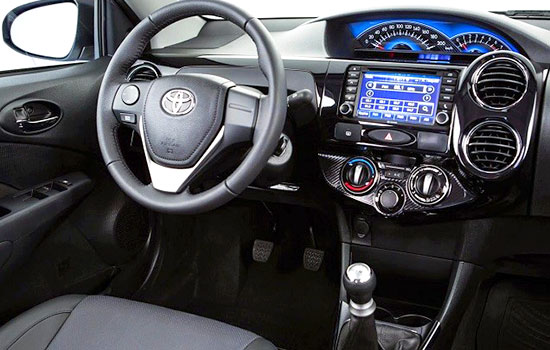
The Etios prioritized interior space and a low price over luxury. The Argentine-market sedan had a 562-liter trunk, which Toyota described as the largest in its segment and larger than the Toyota Corolla’s 470 liters. Buyers got a straightforward dashboard, durable materials and a layout designed for ease of use rather than style.
The hatchback version, sold as the Liva, traded some luggage space for a more compact footprint and a lower price. Both body styles used durable plastics and simple switchgear throughout the cabin.
Safety
The Indian Etios came with an immobilizer and door-ajar warning as standard, but dual airbags, ABS and EBD were fitted only to higher trims. Tested without ABS in 2016, it earned a four-star adult-occupant and three-star child-occupant rating from Global NCAP. A later Brazilian version with two airbags earned a four-star adult and four-star child rating from Latin NCAP in 2019.
The 2016 result applied to Indian cars tested without ABS; versions fitted with ABS, electronic brakeforce distribution and dual front airbags offered more protection, though side and curtain airbags were not part of the lineup.
Pricing and Availability
The Etios was positioned as an affordable entry-level Toyota. Indian sales peaked at 73,831 in 2012 and had fallen to 26,319 by 2019 before the line ended. Since factory production has ceased, buyers can only find used examples, and parts and service follow Toyota’s established dealer network in the markets where the car was sold.
What Replaced It
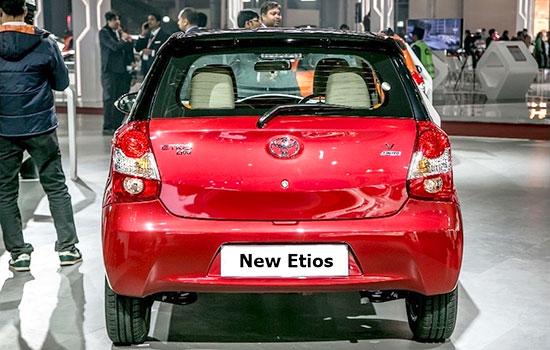
Toyota replaced the Etios in India with the more upmarket Yaris sedan and the Suzuki Baleno-based Glanza hatchback, and in Brazil the Yaris took over the entry-level role. In Indonesia the Agya became the budget model. The Etios name was retired rather than passed to a successor, which is why no new model year was ever announced after production ended.
Related Toyota model reviews on this site: 2019 Toyota Avalon Rumors and Review, 2019 Toyota Avensis Interior Review, and Car Review.