The Toyota Fortuner is a seven-seat, body-on-frame SUV that Toyota builds on the same ladder chassis as the Hilux pickup. It has been on sale since 2005 and is marketed across Asia, the Middle East, Africa, South America and Australasia, but it has never been offered in the United States. The 2019 model year falls in the middle of the second generation, which was introduced in 2015 and facelifted in 2020.

Is there a 2019 Toyota Fortuner?
Yes. The Fortuner was a real, in-production vehicle in 2019, and the 2019 model year belongs to the second generation (model codes AN150 for four-wheel-drive cars and AN160 for rear-wheel-drive cars). Toyota unveiled the second-generation Fortuner on 16 July 2015 at simultaneous events in Bangkok, Thailand and Sydney, Australia, and put it on sale in Australia in late October 2015, according to Toyota’s global newsroom. It replaced the first-generation Fortuner, which was built from 2004 to 2015.
That timeline matters, because some older write-ups described the 2019 Fortuner as an all-new, larger, lighter and more aerodynamic redesign that was about to launch. It was none of those things. The 2019 car is a carryover of the 2015 second-generation vehicle, and the genuine visual update, the facelift with a new front end and a 2.8-liter diesel upgrade, did not arrive until June 2020. The second-generation Fortuner’s specifications are cataloged on Wikipedia.
Platform, layout and dimensions
Like the Hilux, the Fortuner sits on Toyota’s IMV platform, a body-on-frame design with a live rear axle. It is a five-door SUV with three rows of seats and room for seven people. Key second-generation dimensions are:
- Wheelbase: 2,750 mm
- Length: 4,795 mm
- Width: 1,855 mm
- Height: 1,835 to 1,850 mm, depending on wheels and suspension
- Curb weight: 1,850 to 2,135 kg
- Fuel tank: 80 liters
Drive is either rear-wheel drive or part-time four-wheel drive with a low-range transfer case, depending on market and grade.
Engines and performance
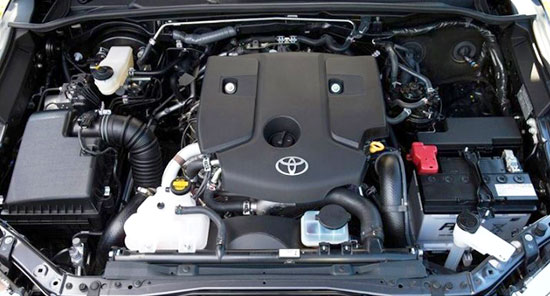
Toyota offered several engines in the second-generation Fortuner, and which ones a buyer gets depends on the market. The diesels come from Toyota’s GD family, while the gasoline engines are carried over with Dual VVT-i. As Paultan.org reported at the 2015 launch, the 2.8-liter diesel and the 2.4-liter diesel replaced the older 3.0- and 2.5-liter units.
| Engine | Type | Power | Torque |
|---|---|---|---|
| 2.4 L 2GD-FTV | Inline-4 turbodiesel | 150 PS (110 kW) at 3,400 rpm | 400 Nm at 1,600-2,000 rpm |
| 2.8 L 1GD-FTV | Inline-4 turbodiesel | 177 PS (130 kW) at 3,400 rpm | 420-450 Nm, market-dependent |
| 2.7 L 2TR-FE | Inline-4 gasoline, Dual VVT-i | 164-166 PS (122 kW) at 5,200 rpm | 245 Nm at 4,000 rpm |
| 4.0 L 1GR-FE | V6 gasoline, Dual VVT-i | 235 PS (175 kW) at 5,200 rpm | 376 Nm at 3,800 rpm |
Transmission choices are a six-speed manual or a six-speed automatic, the automatic featuring sequential shifting and paddle shifters on higher grades. The diesel 4×4 system uses a rotary selector for high-range two-wheel drive, high-range four-wheel drive and low-range four-wheel drive.
Exterior and interior

The second-generation Fortuner has projector or bi-LED headlights depending on grade, LED daytime running lights, fog lamps, a chrome grille and 17- or 18-inch alloy wheels. Roof rails, privacy glass and a power tailgate appear on the upper trims.

Inside, higher grades add leather-trimmed seats, an eight-way power driver’s seat, a touchscreen infotainment system, climate control for all three rows, keyless smart entry and start, and a powered tailgate. Every second-generation Fortuner has an air-conditioned cool box and steering-wheel-mounted audio and phone controls.
The 2019 model-year update and safety
The most significant change during the 2019 model year came in Australia, where Toyota made its Toyota Safety Sense suite standard across the Fortuner range in October 2019. The update added autonomous emergency braking (a pre-collision system with vehicle and pedestrian detection by day or night and cyclist detection during the day), lane-departure alert with steering assistance, active cruise control that operates above 40 km/h, and road-sign assist. GoAuto reported that the entry GX rose to A$45,965, the GXL to A$50,790 and the Crusade to A$58,290, before on-road costs.
The five-star ANCAP rating for that updated Fortuner applies to vehicles built from August 2019 and on sale from October 2019, as recorded by ANCAP. The earlier rating, from 2015, was based on crash tests of the Toyota Hilux, which shares the platform. Buyers should check the build month: a 2019 Fortuner assembled before August 2019 will not have the complete Toyota Safety Sense package.
Fuel use and running costs
The Australian-spec Fortuner runs the 2.8-liter 1GD-FTV turbo-diesel, rated at 130 kW (174 hp) and 450 Nm and matched to a six-speed automatic. Toyota quoted combined fuel consumption of 8.6 L/100 km on the Australian test cycle, and every Australian Fortuner is four-wheel drive.
Where the Fortuner is sold, and where it is not

The Fortuner is assembled and sold in Thailand, Indonesia, the Philippines, India, Vietnam, Malaysia, Pakistan, South Africa, Australia, New Zealand and the Middle East, and it is sold as the SW4 in Argentina and Brazil. It is not sold in the United States or in Western Europe. Earlier articles that referred to a Toyota Fortuner USA were describing a vehicle Toyota has never offered there; the closest US-market Toyota is the 4Runner, a different model on a different platform.
Rivals and buying advice
In showrooms the Fortuner competes with other ladder-frame seven-seaters built from pickups, including the Ford Everest, Isuzu MU-X, Mitsubishi Pajero Sport and Chevrolet Trailblazer. If you are shopping for a used 2019 Fortuner, check the build month to see whether the Toyota Safety Sense update is fitted, confirm the diesel has been serviced on schedule, and test that the four-wheel-drive system engages both high and low range.
See also the 2019 Toyota Premio Review and the 2019 Toyota Estima Review, or return to Toyota Review for more model guides.